Your Responsible Supplier Partner for Oil and Gas Products.

Structural Steel Beams
Recent Products


Rencent Articles



Structural Steel Beams
Types: Wide flange, I-beam, H-beam, welded H-beam and plate girder
Grades: ASTM A992, A572, A36, A588 and A709
Length: Standard or cut to drawing
Fabrication: Cutting, drilling, coping, plates and stiffeners
Surface: Mill finish, primed, coated or galvanized
Inspection: Dimensions, welds, holes and traceability
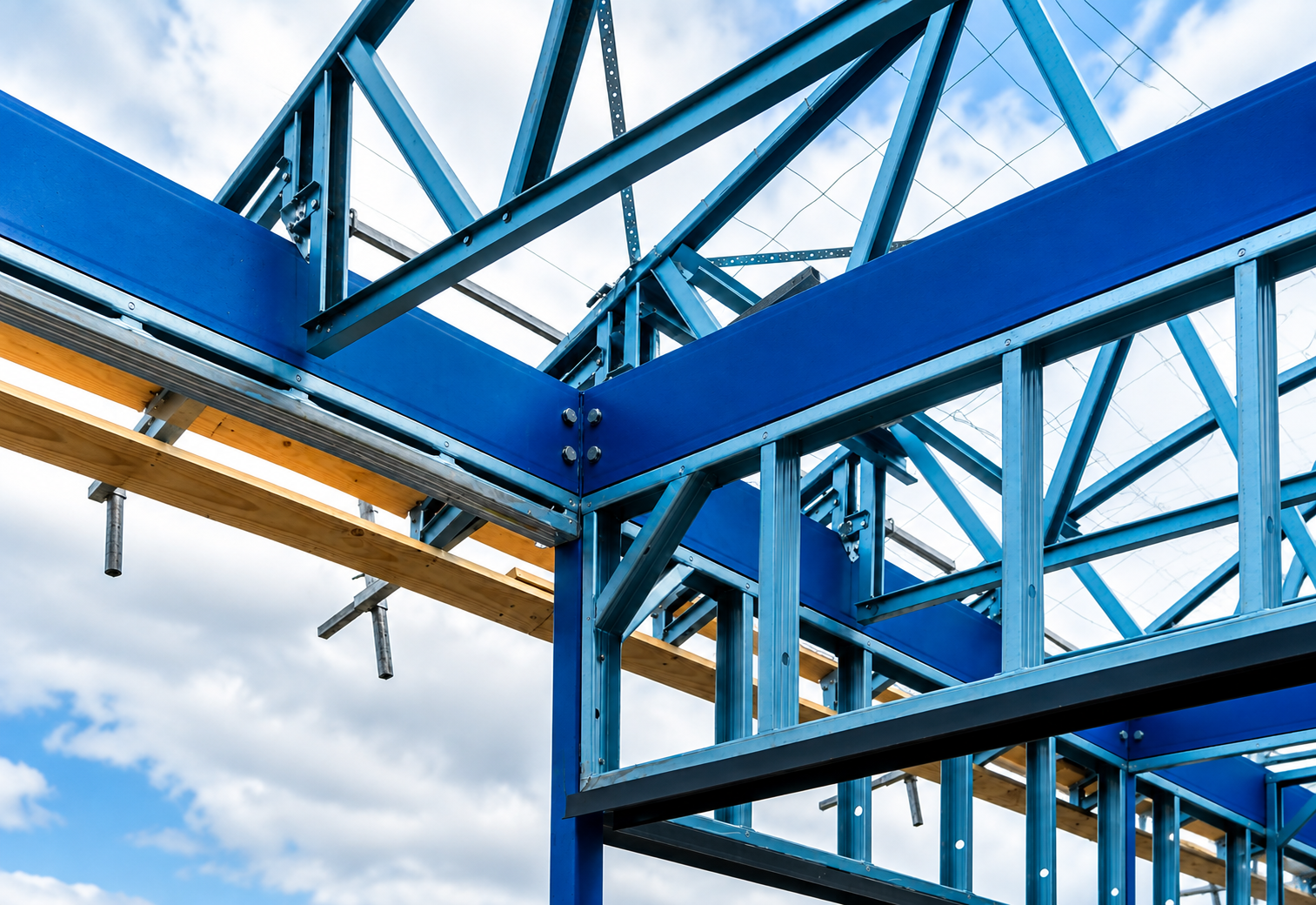
Structural steel beams are primary load-bearing members made from rolled structural sections or welded steel plates. They support floors, roofs, crane systems, equipment and bridge decks, transferring bending and shear forces to columns, walls or other supporting members. As part of a complete structural steel system, the beam section, material grade, connection details and fabrication accuracy must be coordinated with the project load path.
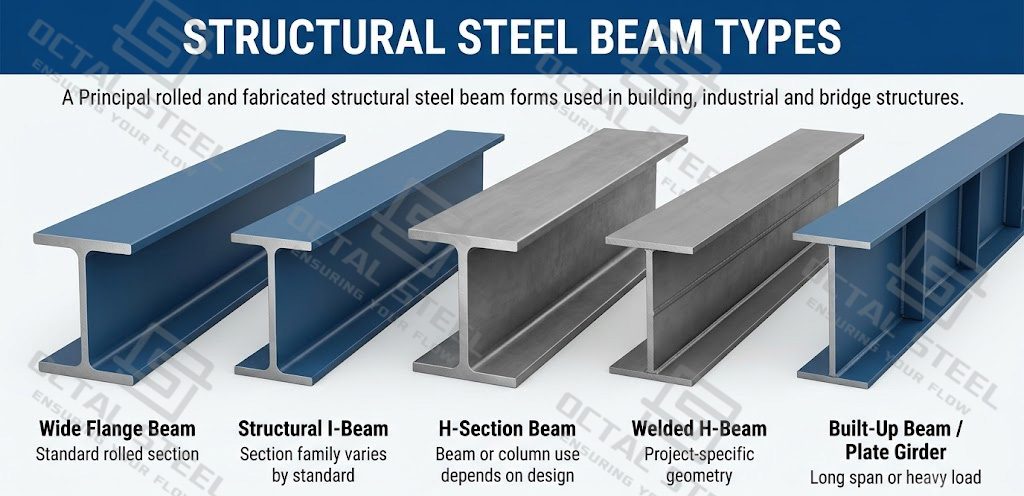
Available products include hot-rolled wide flange steel beams, structural steel I beams, H-section beams, welded H-beams, built-up beams and plate girders. Standard rolled sections are suitable where an available size meets the required capacity and geometry, while welded and fabricated beams provide greater flexibility for heavy loads, long spans, restricted structural depth or project-specific flange and web dimensions.
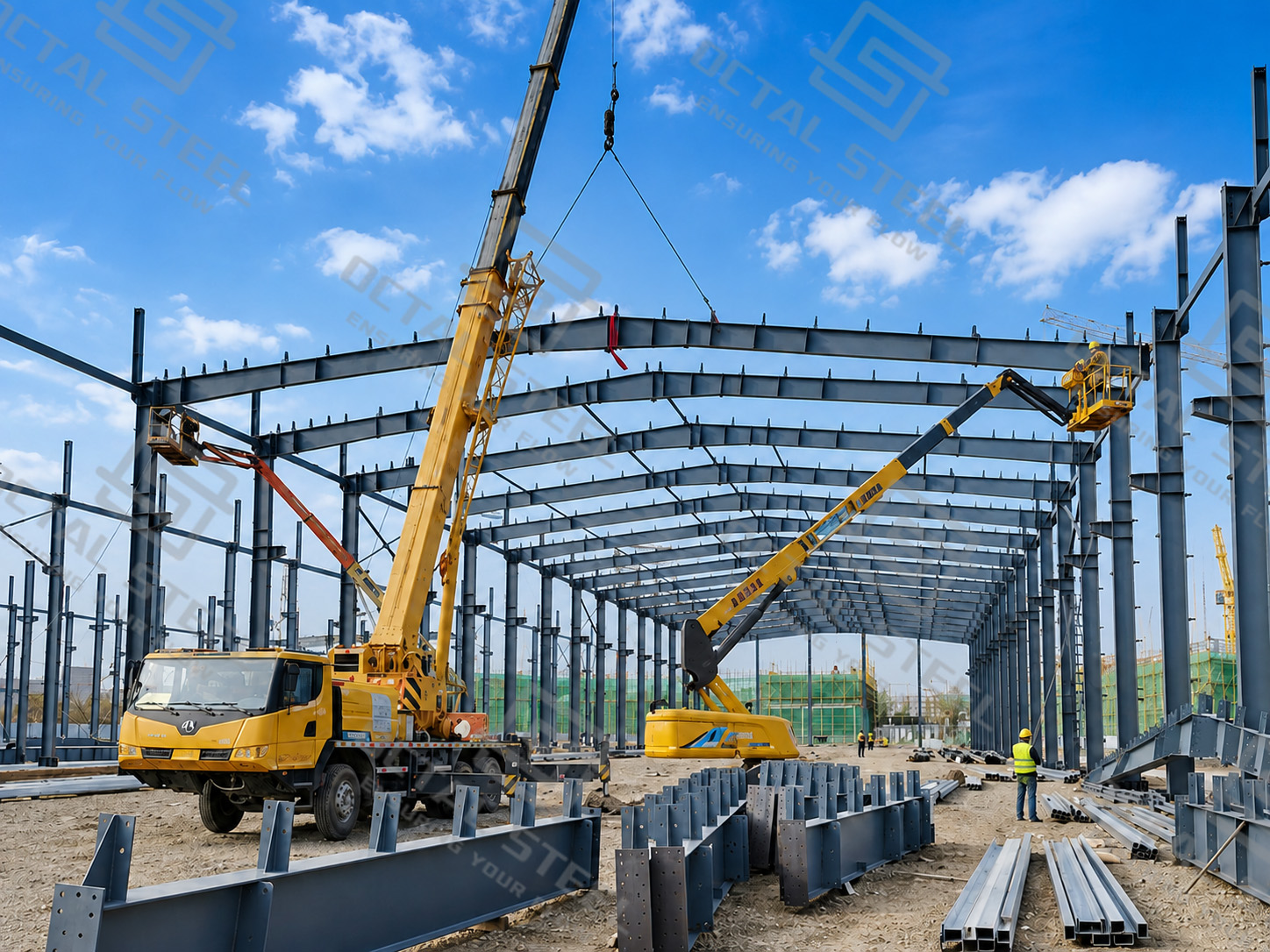
Octal Steel supplies structural steel beams according to approved section schedules, material specifications and fabrication drawings. The supply scope can include cutting, drilling, coping, cambering, welded stiffeners, end plates, splice plates, haunches, shear connectors, surface treatment, assembly marking and export packing. Structural steel beam processing is confirmed against the required connection geometry and installation sequence before production.
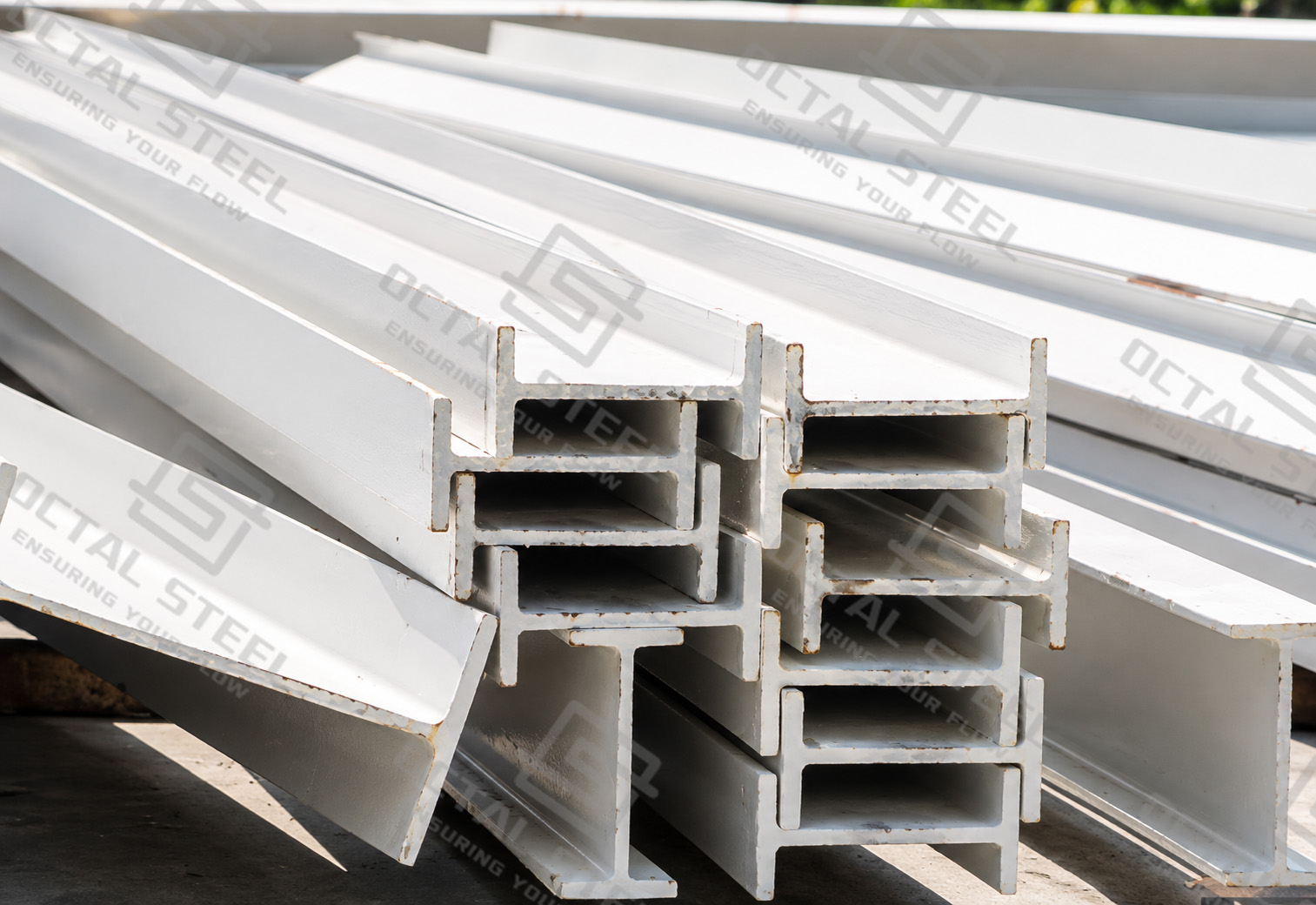
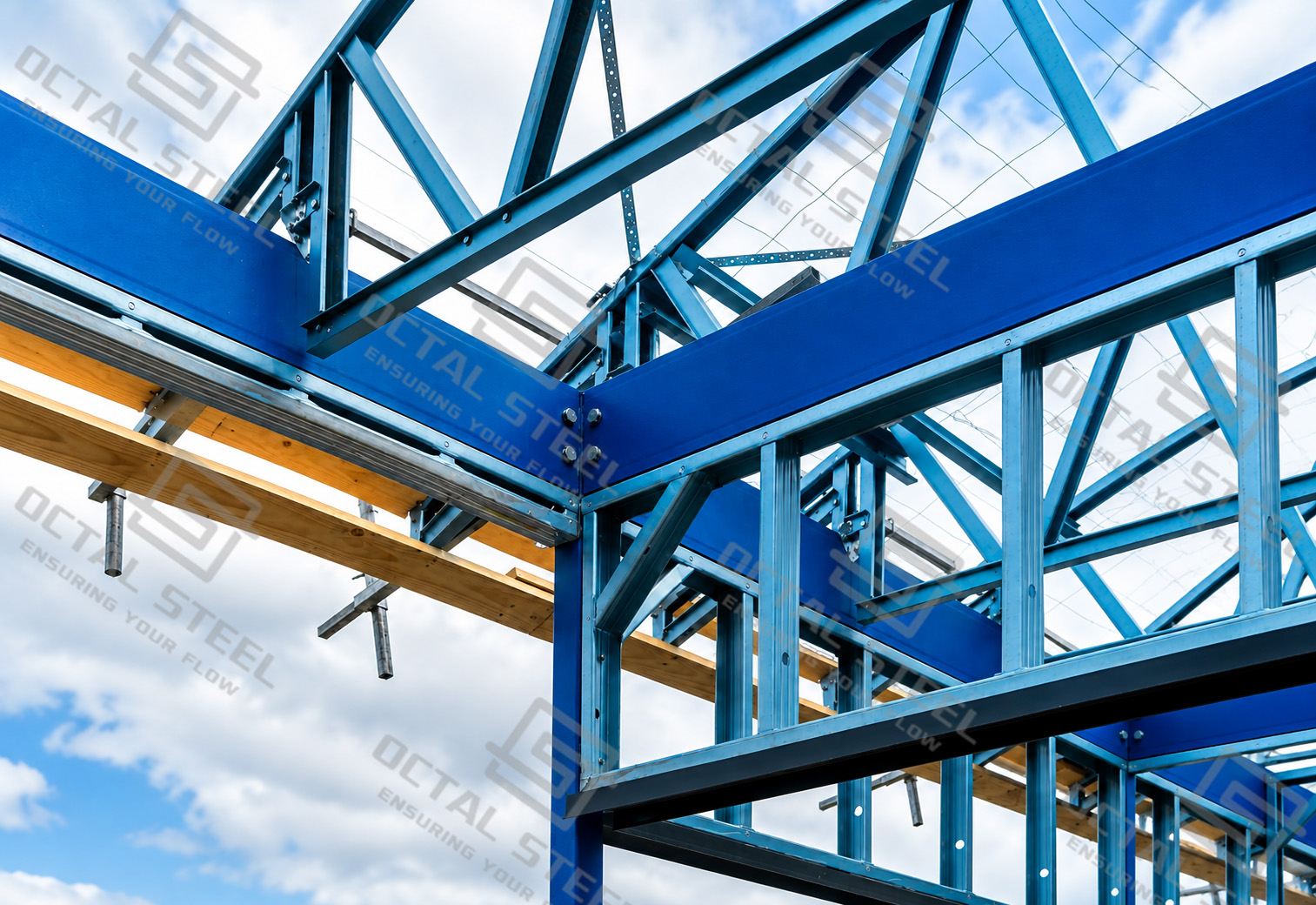
Structural Steel Beam Supply Range
| Product Item | Available Scope |
|---|---|
| Product Types | Wide flange beams, structural steel I beams, H-section beams, welded H-beams, built-up beams and plate girders |
| Material Specifications | ASTM A992, ASTM A572, ASTM A36, ASTM A588 and project-specified structural grades |
| Section Supply | Standard rolled sections and project-specific welded sections |
| Length | Standard mill length or cut to the approved beam schedule |
| Fabrication | Cutting, drilling, coping, notching, welding, cambering and connection-plate assembly |
| Beam Details | End plates, splice plates, stiffeners, haunches, brackets, shear connectors and service openings |
| Surface Condition | Mill finish, blasted, shop-primed, coated or galvanized where technically applicable |
| Inspection | Material verification, dimensional inspection, weld inspection and specified NDT |
| Product Form | Plain beams, processed beams or finished fabricated structural steel beams |
| Packing | Bundled sections, supports or transport frames with identification and assembly marks |
The exact combination of section size, steel grade, fabrication detail and protective system is determined by the approved project documents. A standard rolled section should not be replaced by a welded or alternative beam designation without engineering approval.
Types of Structural Steel Beams
Structural steel beams are identified by their cross-section, manufacturing method and structural duty. Terms such as I-beam, H-beam and wide flange beam are sometimes used interchangeably in commercial enquiries, but the final purchase specification must use the designation and dimensions required by the applicable section standard.
Wide Flange Steel Beams
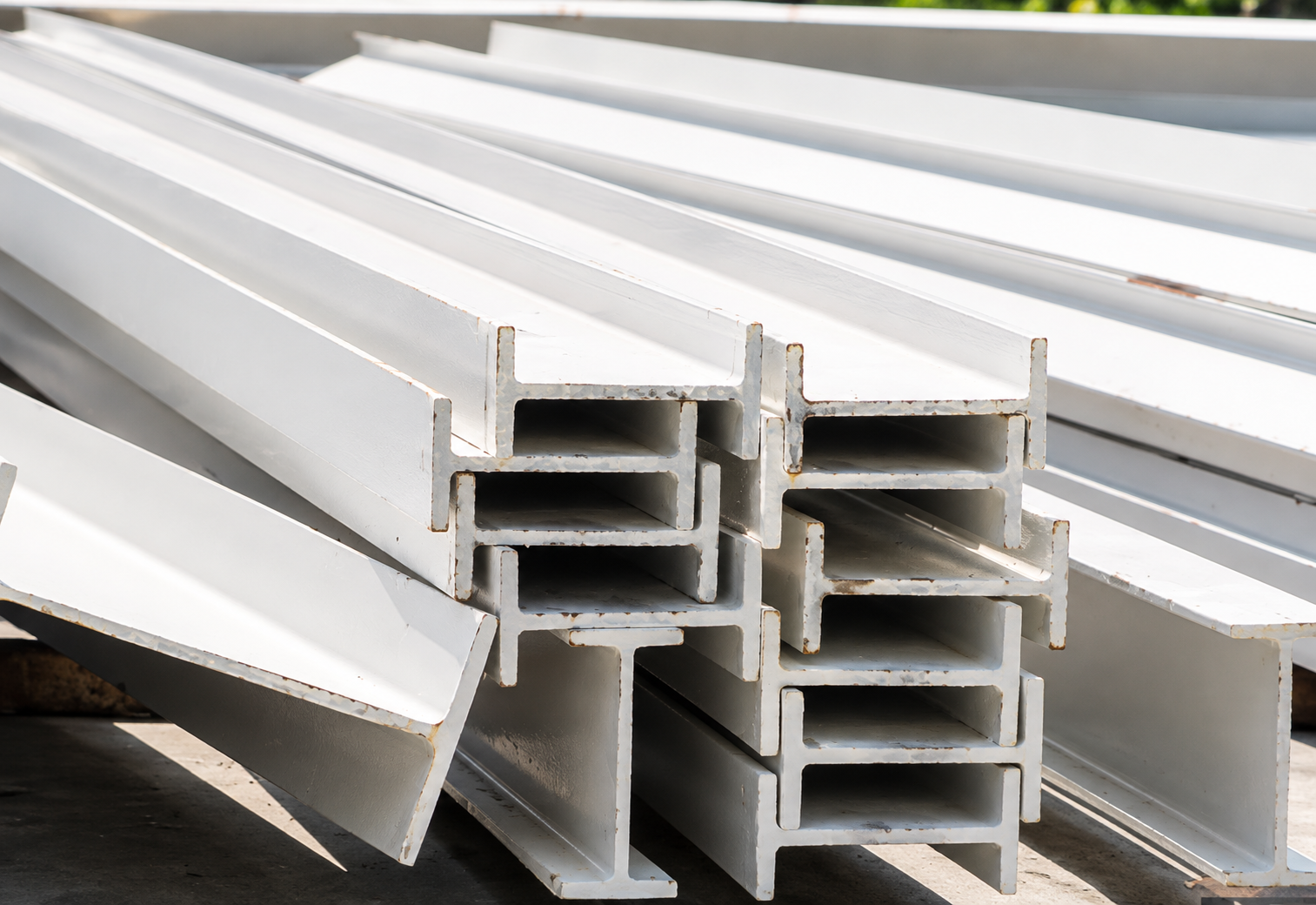
Wide flange steel beams have two broad flanges connected by a central web. The flanges carry most of the bending stress, while the web primarily transfers shear between them.
In North American section systems, a wide flange section is commonly identified by the letter W, followed by its nominal depth and mass or weight per unit length. These sections are widely used as floor beams, roof beams, bridge girders, crane-support members and primary framing components.
The relatively broad parallel flanges provide convenient surfaces for bolted and welded connections. They also allow connection plates, stiffeners, shear connectors and brackets to be attached during fabrication.
Structural Steel I Beams
A structural steel I beam is a rolled or fabricated member with two flanges connected by a vertical web. In the structural frame, the flanges mainly resist bending, while the web transfers shear between the supports. The beam is selected as part of the complete load path rather than by its external shape or nominal depth alone.
| Position in the Structure | Actual Working Condition | Main Specification Controls |
|---|---|---|
| Floor and Roof Framing | Carries floor deck, roof panels, secondary members and imposed loads, then transfers them to columns or primary girders. | Section designation, span, support condition, deflection limit and lateral restraint. |
| Secondary Building Beams | Connects primary frames and supports decking, joists, purlins or local floor areas. | Beam spacing, connection-hole pattern, flange level and compatibility with adjoining members. |
| Industrial Platforms | Supports equipment, maintenance loads, piping and operating platforms. | Concentrated loads, vibration, stiffener locations, equipment-base details and access openings. |
| Lintels and Transfer Members | Carries wall, façade or framing loads across an opening and transfers them to adjacent supports. | Bearing length, end-plate arrangement, local web reinforcement and connection geometry. |
| Beam-to-Column Assemblies | Transfers shear, bending moment or combined forces through bolted or welded connections. | End plates, fin plates, bolt holes, weld details, copes and erection clearance. |
| Beam-to-Beam Assemblies | Supports secondary beams connected to a primary beam or girder. | Flange alignment, web coping, connection level, hole position and site fit-up. |
Beam Specification Note:
Two beams may have the same nominal depth but different flange widths, web thicknesses, unit weights and structural properties. To prevent quotation or fabrication errors, specify the full section designation or provide an approved beam schedule instead of using a description such as “300 mm I-beam.”
Structural Steel H Beams
The term structural steel H beam generally describes an H-shaped member with relatively broad flanges. Depending on the market and referenced standard, it may refer to a rolled wide flange section, a universal column-type section or a welded H-section.
H-section beams can be used as horizontal members, but similar sections are also used as columns and piles. A beam and an H-pile should not be treated as the same product because they are selected for different load conditions and may follow different dimensional and material requirements.
Welded H-Beams
Built-Up Beams and Plate Girders
Built-up beams and plate girders are fabricated from steel plates to provide deeper or heavier sections than ordinary rolled beams. They are used for long spans, heavy industrial floors, crane girders, bridge structures and concentrated equipment loads.
A plate girder may include transverse stiffeners, bearing stiffeners, web splices, flange splices, connection plates and intermediate bracing details. Each component must be positioned according to the approved fabrication drawing because local plate arrangement directly affects load transfer and site fit-up.
Download:Structural_Steel_Beam_Types_and_Selection.pdf
Structural Steel Beam Sizes and Designations
Structural steel beam sizes are not defined by depth alone. A complete beam designation or dimensional schedule normally includes:
| Parameter | Engineering Meaning |
|---|---|
| Overall Depth | Distance between the outer surfaces of the upper and lower flanges |
| Flange Width | Width available to resist bending and form structural connections |
| Flange Thickness | Influences bending capacity and local flange behavior |
| Web Thickness | Influences shear resistance and web stability |
| Root Radius | Transition radius between the web and flange of a rolled section |
| Mass per Unit Length | Used for section identification, weight calculation, transportation and lifting planning |
| Cross-Sectional Area | Used in strength calculations and member-weight determination |
| Moment of Inertia | Indicates the section’s resistance to flexural deformation |
| Section Modulus | Relates section geometry to bending stress and flexural capacity |
| Length and Camber | Controls installation level, deflection allowance and final framing geometry |
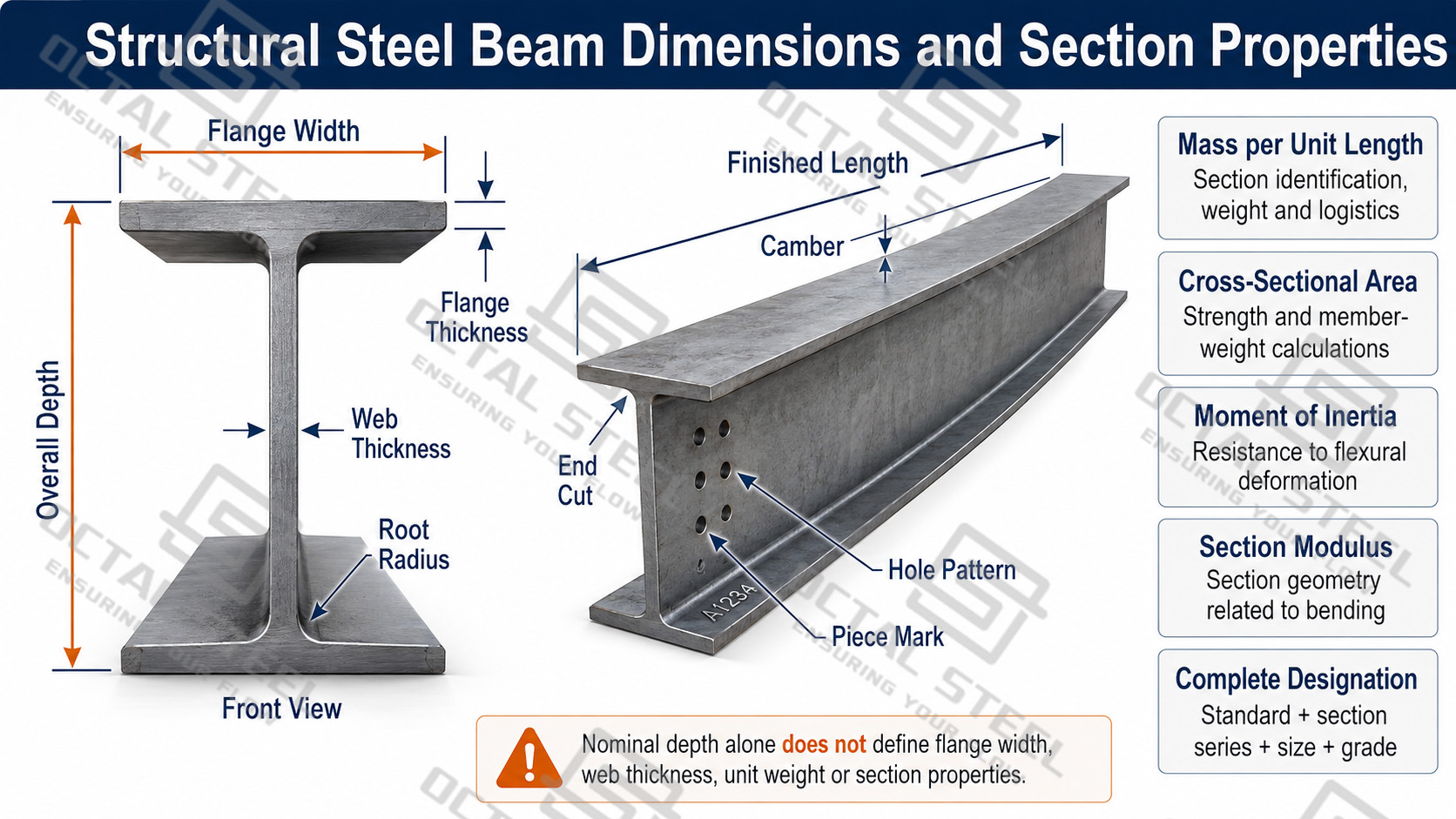
For W-sections, the designation normally combines nominal depth with weight per unit length. Metric and other international section systems may use different naming conventions, so the purchase order should include the applicable standard, full section designation and beam schedule.
Structural steel beam selection is controlled by applied loads, span, deflection, lateral-torsional stability, support conditions, connection restraint, vibration, fatigue and fire-design requirements. The final section must therefore be specified by the project designer rather than selected from nominal size alone. AISC maintains standardized dimensions and section properties for recognized structural shapes.
Material Grades for Structural Steel Beams
Material grade determines yield strength, tensile properties, weldability, toughness requirements and environmental suitability. Common project specifications include:
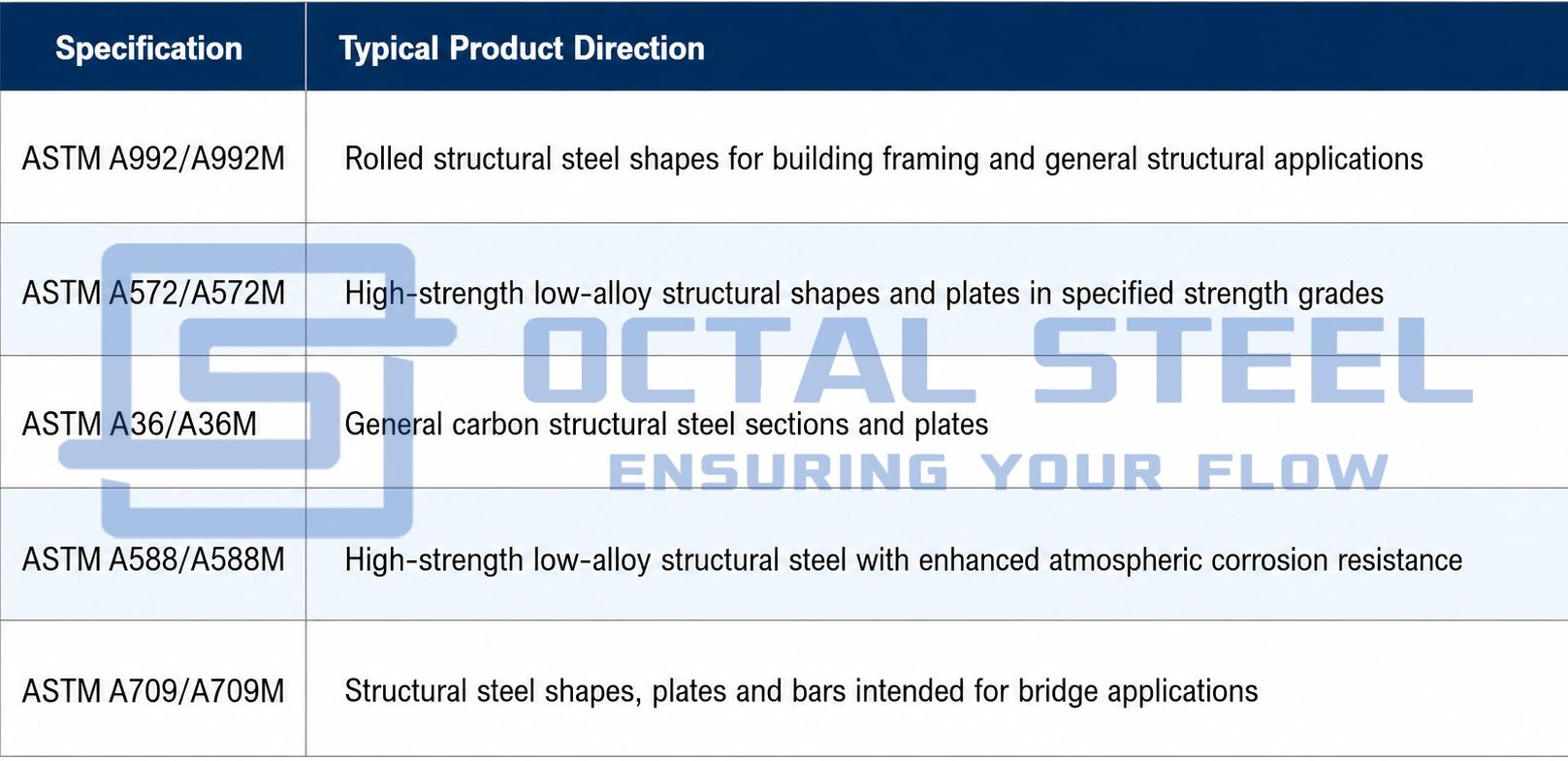
ASTM A992 steel beams are commonly specified for rolled structural shapes in building framing, but the material grade must match the design drawings and purchase specification. ASTM A572, A36, A588 and A709 are not automatic substitutes for one another.
For fabricated structural steel beams, the flange plate, web plate, stiffeners and connection plates must be compatible with the required welding procedure and service conditions. Supplementary impact testing, through-thickness properties or enhanced toughness requirements apply only when specified by the project.
Download:Structural_Steel_Beam_Dimensions_and_Material.pdf
Structural Steel Beam Connections
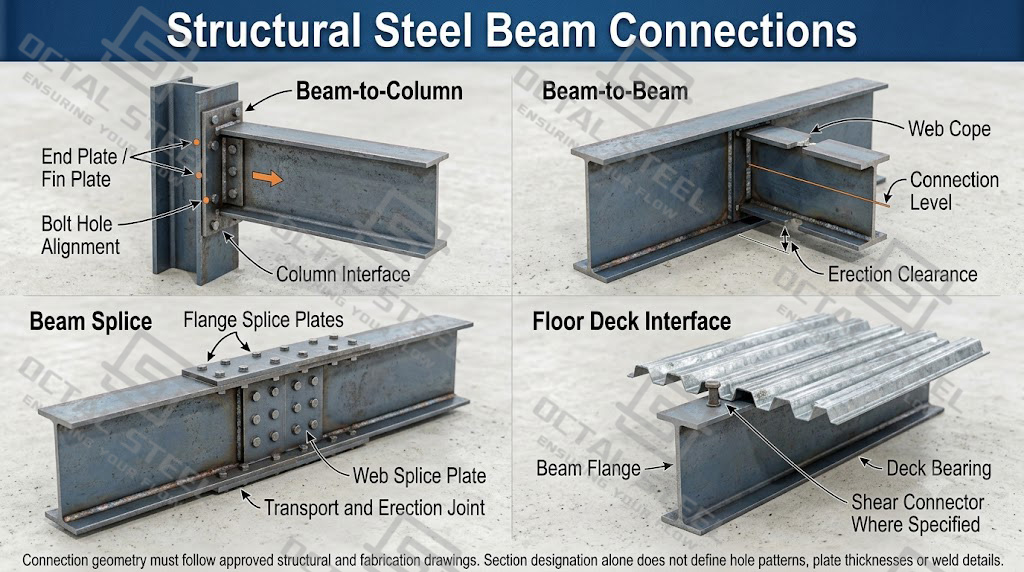
A structural steel beam operates as part of a connected framing system. The connection must transfer the intended shear, bending moment, axial force or combined action without creating an unintended load path.
- Beam-to-Column Connections:Beam-to-column connections may use end plates, fin plates, angles, seats or directly welded details. The connection arrangement depends on whether the joint is designed as simple, semi-rigid or moment-resisting.
- Beam-to-Beam Connections:Secondary beams can connect to primary beams through fin plates, end plates, seated connections or welded details. Web copes may be required where the top flanges need to align.
- Beam Splices:Beam splices divide long or heavy members into transportable and erectable sections. They may use bolted flange and web splice plates, welded joints or combined shop-welded and site-bolted arrangements.
- Floor Joist and Deck Interfaces:Structural steel beams can support floor joists, metal deck, precast units or composite floor systems. Connection plates, bearing seats, deck edges and shear connectors must be coordinated with the selected floor system.
Connection details are fabricated from approved structural drawings. Hole patterns, plate thicknesses and weld sizes cannot be determined from the beam section designation alone.
Applications of Structural Steel Beams
Structural steel beams are used wherever horizontal members must carry and transfer floor, roof, equipment or transportation loads.
| Application | Typical Beam Function |
|---|---|
| Industrial Buildings | Supports roofs, crane systems, equipment and production floors |
| Warehouses | Creates open floor areas with controlled column spacing |
| Multi-Storey Buildings | Supports floor deck and transfers loads to columns |
| Bridges | Forms main girders, cross beams and deck-support members |
| Crane Buildings | Carries crane-rail reactions and repeated dynamic loading |
| Equipment Platforms | Supports machinery, vessels, piping and maintenance access |
| Long-Span Roofs | Supports roof systems with fewer intermediate columns |
| Commercial Buildings | Forms primary and secondary floor framing |
| Transport Facilities | Supports terminals, stations, platforms and canopies |
The beam form is selected according to structural duty. A standard rolled wide flange beam may be suitable for ordinary framing, while a welded beam or plate girder may be required for heavy loads, restricted depth or special connection conditions.
How to Specify Structural Steel Beams
A structural steel beam enquiry should identify the member accurately enough for material allocation, fabrication, inspection and transport planning. For standard rolled beams, the complete section designation and material grade are normally required. For welded or built-up beams, approved dimensional drawings and connection details should be provided.
For a plain rolled beam, the minimum practical enquiry normally includes the complete section designation, steel grade, finished length, quantity and required surface condition. A processed beam also requires fabrication drawings showing all holes, copes, plates, stiffeners and connection details.
For example, an enquiry stating only “600 mm deep steel beam” is not sufficient. Beams with a similar nominal depth may have different flange widths, web thicknesses, weights and structural properties. The purchase specification should therefore identify either the recognized section designation or the complete welded-section dimensions.
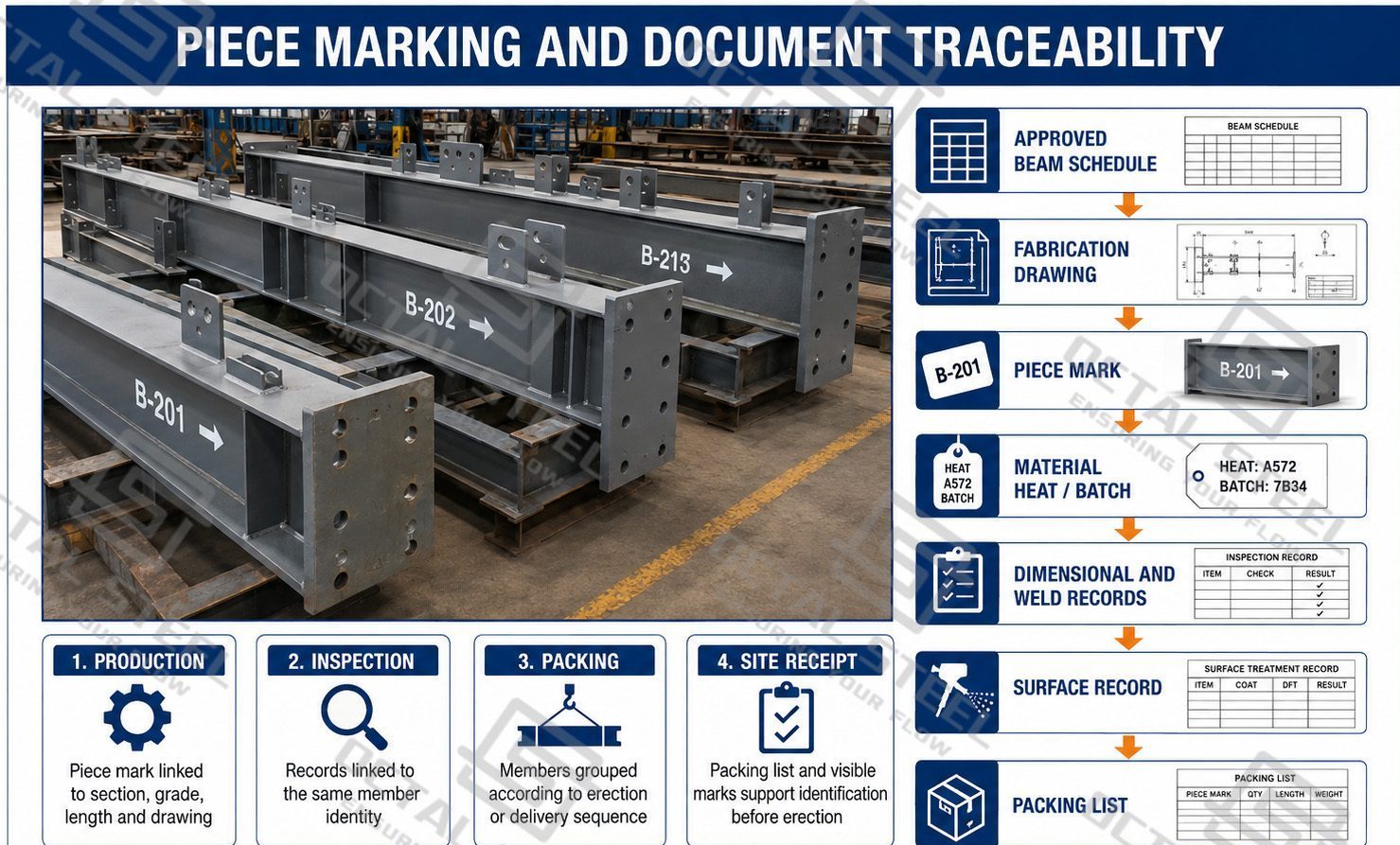
Before order release, the beam schedule, fabrication drawings and document scope should use the same piece-mark system. This allows the finished structural steel beams, material certificates, inspection records and packing list to be checked against one consistent identification chain.
Download:Structural_Steel_Beam_Ordering_and_Traceability.pdf
Inspection of Structural Steel Beams
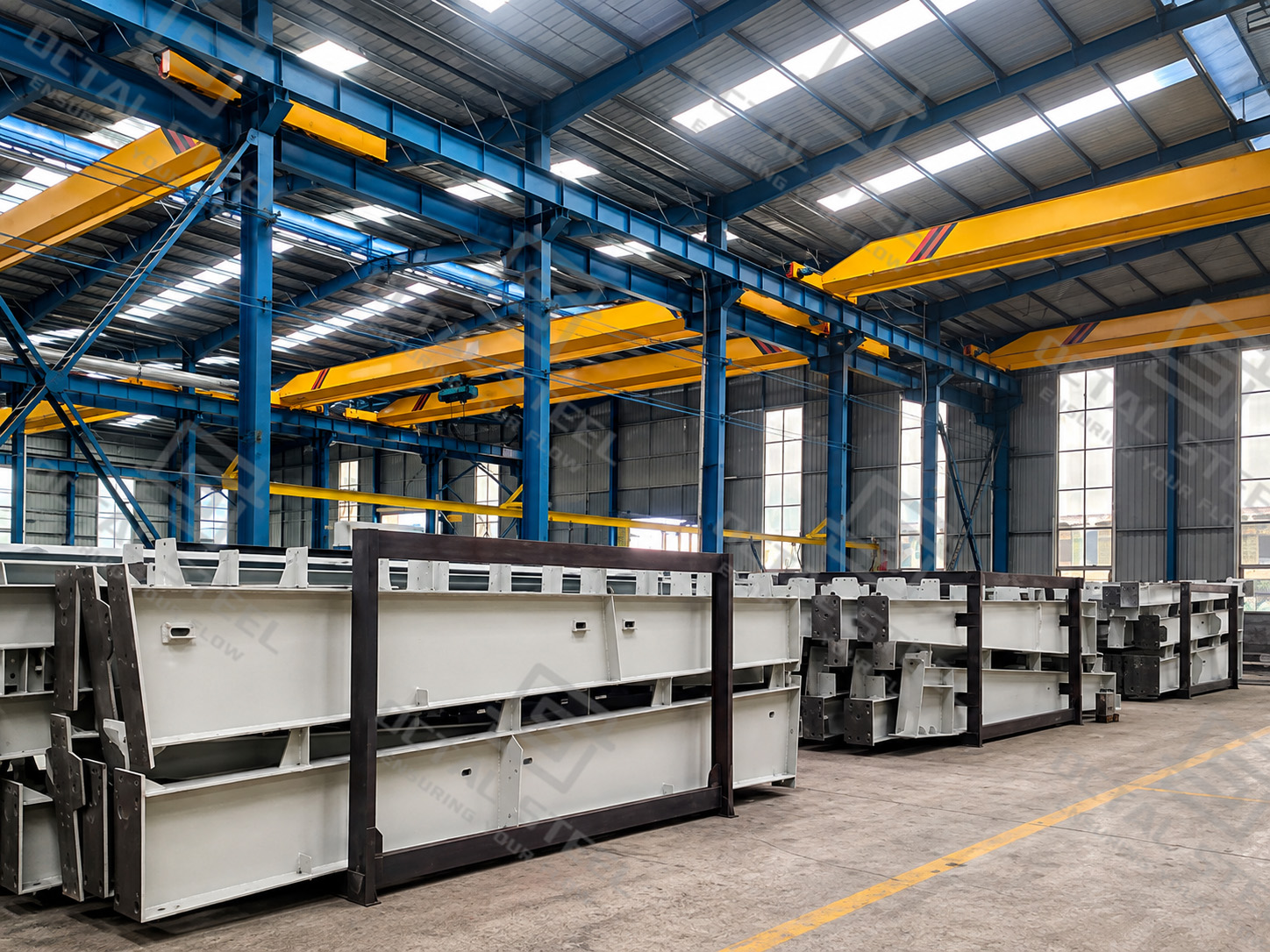
Inspection confirms that each structural steel beam matches the approved material specification, beam schedule and fabrication drawing before coating, packing and shipment. The inspection scope covers material traceability, section dimensions, connection details, weld quality, surface condition and member identification.
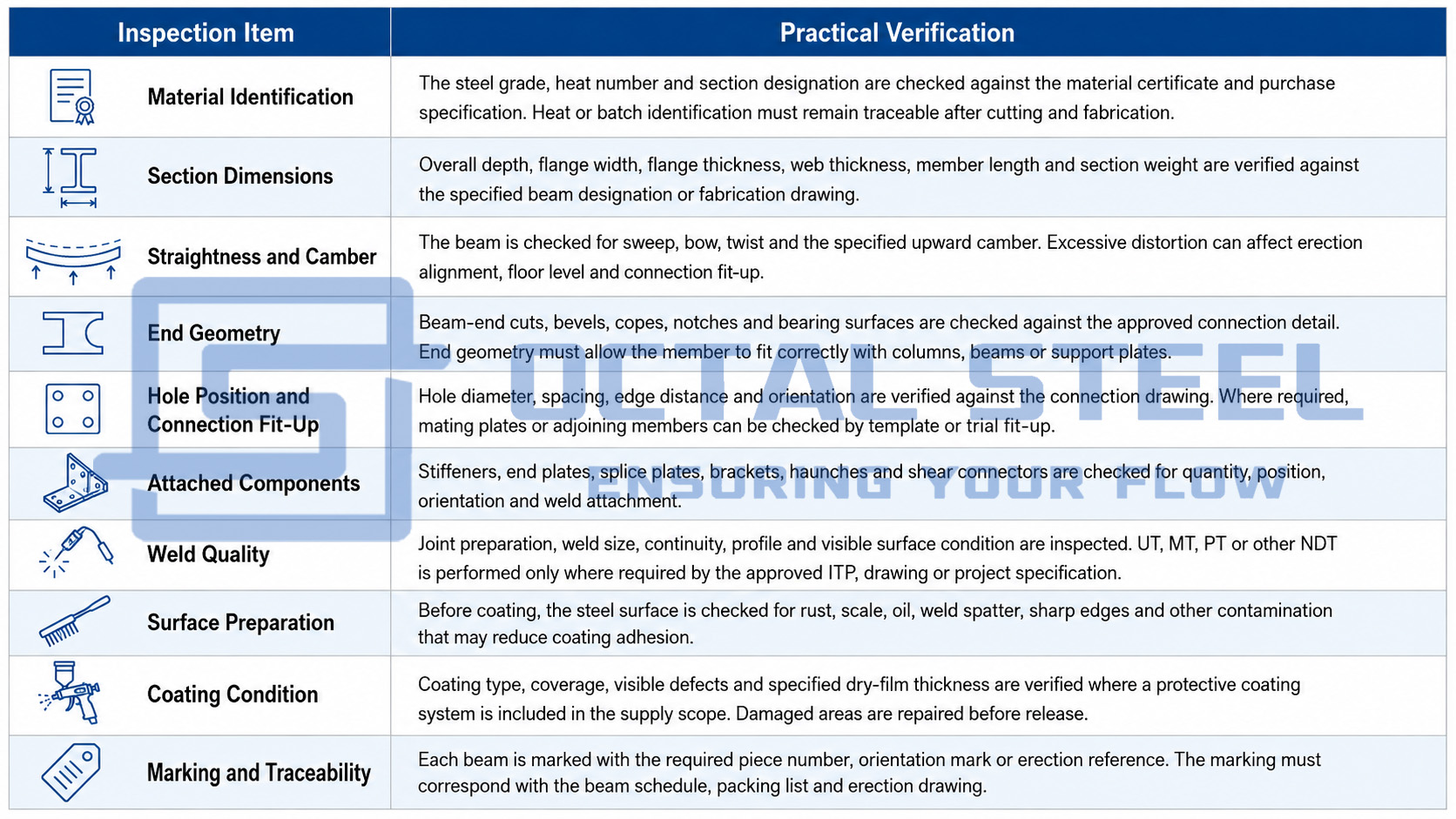
Inspection records are compiled according to the agreed documentation scope. The release package may include material certificates, dimensional inspection reports, welding records, NDT reports, coating records, piece-mark lists and packing documents.
For fabricated structural steel beams, the most important release point is not only whether the beam meets its nominal section size, but whether the holes, plates, stiffeners and member markings correspond with the final erection drawing. This control reduces site rework, connection mismatch and installation delay.
Surface Protection
Structural steel beams may be supplied with mill finish, blasted surface, shop primer, multi-layer coating or galvanizing, depending on the environment and fabrication design.
The protection system is selected according to atmospheric exposure, moisture, chemicals, marine conditions, maintenance access and the required design life. Galvanizing or coating does not replace correct detailing around connections, water traps, crevices and damaged site areas.
Where fire resistance is required, the beam forms part of an approved fire-protection system. The required protection may involve intumescent coating, spray-applied material, board encasement or another specified method. Structural steel should not be described as inherently fireproof.
Download:Structural_Steel_Beam_Inspection_and_Surface_Protection.pdf
Structural Steel Beam Supply from Octal
Octal supplies both standard rolled sections and project-specific fabricated structural steel beams, allowing the beam type, material grade, connection details and surface condition to be coordinated within one supply scope. Cutting, drilling, coping, stiffeners, end plates and welded assemblies can be completed according to the approved beam schedule and fabrication drawings, reducing separate processing and connection mismatch.
For fabricated members, Octal reviews section geometry, adjoining connections, transport limits and inspection requirements before production. Each beam can be linked to its material documents, fabrication drawing, inspection records, piece mark and packing list, helping procurement and site teams control traceability, erection sequence and delivery identification.
FAQ
Q: What is the difference between a wide flange beam and a structural steel I beam?
A: Both have an I-shaped cross-section, but wide flange beams generally have broader flange surfaces and are identified as a specific standardized section family. The exact difference depends on the referenced section standard, so procurement should use the full designation rather than the visual description alone.
Q: Which material grade is used for structural steel beams?
A: Common specifications include ASTM A992, ASTM A572, ASTM A36, ASTM A588 and ASTM A709. The correct grade depends on the structural design, product form, welding requirements, toughness, corrosion exposure and applicable project standard.
Q: Can structural steel beams be supplied with connection plates and holes?
A: Yes. Structural steel beam processing can include cutting, drilling, coping, notching, end plates, stiffeners, splice plates, brackets, haunches and welded attachments according to approved fabrication drawings.
Q: What information is required to order fabricated structural steel beams?
A: Provide the beam schedule, material grade, section designation, length, quantity, connection drawings, hole details, camber, welded attachments, inspection scope, surface treatment, piece marking, packing requirements and delivery destination.
Social Share