Your Responsible Supplier Partner for Oil and Gas Products.

Steel Pipe Manufacturer
Steel Pipe Manufacturer
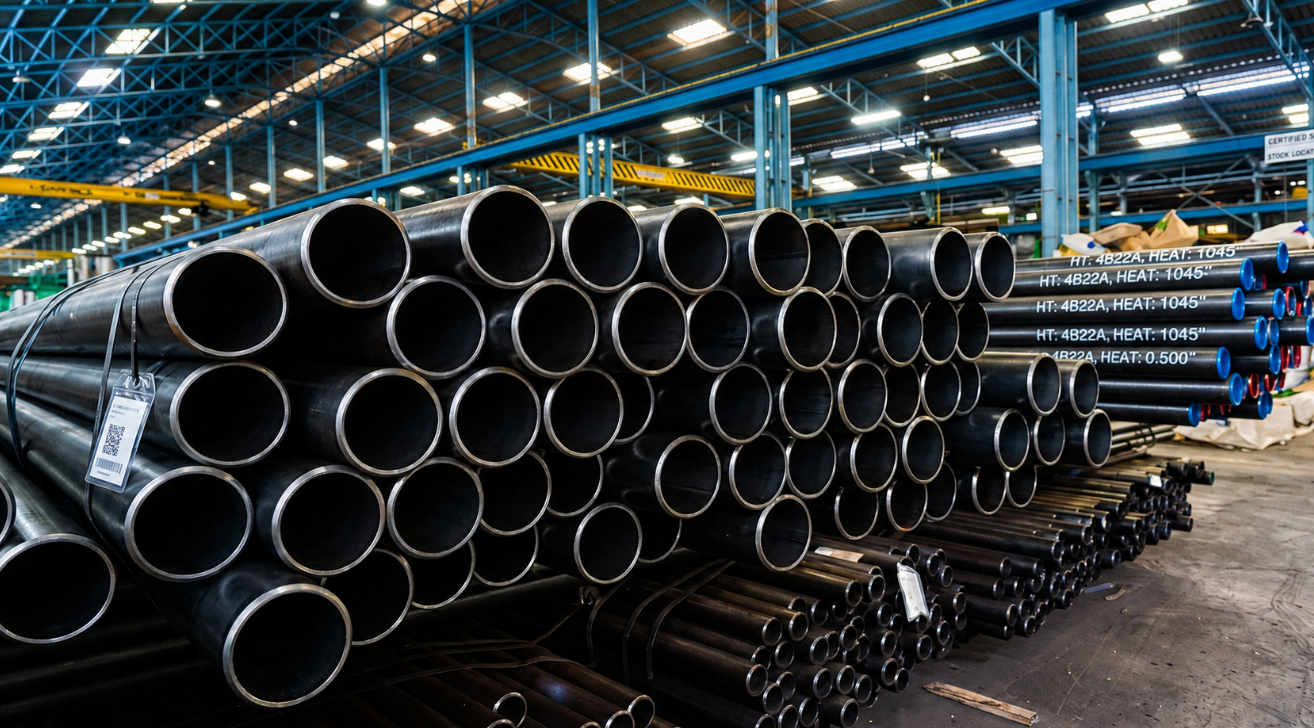
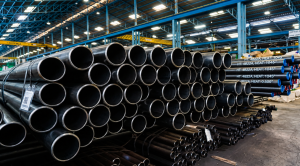
A steel pipe manufacturer is a company that produces steel pipes from raw steel materials through forming, welding or seamless rolling, heat treatment, inspection, marking and packing. Its work is not only to make pipe by size, but to deliver steel pipe that matches the required standard, grade, wall thickness, manufacturing route and project service condition.
Choosing a steel pipe manufacturer is therefore not only about price. For project buyers, the real value is whether the supplier can control material selection, production, inspection, packing, export delivery and final documents in one reliable process.
A professional manufacturer should support different pipe routes, including seamless steel pipe, welded steel pipe, stainless steel pipe, carbon steel pipe and alloy steel pipe. Each route has different control points: seamless pipe needs wall-thickness and NDT control; stainless pipe needs grade selection and PMI; alloy pipe needs heat treatment and traceability; carbon steel pipe needs correct standard, schedule, coating and hydrotest records.
For international buyers, a strong steel pipe manufacturer is different from a simple trading supplier. The manufacturer should be able to connect the full evidence chain:
pipe marking → heat number → MTC → inspection records → packing list → shipment documents
This is especially important for mixed orders that include carbon steel pipe, stainless steel pipe, alloy steel pipe, fittings, flanges and bolting materials together. Clear traceability helps buyers avoid wrong-grade delivery, missing MTC, mixed heat numbers, inspection delays and receiving disputes.
Steel Pipe Manufacturer Product Capability
A professional steel pipe manufacturer should clearly show what it can supply, which standards it can follow, and what inspection records can be provided before shipment. This reduces the risk of wrong material, wrong standard, missing documents or receiving disputes.
| Pipe Category | Common Standards | Typical Products | Buyer Focus |
|---|---|---|---|
| Seamless Steel Pipe | ASTM A106, ASTM A335, API 5L, ASTM A312 | Carbon seamless pipe, alloy seamless pipe, stainless seamless pipe | OD, wall thickness, grade, heat treatment, NDT, hydrotest, MTC |
| Stainless Steel Pipe | ASTM A312, ASTM A269, ASTM A213 | 304/304L, 316/316L, 321, 347 stainless pipe/tube | Grade selection, corrosion condition, PMI, surface finish, MTC |
| Carbon Steel Pipe | ASTM A106, ASTM A53, API 5L | Seamless pipe, welded pipe, line pipe, pressure pipe | Standard, schedule, grade, test records, coating, delivery |
| Alloy Steel Pipe | ASTM A335, ASTM A213, ASTM A519 | P11, P22, P91, T11, T22, T91, mechanical alloy tube | Cr-Mo content, heat treatment, hardness, impact test, traceability |
| Welded Steel Pipe | API 5L, ASTM A53, ASTM A671, ASTM A672 | ERW, LSAW, SSAW, EFW pipe | Weld seam inspection, RT/UT, hydrotest, coating, dimensional control |
Download:Steel Pipe Manufacturer product capability
Steel Pipe Manufacturer Capability Comparison
Not every steel pipe manufacturer has the same production focus. Some manufacturers are stronger in seamless carbon steel pipe, some focus on stainless corrosion-resistant pipe, while others specialize in alloy steel pipe for high-temperature service. For buyers, the key is to match the manufacturer’s real production and inspection capability with the project’s working condition.
A top steel pipe manufacturer should not only supply one pipe type. More importantly, it should understand how each pipe route is selected, inspected and documented. For example, a stainless pipe order may need PMI and surface protection, while an alloy pipe order may require stricter heat treatment and hardness review. A seamless pipe order may focus more on wall-thickness uniformity and pipe-body NDT, while a welded pipe order must pay close attention to weld seam inspection.
| Manufacturer Type | Main Product Focus | Key Control Point | Best-Fit Use |
|---|---|---|---|
| Seamless Steel Pipe Manufacturer | Carbon, alloy or stainless seamless pipe | Wall thickness, heat treatment, NDT, hydrotest, MTC | High-pressure, high-temperature, refinery, boiler and thick-wall piping |
| Stainless Steel Pipe Manufacturer | 304/316/321/347 stainless pipe and tubing | Grade selection, PMI, surface finish, corrosion condition | Chemical lines, food systems, coastal service and chloride-bearing fluids |
| Carbon Steel Pipe Manufacturer | General seamless or welded carbon steel pipe | Standard, schedule, bevel end, coating, dimensional inspection | Steam, water, oil and gas pipelines, general industrial piping |
| Alloy Steel Pipe Manufacturer | Cr-Mo alloy pipe for demanding service | Chemistry, heat treatment, hardness, impact test, traceability | Power plants, boilers, refineries and high-temperature steam systems |
| Welded Steel Pipe Manufacturer | ERW, LSAW, SSAW and EFW welded pipe | Weld seam quality, RT/UT, hydrotest, straightness, coating | Large OD pipelines, structural pipe and water transmission |
Download:Steel Pipe Manufacturer Capability Comparison
A well-organized China steel pipe manufacturer can offer practical advantages for global projects through a complete supply chain covering raw materials, seamless pipe, welded pipe, stainless pipe, alloy pipe, fittings, flanges, coating, testing and export packing. This helps buyers combine different product types in one shipment, reduce sourcing time, control cost and receive a complete document package before cargo release.
The advantage is not only price, but also stronger flexibility in production coordination, mixed-product supply, inspection arrangement and export delivery.
For buyers, the key is not only finding a steel pipe manufacturer, but matching the manufacturer’s strongest capability with the project’s standard, service condition, inspection requirement and document package.
Seamless Steel Pipe Manufacturer
A seamless steel pipe manufacturer produces pipe without a longitudinal weld seam. Seamless pipe is usually made from steel billet through heating, piercing, rolling, sizing, heat treatment, straightening, inspection, marking and packing. Because there is no weld seam, seamless pipe is often selected for high-pressure, high-temperature, thick-wall or critical pipe-body applications.
However, seamless pipe still needs strict control. A buyer should not only check the pipe grade and size. The main acceptance points are wall-thickness uniformity, eccentricity, OD tolerance, heat treatment condition, NDT records, hydrostatic test, MTC and heat number traceability.
| Production Step | What It Controls | Buyer-Side Meaning |
|---|---|---|
| Billet selection | Steel heat, chemistry and raw material condition | Confirms material origin and traceability |
| Heating and piercing | Initial pipe body formation | Affects internal quality and wall distribution |
| Rolling and sizing | OD, wall thickness and straightness | Supports fit-up and pressure design reliability |
| Heat treatment | Strength, toughness and hardness | Critical for carbon, alloy and high-temperature pipe |
| NDT / hydrotest | Pipe-body integrity and pressure release | Supports shipment acceptance |
| Marking and packing | Product identification and shipment control | Helps site receiving and document matching |
For ASTM A106 seamless carbon steel pipe, buyers should pay attention to high-temperature service requirements, forming suitability, mechanical testing, hydrostatic testing or nondestructive electric testing where required by the standard and purchase specification.
Stainless Steel Pipe Manufacturer
A stainless steel pipe manufacturer should provide more than a clean surface or polished appearance. Stainless pipe is selected for corrosion resistance, but final suitability depends on medium, chloride content, temperature, pressure, welding condition, cleaning chemicals and surface requirement.
ASTM A312 is a key stainless pipe specification because it covers seamless, straight-seam welded and cold-worked welded austenitic stainless steel pipe intended for high-temperature and general corrosive service.
| Stainless Grade | Typical Selection Logic | Buyer Checkpoint |
|---|---|---|
| 304 / 304L | General corrosion-resistant service, clean water, food equipment, indoor industrial piping | 304L is preferred when welding is involved |
| 316 / 316L | Chloride-bearing, coastal, marine-related or chemical service | Confirm chloride level, temperature and PMI |
| 321 / 347 | High-temperature stainless pipe where stabilized grades are required | Check temperature condition and project standard |
| Duplex / Super Duplex | Higher chloride and stress-corrosion resistance | Review corrosion data and project design basis |
For stainless pipe orders, buyers should request PMI, MTC, heat number traceability, dimensional inspection, surface inspection and packing protection, especially when 304, 316, duplex or different stainless grades are shipped in the same order.
Carbon Steel Pipe Manufacturer
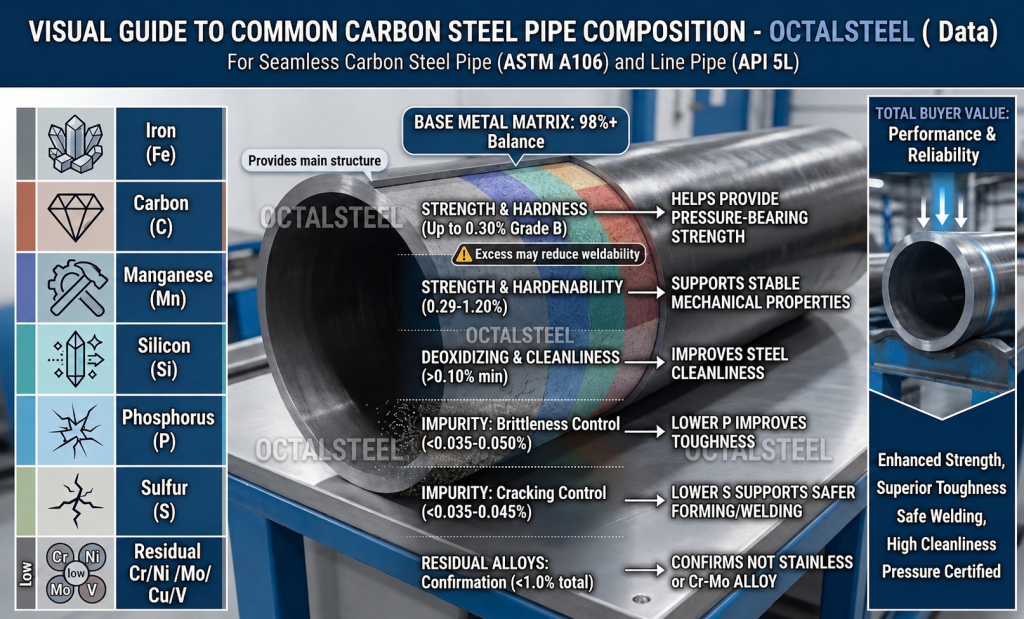
A carbon steel pipe manufacturer usually supplies pipe for pressure piping, line pipe, water transmission, refinery lines, structural applications and general industrial systems. Carbon steel pipe is mainly based on iron, carbon and manganese, with silicon used for deoxidation and phosphorus / sulfur controlled as impurity elements. Its value comes from a practical balance of strength, weldability, pressure service, availability and cost control, making it a common choice for general industrial piping.
Unlike stainless steel pipe, carbon steel pipe does not rely on high chromium or nickel content for corrosion resistance. Unlike Cr-Mo alloy steel pipe, it is not designed for severe high-temperature alloy service. Common standards include ASTM A53 for seamless and welded black or galvanized steel pipe, ASTM A106 for seamless carbon steel pipe used in high-temperature service, and API 5L for line pipe applications in pipeline systems.
| Standard | Product Focus | Typical Application |
|---|---|---|
| ASTM A106 Gr.B | Seamless carbon steel pipe for high-temperature service | Steam, refinery, petrochemical pressure piping |
| ASTM A53 Gr.B | General seamless or welded pipe | Water, air, steam, general industrial service |
| API 5L Gr.B / X Grades | Line pipe for pipeline transportation | Oil, gas, water and pipeline systems |
| ASTM A671 / A672 | EFW pressure pipe | Large OD pressure piping |
For carbon steel pipe, buyers should pay attention to wall thickness, schedule, bevel end, coating requirement, hydrostatic test, NDT requirement, MTC and heat/lot mapping. If the order includes both pipe and fittings, the pipe standard should be matched with compatible fitting and flange standards.
Alloy Steel Pipe Manufacturer
An alloy steel pipe manufacturer supplies pipe with alloy elements such as chromium, molybdenum, nickel, manganese or vanadium to improve strength, hardenability, heat resistance or high-temperature stability. Alloy steel pipe is commonly selected for boilers, power plants, refineries, petrochemical units, high-temperature steam lines and pressure systems.
ASTM A335 is a key seamless ferritic alloy-steel pipe specification for high-temperature service. It covers several grades and requires the steel material to meet chemical composition, tensile property and hardness requirements; ASTM also notes that each pipe length shall be subjected to hydrostatic testing under the specification.
| Alloy Pipe Grade | Main Alloy Route | Typical Use |
|---|---|---|
| ASTM A335 P11 | Cr-Mo alloy steel | High-temperature pressure piping |
| ASTM A335 P22 | Higher Cr-Mo route than P11 | Power plant, refinery, steam service |
| ASTM A335 P91 | High Cr-Mo-V-Nb route | Severe high-temperature service |
| ASTM A213 T11 / T22 / T91 | Alloy boiler and heat-exchanger tubes | Boiler, superheater and heat exchanger service |
Download:Alloy Steel Pipe Manufacturer
For alloy steel pipe, buyers should not rely only on the grade name. The order should confirm chemical composition, heat treatment, hardness, impact test if required, NDT, hydrostatic test, MTC and heat number traceability. For P22, P91 or other Cr-Mo grades, heat treatment and hardness review are especially important.
Steel Pipe Manufacturing Process
A strong steel pipe manufacturing process should control the pipe from raw material to final shipment. The exact route depends on whether the product is seamless, LSAW, SSAW or ERW pipe, but the buyer-side concern is similar: every pipe should be traceable, inspectable and document-backed.
| Process Stage | Key Control Point | Buyer Value |
|---|---|---|
| Raw material / billet / plate | Heat number, chemistry, surface condition | Prevents material mix-up |
| Forming / piercing / welding | Pipe body formation and geometry | Controls structural reliability |
| Heat treatment | Strength, toughness, hardness | Supports service performance |
| Sizing / straightening | OD, wall thickness, ovality, straightness | Reduces fit-up and installation problems |
| Testing | NDT, hydrotest, mechanical test, PMI if required | Supports acceptance before shipment |
| Marking / packing | Heat number, standard, grade, bundle ID | Makes receiving inspection easier |
| Documents | MTC, inspection records, packing list | Connects product to project approval |
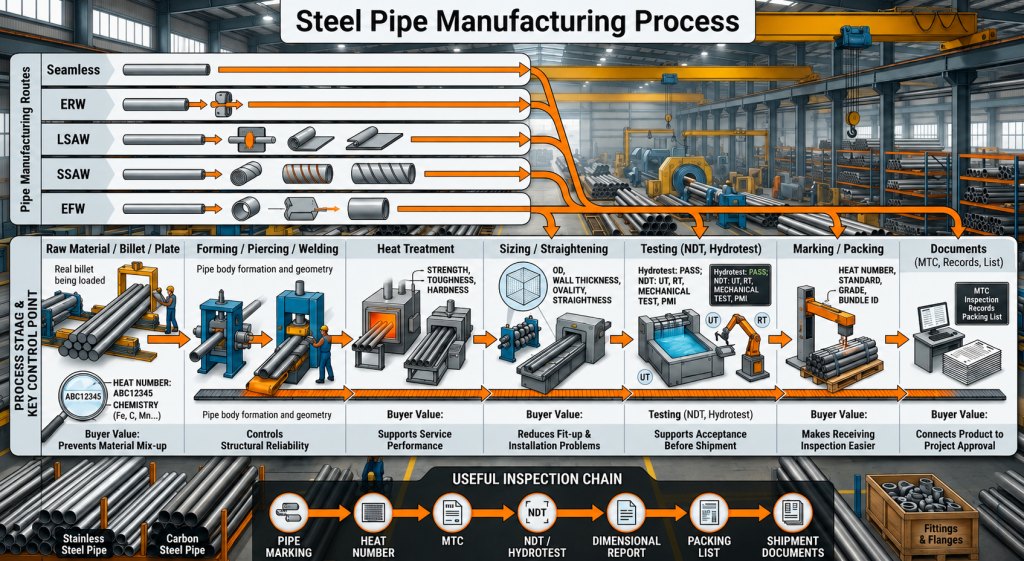
A useful inspection chain should connect:
pipe marking → heat number → MTC → NDT / hydrotest → dimensional report → packing list → shipment documents
This traceability chain is especially important when one order includes different pipe types, such as stainless steel pipe, carbon steel pipe, alloy steel pipe, fittings and flanges.
How to Identify a Top Steel Pipe Manufacturer
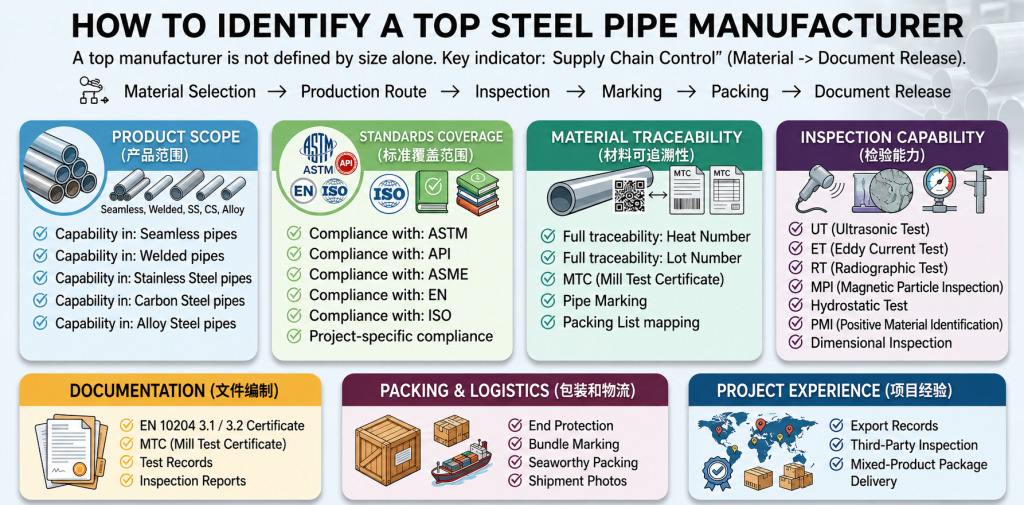
Download:How to Identify a Top Steel Pipe Manufacturer
A top steel pipe manufacturer is not defined by factory size alone. For international buyers, the stronger indicator is whether the manufacturer can control the full supply chain from material selection, production route, inspection, marking, packing and final document release.
For international projects, the most valuable supplier is not always the one that quotes fastest. A reliable steel pipe manufacturer should help reduce specification mismatch, inspection delays, receiving disputes, mixed heat-number problems and missing-document risks before shipment.
Quality Control and Document Package
For steel pipe export orders, the document package is part of the product. A professional manufacturer should provide records that allow the buyer to verify material identity, production batch, inspection results and shipment consistency.
A typical steel pipe document package may include:
- Material Test Certificate, MTC
- Heat number and lot traceability
- Chemical composition report
- Mechanical test results
- NDT report
- Hydrostatic test record
- Dimensional inspection report
- PMI report for stainless steel or alloy steel pipe when required
- Coating inspection report when applicable
- Packing list and bundle marking photos
- Third-party inspection report when specified
A strong document chain should connect:
pipe marking → heat number → MTC → inspection records → packing list → shipment documents
This is especially important for mixed orders that include stainless steel pipe, carbon steel pipe, alloy steel pipe, pipe fittings, flanges and bolting materials together.
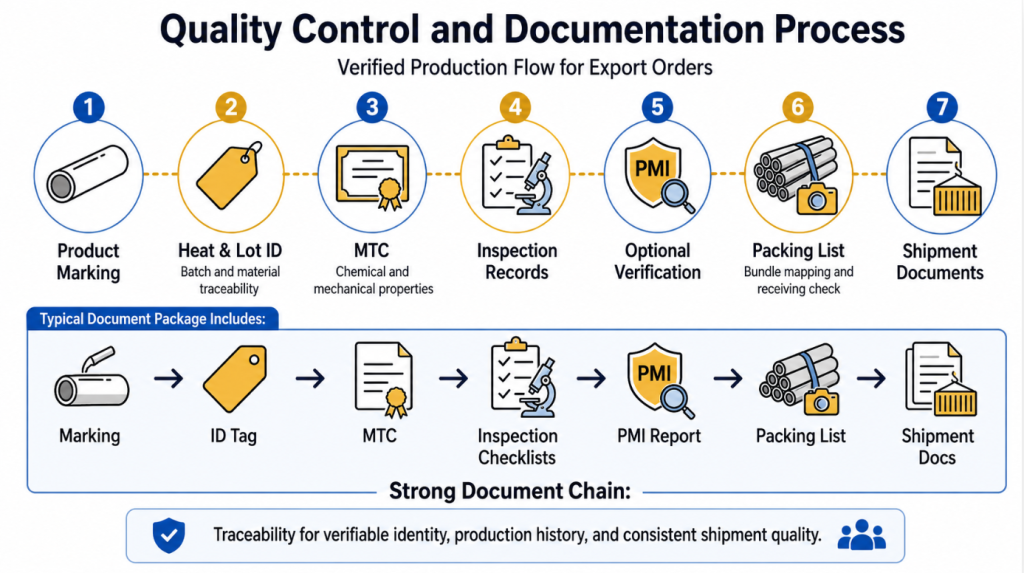
Clear traceability helps the buyer match each pipe bundle with the correct standard, grade, heat number, test record and packing list during receiving inspection.
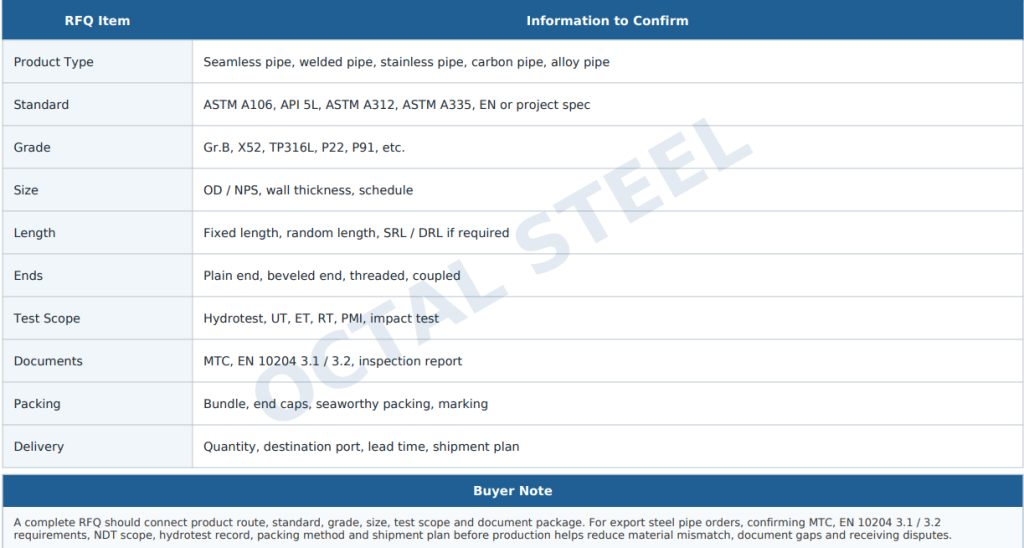
Buyer Checklist Before Ordering Steel Pipe
Before placing an order with a steel pipe manufacturer, buyers should confirm the following information in the RFQ:
Conclusion
A reliable steel pipe manufacturer should provide more than pipe supply. The real value is the ability to match the correct standard, grade, manufacturing process, inspection records, packing method and document package with the project requirement.
Whether buyers are looking for a seamless steel pipe manufacturer, stainless steel pipe manufacturer, carbon steel pipe manufacturer or alloy steel pipe manufacturer, the safest purchase decision should be based on verifiable production control: MTC, heat number traceability, NDT, hydrostatic test, dimensional inspection and shipment documents.


Tags:API 5L pipeSteel pipesteel pipe manufacturer
Related Products
Related Resources
Recent News
Hot Topic

Octal is located in China recognized as a leading supplier, distributor, and manufacturer union in providing piping solutions for oil and gas company. Product ranges in Steel Pipe, Casing and Tubing, Steel Plate, Sucker Rod, Steel Pipe Fittings, Valves, and Equipment for pipelines.
Contact Info
Unit 2544, 25/F, Tower A, Wanda Plaza, Wenfeng District, Anyang, Henan, China & Building A, No.18 Dirun Road, Zhengdong New District, Zhengzhou, Henan, China
+86 372 2157660 / +86 186 3727 1277
[email protected]