Your Responsible Supplier Partner for Oil and Gas Products.

Nickel Alloy Casing and Tubing
Recent Products


Rencent Articles


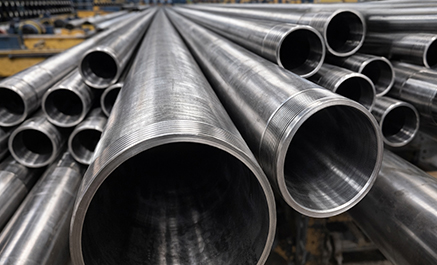
Nickel Alloy Casing and Tubing
Available Grades: N08028, N08535, N08135, N08825, N06985, N09925, N07718
Product Scope: Nickel Alloy Tubing, Casing, and Coupling Stock
Strength Level: 110/125 KSI CH, with selected 110 / 120 / 140 KSI Age-hardened routes
Applicable Standards: ISO 13680 / API Spec 5CRA, API 6ACRA
Size Range: 2-7/8″ to 8-5/8″
Max. Wall Thickness: Up to 30 mm
Length Range: R2 or R3
Suitable Service: H2S, CO2, Chlorides, High-Salinity Brine, Sour Service Wells
Nickel alloy casing and tubing is a Ni-based CRA OCTG product used for oil and gas wells where conventional carbon steel or standard OCTG grades are no longer reliable enough against corrosion and cracking. Instead of relying on corrosion allowance alone, this material route uses high-alloy nickel-based grades such as N08028, N08535, N08135, N08825, and N06985 under API 5CRA supply logic, with N09925 and N07718 available for selected age-hardened API 6ACRA applications.
These grades are selected for well conditions involving H2S, CO2, chlorides, high-salinity produced water, and elevated temperature, where resistance to sulfide stress cracking, stress corrosion cracking, localized corrosion, and connection-related failure must be supported by alloy route, delivery condition, manufacturing process, and test evidence rather than by general corrosion-resistant claims.
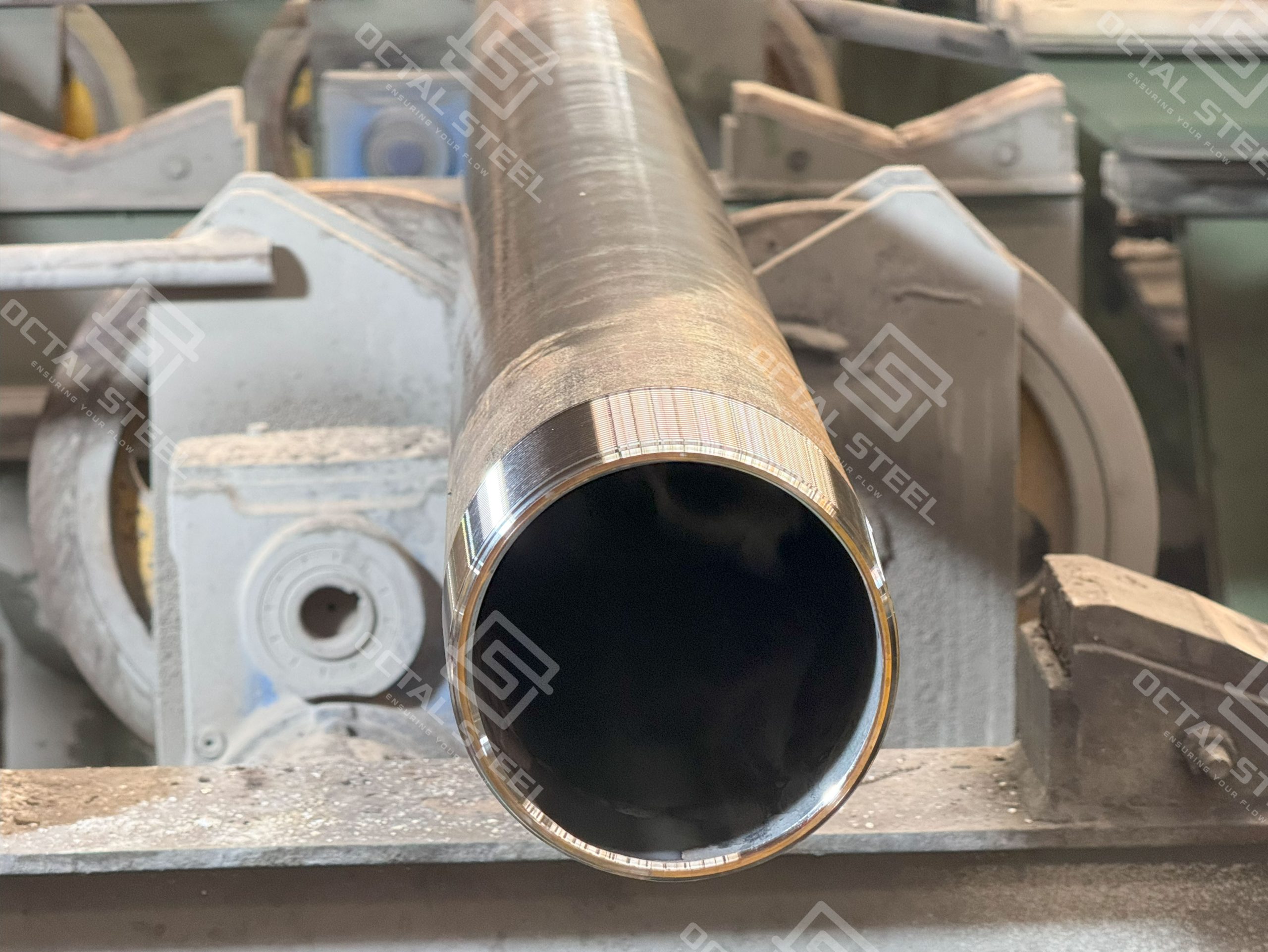
Available Nickel Alloy OCTG Grades
For API 5CRA routes, the Ni-based alloy section includes BG2830 / UNS N08028, BG2532 / UNS N08535, BG2235 / UNS N08135, BG2142 / UNS N08825, and BG2250 / UNS N06985, all listed for tubing, casing, and coupling stock at 110/125 ksi with cold hardened delivery condition. For API 6ACRA routes, N09925 is listed at 110 ksi age-hardened, while N07718 is available at 120 and 140 ksi age-hardened in bar or tubular form.
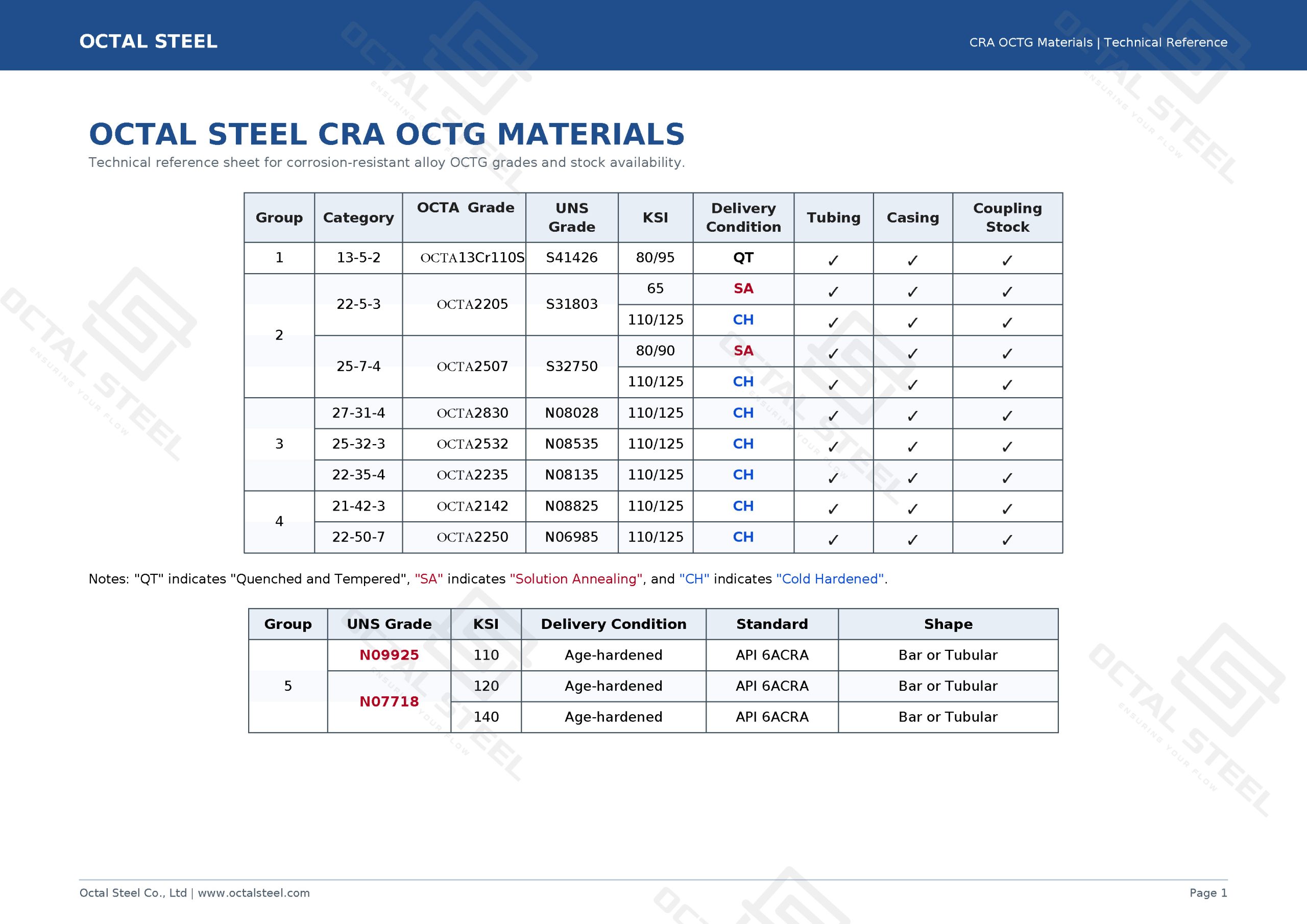
Download:Octal Steel CRA OCTG Materials-OCTAL
A practical project view is to separate the grade family into three selection layers. The first layer is sour and chloride-resistant CRA tubing and casing in the N08028, N08535, N08135, N08825, and N06985 range for wells that need stronger corrosion control than low-alloy or standard stainless OCTG can provide. The second layer is age-hardened routes such as N09925 and N07718 where higher strength and more demanding equipment-service conditions are part of the specification. The third layer is the connection and release package, because a high-value alloy string can still fail at the thread, shoulder, or release stage if the machining and inspection discipline are weak.
Standards Behind Nickel Alloy Casing and Tubing
The supplied mill route for nickel alloy casing and tubing is aligned with ISO 13680 / API Spec 5CRA, PSL-1 and PSL-2, with reference to NACE MR0175 / ISO 15156-3 and API 5CT / ISO 11960. This standards framework matters because nickel alloy OCTG tube is selected not only by size and strength, but also by its suitability for sour service, chloride-bearing fluids, and demanding downhole environments where material qualification and release documentation must be clear.
In practical project review, these standards define how the product is specified, manufactured, inspected, and accepted for corrosive downhole service. Nickel alloy casing and tubing should be evaluated separately from conventional OCTG, and also separately from CRA clad or lined pipe used in surface or line-pipe service, because the product form, service duty, and qualification route are different.
Nickel Alloy OCTG for Sour Service and High-Chloride Wells
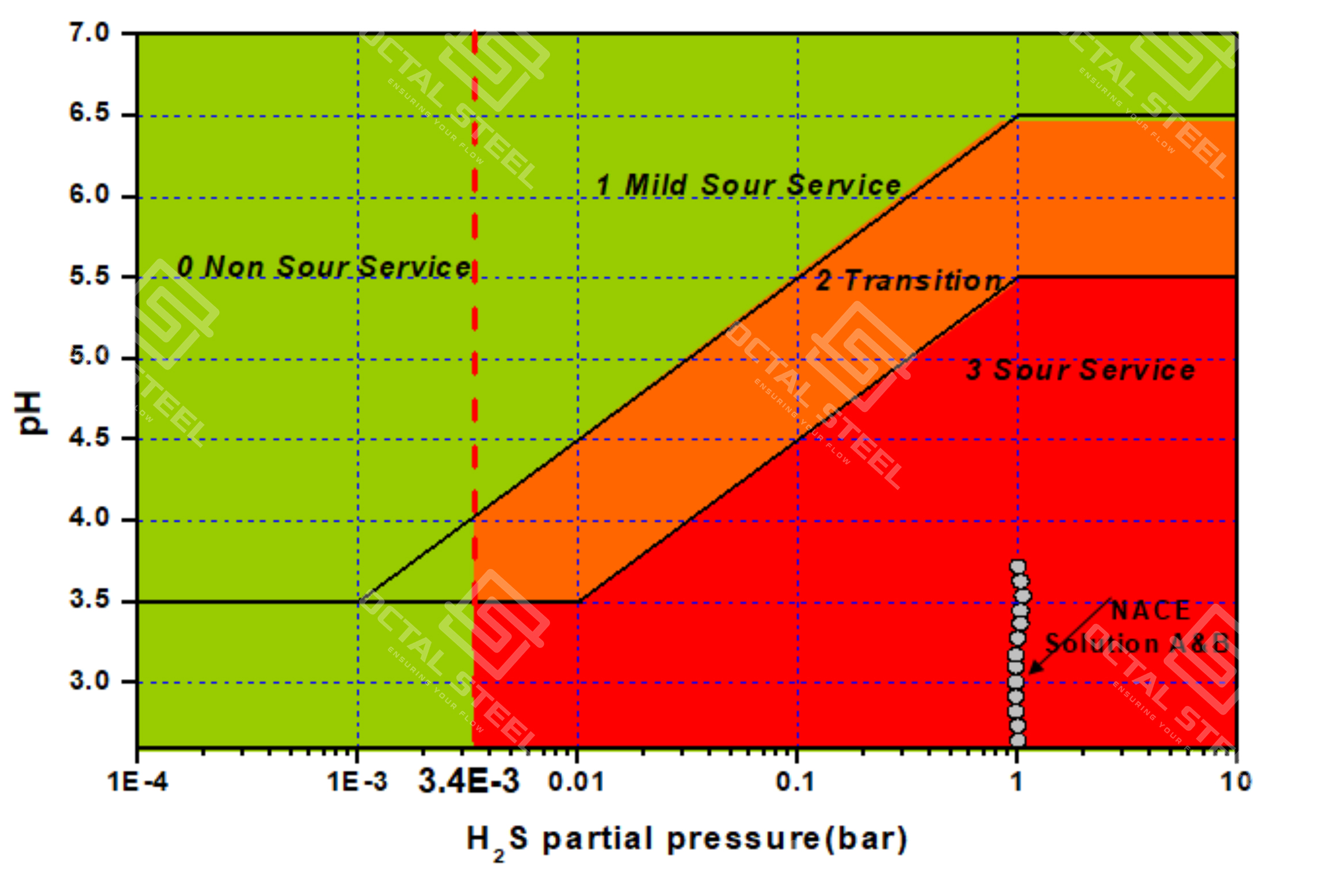
Download:Division of SSC environmental severity (NACE MR0175 provision)-octalsteel
The supplied selection chart divides SSC environmental severity under NACE MR0175 logic, showing how H2S partial pressure and pH move service conditions from non-sour to mild sour, transition, and sour service. In real projects, this is the difference between a material that survives over the planned production window and a string that starts a corrosion or cracking discussion too early in the well life.
Buyers usually need to think about produced water salinity, chloride level, H2S partial pressure, CO2 partial pressure, shut-in temperature, and the stress state carried by the tubing or casing during service. In high-salinity gas wells, deep production strings, or injection-service intervals where pitting, SCC, or SSC risk is active, nickel alloy casing and tubing becomes a way to reduce material compromise rather than a way to decorate the specification with a premium alloy name.
Manufacturing Route for Ni-based CRA OCTG
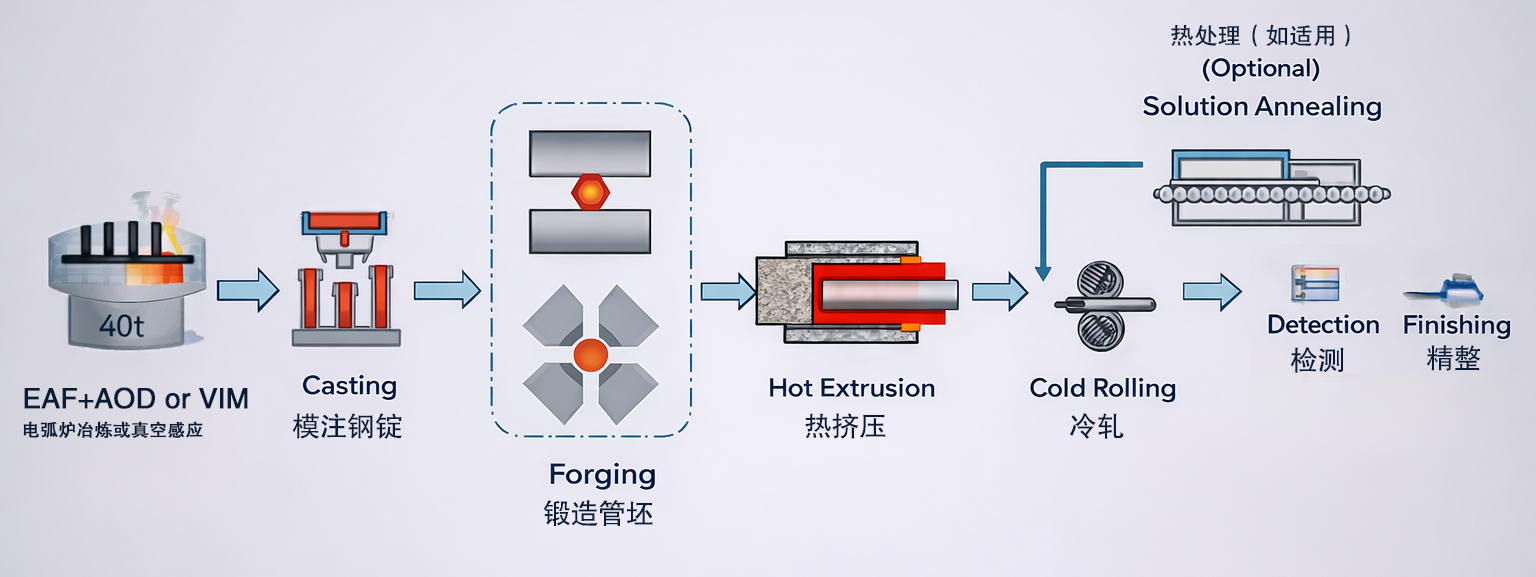
Nickel Alloy OCTG Tube Manufacturing Process Chart
| UNS Grade | KSI | Delivery Condition | Manufacturing Process |
|---|---|---|---|
| S31803 | 65 | SA | EAF+AOD+LF→IC→ESR (If required)→ Forging Billet→ Hot extrusion/Hot piercing→ Cold pilgering/Cold drawing→ Solution annealing→ Inspection |
| S32750 | 80/90 | SA | EAF+AOD+LF→IC→ESR (If required)→ Forging Billet→ Hot extrusion/Hot piercing→ Cold pilgering/Cold drawing→ Solution annealing→ Inspection |
| S31803 | 110/125 | CH | EAF+AOD+LF→IC→ESR (If required)→ Forging Billet→ Hot extrusion/Hot piercing→ Solution annealing→ Cold pilgering/Cold drawing→ Inspection |
| S32750 | 110/125 | CH | EAF+AOD+LF→IC→ESR (If required)→ Forging Billet→ Hot extrusion/Hot piercing→ Solution annealing→ Cold pilgering/Cold drawing→ Inspection |
| N08028 N08535 N08135 |
110/125 | CH | EAF+AOD+LF→IC→ Forging Billet→ Hot extrusion→ Solution annealing→ Cold pilgering→ Inspection |
| N08825 N06985 |
110/125 | CH | EAF+AOD+LF→IC→ESR→ Forging Billet→ Hot extrusion→ Solution annealing→ Cold pilgering→ Inspection |
| N09925 | 110 | Age-hardened | Path1: VIM→ESR/VAR→ Forging Billet→ Hot extrusion→ Cold working→ Solution annealing→ Age hardening→ Inspection |
| N07718 | 120/140 | Age-hardened | Or Path2: VIM→ESR/VAR→ Forging bar→ Solution annealing→ Age hardening→ Machining |
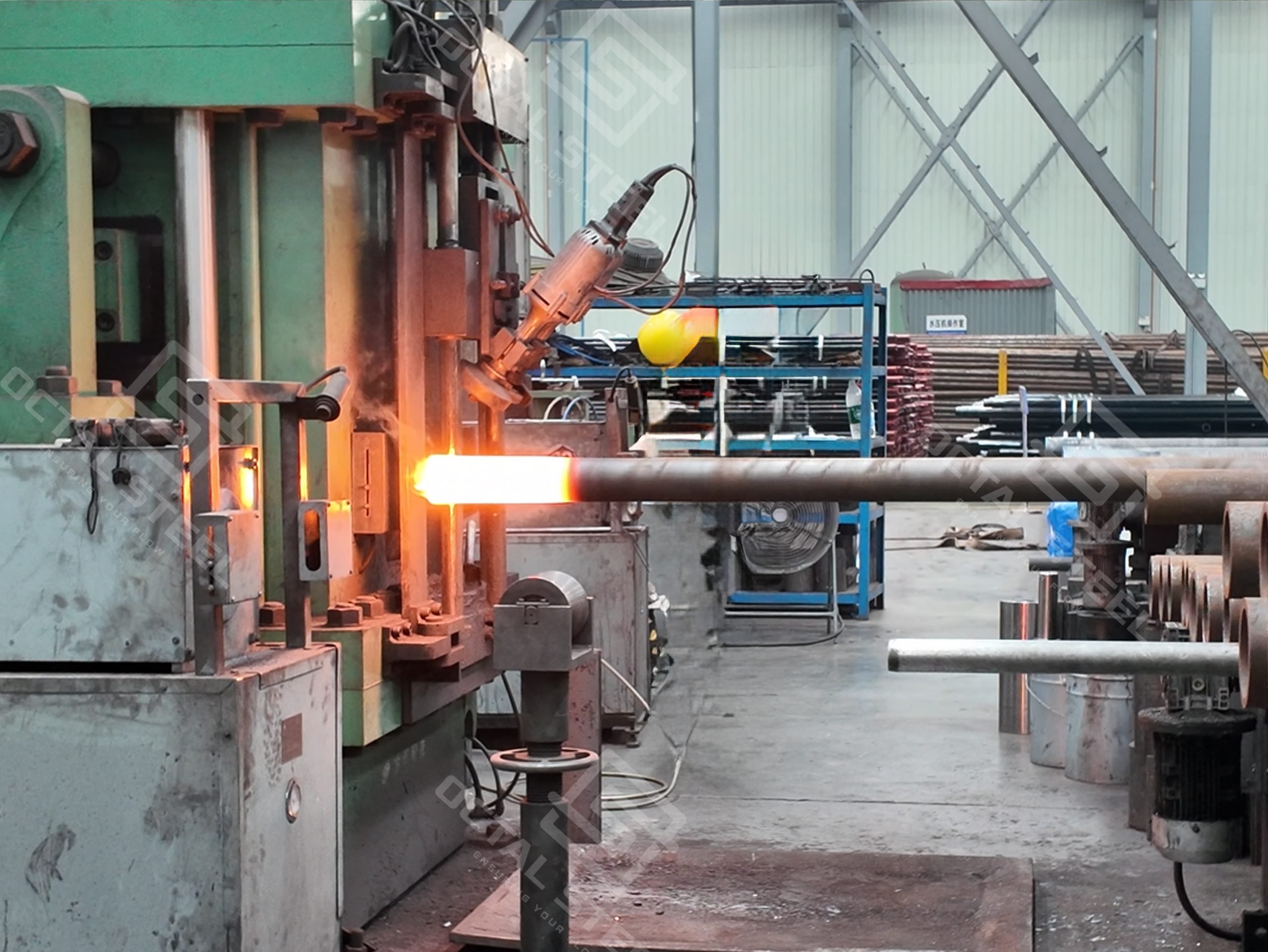
Nickel alloy OCTG is expensive for a reason. The supplied mill manufacturing routes show that this is not a simple seamless tube purchase. Depending on the grade, the process may include EAF + AOD + LF melting, ingot casting, ESR where required, forging billet, hot extrusion or hot piercing, solution annealing, cold pilgering or cold drawing, and final inspection. For N09925 and N07718, the route extends to VIM plus ESR or VAR, followed by hot working or bar forging, solution annealing, age hardening, and inspection or machining. That process route is one of the real cost drivers behind nickel alloy casing and tubing supply.
The process notes in the supplied mill data also explain the purpose of that route. Refining practice is used to control chemistry and purity, reduce segregation, and keep harmful elements under control. Hot extrusion and cold rolling are used to improve microstructural uniformity and dimensional accuracy.
Third-Party SCC Test Results
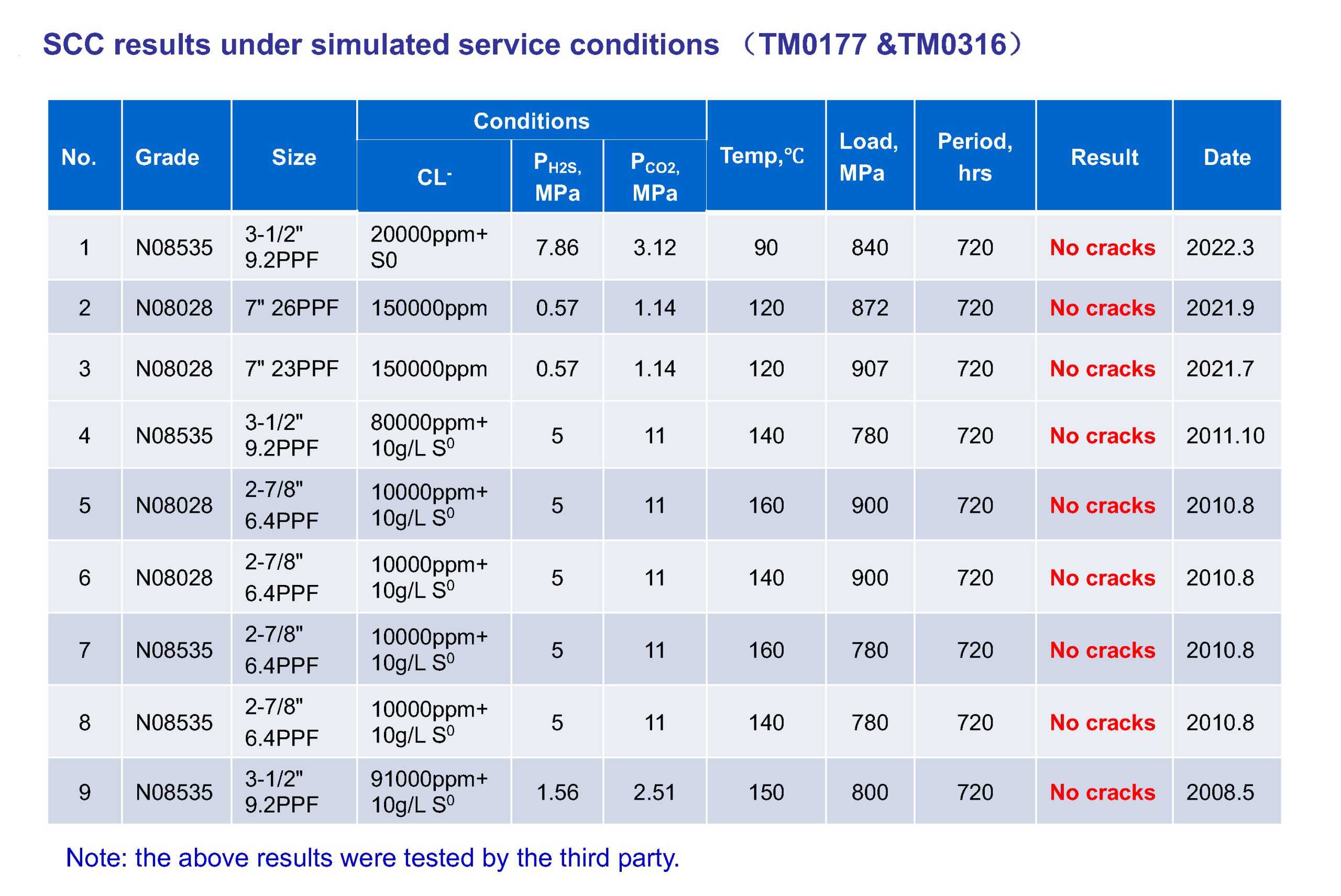
You can review the SCC results under simulated service conditions in the PDF below:
SCC Results Under Simulated Service Conditions-octalsteel
The mill data includes third-party SCC results under simulated service conditions for N08028 and N08535, with all listed results reported as No cracks after 720 hours. The table includes actual condition windows rather than generic claims, which makes it useful to both project buyers and technical reviewers.
Examples from the supplied test set include N08535 at 3-1/2″ 9.2 PPF under 20,000 ppm+ chloride condition at 90°C and 840 MPa for 720 hours with no cracks, and N08028 at 7″ 26 PPF under 150,000 ppm chloride condition at 120°C and 872 MPa for 720 hours with no cracks. The same data set also shows N08028 at 2-7/8″ 6.4 PPF tested at 160°C and 900 MPa for 720 hours with no cracks, and N08535 at 2-7/8″ 6.4 PPF tested at 160°C and 780 MPa for 720 hours with no cracks.
Where Nickel Alloy Casing and Tubing Is Used
Nickel alloy casing and tubing is mainly used in well sections where H2S, CO2, chlorides, and service temperature make conventional OCTG less reliable over the planned service life.
Typical applications include sour gas wells, high-salinity production or completion environments, and critical well sections where the cost of workover or deferred production is much higher than the premium paid for a higher-grade CRA OCTG route. In these cases, material selection is driven by long-term integrity, corrosion resistance, and reduced intervention risk rather than by first-cost comparison alone.
Connection Integrity, Inspection, and Document Package
For nickel alloy casing and tubing, alloy performance alone is not enough if the connection route is not properly controlled. The available mill route includes premium connection BGT3, with optimized sealing geometry, controlled make-up behavior, and high-temperature evaluation to API RP 5C5:2017. Repeated make-up and break-out performance is also part of the connection value for demanding OCTG service.
Inspection and release should follow a clear evidence chain. Available mill capabilities include NDT, hydrostatic testing, tensile testing, hardness testing, metallurgical examination, and related inspection records. Orders can be released with traceable marking, heat and lot identification, MTC, and supporting mill or third-party documents required by the project.
Delivery and Project Planning
- Nickel alloy casing and tubing is usually supplied on a project basis rather than as a standard stock item.
- Based on the current mill route, normal delivery typically starts from M+3, with follow-up shipments of approximately 300 to 500 tons per month.
- Special specifications, urgent schedules, and non-standard requirements can be reviewed separately.
- For this reason, nickel alloy OCTG should be planned early by grade family, size range, connection requirement, and inspection scope, rather than treated like conventional commodity tubing.
- Before production release, the order should clearly define grade, UNS designation, ksi level, delivery condition, size, weight, connection type, applicable standard, inspection requirements, and release documents.
- Clear alignment at the PO stage helps reduce approval delays, avoid specification mismatch during production, and make batch release and shipment planning more predictable.
Why Source Nickel Alloy Casing and Tubing Through Octal
Octal supplies nickel alloy casing and tubing through qualified CRA OCTG mill routes for corrosive well service, with controlled manufacturing, documented release, and support for standard API 5CRA size ranges.
- Available grades include N08028, N08535, N08135, N08825, and N06985 for tubing, casing, and coupling stock, with N09925 and N07718 for selected age-hardened applications.
- Standard supply scope covers 2-7/8″ to 8-5/8″, wall thickness up to 30 mm, and length in R2 or R3.
- The material route is aligned with ISO 13680 / API Spec 5CRA, with reference to NACE MR0175 / ISO 15156-3 and API 5CT / ISO 11960.
- Depending on grade, production can cover melting, forging, hot extrusion, solution annealing, cold finishing, and final inspection.
- Premium connection BGT3 is also available for projects requiring more controlled OCTG connection performance.
FAQ
Q1: When should nickel alloy casing and tubing be selected instead of standard OCTG?
Nickel alloy casing and tubing is usually selected when H2S, CO2, chlorides, temperature, and lifecycle risk push standard OCTG or lower-CRA routes beyond a comfortable corrosion window. It is most relevant for sour wells, HPHT duty, and high-chloride service where long-term integrity matters more than first-cost alone.
Q2: Is nickel alloy casing and tubing supplied to API 5CRA?
Yes. For seamless CRA products used as casing, tubing, and coupling stock, API 5CRA / ISO 13680 is the core standards route. API also issued a 5CRA 3rd Edition update notice in April 2025, so buyers should confirm the edition and project compliance basis during review.
Q3: Which nickel alloy grades are most commonly considered for sour-service OCTG?
The grades most often seen across current supplier content include Alloy 28 / UNS N08028, Alloy 825 / UNS N08825, and Alloy G-3 / UNS N06985 in 110/125 strength classes, while some suppliers also push higher-strength proprietary or age-hardened nickel alloy routes for more severe service. Alloy 28 appears especially often in CRA OCTG discussions, and one Tubacex publication even calls it the most widely used grade in CRA OCTG casing and tubing.
Q4: What should be confirmed before ordering nickel alloy casing and tubing?
Before placing the order, buyers should confirm the service environment, applicable standard, alloy grade and UNS number, strength level, delivery condition, size and length, connection requirement, and required test/document package. This question is not covered well on many marketing pages, but it matches how API 5CRA qualification and supplier checklists are actually structured.