Your Responsible Supplier Partner for Oil and Gas Products.

API 5CT Casing and Tubing Specification
API 5CT Casing and Tubing Specification
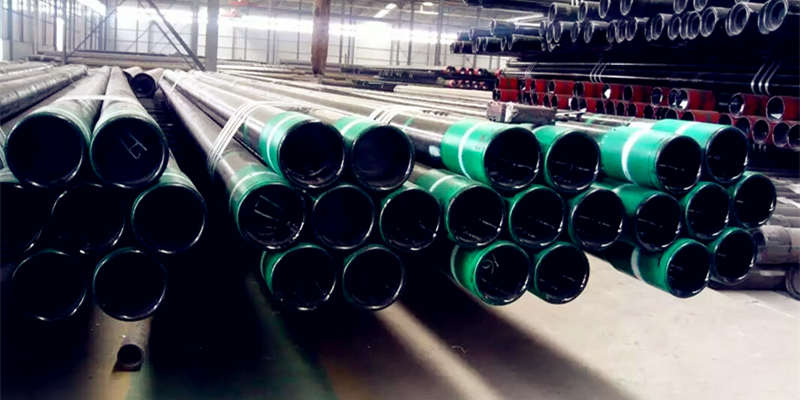
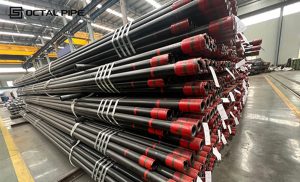
API 5CT Specification defines the technical delivery conditions for steel casing, tubing, pup joints, couplings, coupling stock, coupling material and related accessory material used in oil and gas wells. The current technical basis is API Spec 5CT, 11th Edition, December 2023, together with Addendum 1 published in May 2025 and subsequent errata. The standard controls material grade, dimensions, mass, wall thickness, end finish, heat treatment, mechanical properties, inspection, marking and certification requirements.
An API 5CT specification normally combines multiple technical parameters to define the required casing or tubing product. The ordered item should identify the grade and type, outside diameter, nominal weight or wall thickness, length range, manufacturing route, end finish, connection, heat treatment, drift requirement, inspection level and required documentation. Thread geometry and gauging requirements for standard API casing and tubing connections are covered separately under API 5B.
API 5CT Grades and Mechanical Property Comparison
API 5CT grade selection is determined by the required mechanical performance and well conditions. The grade defines the specified strength range, while factors such as yield strength, tensile strength, hardness limits, heat-treatment condition and service environment determine whether the material is suitable for the intended application.
The following values are based on the tensile and hardness requirements in API 5CT 11th Edition and Addendum 1.
| Grade / Type | Yield Strength, MPa | Yield Strength, ksi | Min. Tensile Strength, MPa | Max. Hardness | Main Technical Difference |
|---|---|---|---|---|---|
| H40 | 276–552 | 40–80 | 414 | — | Lowest standard strength level |
| J55 | 379–552 | 55–80 | 517 | — | Common lower-strength casing/tubing grade |
| K55 | 379–552 | 55–80 | 655 | — | Same yield range as J55, higher minimum tensile strength |
| N80 Type 1 | 552–758 | 80–110 | 689 | — | Heat-treated N80 route |
| N80Q | 552–758 | 80–110 | 689 | — | Quenched-and-tempered N80 route |
| R95 | 655–758 | 95–110 | 724 | — | Narrower high-strength range than P110 |
| L80 Type 1 | 552–655 | 80–95 | 655 | 23 HRC | Controlled strength and hardness |
| L80 3Cr | 552–655 | 80–95 | 655 | 23 HRC | Chromium-bearing L80 introduced in 11th Edition |
| L80 9Cr | 552–655 | 80–95 | 655 | 23 HRC | Martensitic chromium grade |
| L80 13Cr | 552–655 | 80–95 | 655 | 23 HRC | Higher chromium content for corrosion-related service selection |
| C90 | 621–724 | 90–105 | 689 | 25.4 HRC | Controlled hardness and SSC-related requirements |
| T95 | 655–758 | 95–110 | 724 | 25.4 HRC | Higher yield range with controlled hardness |
| C110 | 758–828 | 110–120 | 793 | 29 HRC | High-strength grade with additional SSC controls |
| P110 | 758–965 | 110–140 | 862 | — | Wide high-strength range for higher mechanical loading |
| C125 | 862–931 | 125–135 | 896 | 34 HRC | New high-strength grade added by Addendum 1 |
| Q125 | 862–1034 | 125–150 | 931 | No fixed maximum* | Highest standard yield range in this group |
* Q125 uses hardness-variation controls rather than a single maximum hardness limit in Table C.5.
J55 and K55 use the same yield strength range, but their tensile strength requirements are different. K55 requires a minimum tensile strength of 655 MPa, while J55 requires 517 MPa.
N80 Type 1 and N80Q have the same minimum strength requirements, but the heat-treatment condition is different. N80Q is supplied in the quenched and tempered condition, while N80 Type 1 follows the heat-treatment route specified for that grade.
The L80 family includes Type 1, 3Cr, 9Cr and 13Cr grades. Their strength range is similar, but the chemical composition changes with chromium content, which affects material selection for different well environments.
Casing and Tubing Sizes, Weight and Length Ranges
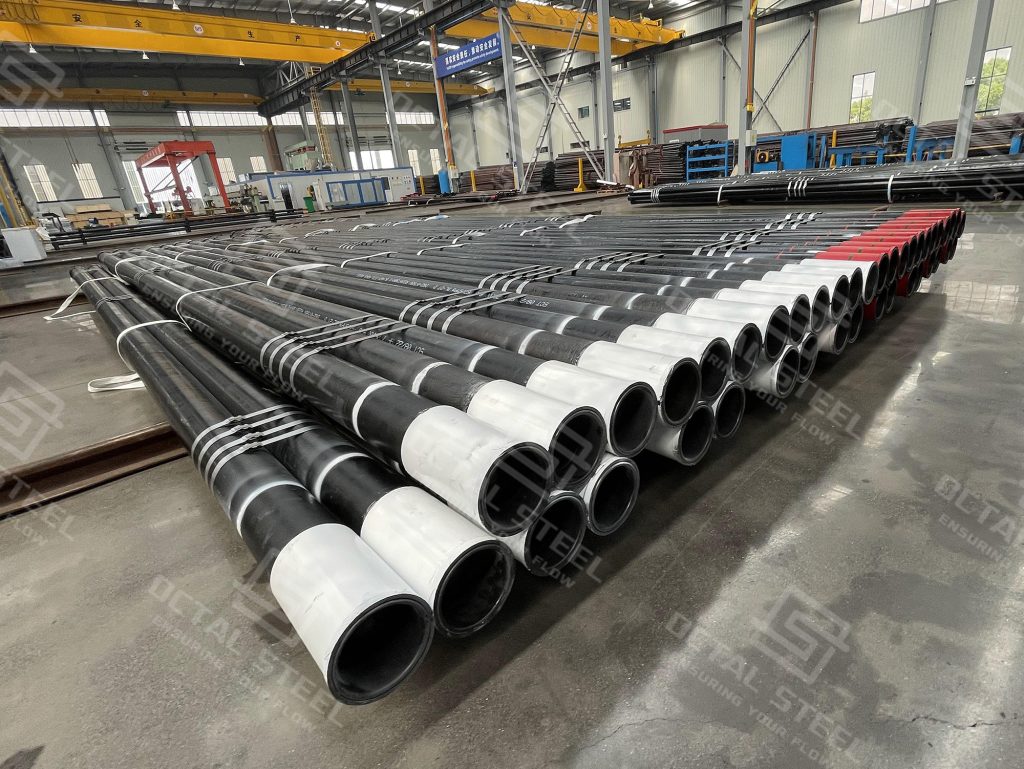
API 5CT casing and tubing are identified by outside diameter, nominal weight or wall thickness, grade and connection type. Unlike general pipe products that are often selected by schedule, OCTG dimensions follow API 5CT size designations with specific combinations of OD, weight and performance requirements.
Common casing sizes range from 4-1/2 in. to 20 in. OD, while tubing sizes generally cover approximately 1.050 in. to 4-1/2 in. OD. Each diameter includes different weight options, and the selected weight determines the wall thickness, internal diameter, drift diameter and pressure performance of the pipe.
For example, a 7 in. casing can be supplied in multiple nominal weights. Although the outside diameter is identical, different weights result in different wall thicknesses and internal dimensions, which directly affect burst pressure, collapse resistance and running conditions in the well.
Detailed size selection can be checked through the following reference charts:
• API 5CT Casing Dimensions and Weight Chart
• API 5CT Tubing Dimensions and Weight Chart
API 5CT Length Ranges
API 5CT casing and tubing are supplied in R1, R2 and R3 length ranges, allowing the pipe string design, transportation arrangement and field handling requirements to be considered together.
| Product | R1 | R2 | R3 |
|---|---|---|---|
| Casing | 4.88–7.62 m | 7.62–10.36 m | 10.36–14.63 m |
| Tubing | 6.10–7.32 m | 8.53–9.75 m | 11.58–12.80 m |
Lengths outside these ranges can also be supplied when agreed between the purchaser and manufacturer.
The selected length range depends on well design, rig handling capability, transportation limits and site conditions. Longer joints can reduce the number of connections in the string, while shorter joints may be preferred where lifting, storage or transport limitations apply.
API 5CT Drift Requirements
Drift testing verifies the minimum internal clearance of the pipe after manufacturing. This measurement is important when completion tools, plugs, packers or other downhole equipment need to pass through the casing or tubing string.
The required drift diameter is calculated from the pipe internal diameter (d) defined in API 5CT. Standard drift requirements are listed below.
| Product / Size | Drift Mandrel Length | Minimum Drift Diameter |
|---|---|---|
| Casing < 9-5/8 in. | 152 mm | d − 3.18 mm |
| Casing 9-5/8 to 13-3/8 in. | 305 mm | d − 3.97 mm |
| Casing > 13-3/8 in. | 305 mm | d − 4.76 mm |
| Tubing ≤ 2-7/8 in. | 1067 mm | d − 2.38 mm |
| Tubing > 2-7/8 to ≤ 5-5/8 in. | 1067 mm | d − 3.18 mm |
| Tubing > 5-5/8 to < 10-3/4 in. | 1067 mm | d − 3.97 mm |
Alternative drift sizes can be specified when the well design requires additional internal clearance.
The required drift condition should be identified together with the pipe specification, including standard drift or special drift requirements where applicable. This information allows the supplied pipe to match the planned completion equipment and running conditions.
API 5CT Connections and API 5B Thread Requirements
API 5CT covers the product requirements and end-finish conditions for casing and tubing, while API 5B defines the dimensional requirements, tolerances, gauging and inspection methods for standard API threads.
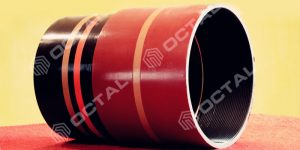
The connection type forms an important part of the OCTG specification because it affects make-up geometry, coupling dimensions, clearance and connection performance. Common API casing and tubing connections include:
Casing Connections
| API 5CT / 5B Designation | Common Market Term | Description |
|---|---|---|
| SC | STC | Short round thread casing |
| LC | LTC | Long round thread casing |
| BC | BTC | Buttress thread casing |
Tubing Connections
| Designation | Common Market Term | Description |
|---|---|---|
| NU | NUE | Non-upset tubing |
| EU | EUE | External upset tubing |
| IJ | Integral Joint | Tubing connection without a conventional coupling |
Standard API threads are manufactured and inspected according to API 5B gauging requirements. For proprietary or premium connections, the pipe body may still meet API 5CT requirements, but thread dimensions, torque values, acceptance criteria and inspection procedures are controlled by the connection manufacturer’s specification.
The final connection selection depends on the well design, load requirements, clearance limitations and operating conditions. Therefore, casing and tubing specifications normally include the exact connection designation rather than only stating “API thread”.
Manufacturing and Heat Treatment by Grade
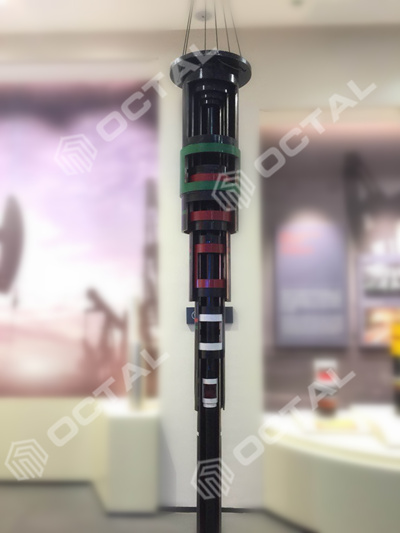
API 5CT casing and tubing can be produced through different manufacturing routes depending on the grade and product type. Seamless (S) products are formed from steel billets through piercing and hot working processes, while electric-welded (EW) products are manufactured from steel strip with a welded seam that is controlled through the applicable API requirements.
After forming, the required heat-treatment condition is applied according to the grade. Heat treatment controls the final mechanical properties, including yield strength, tensile strength, hardness and toughness, especially for higher-strength OCTG grades used in demanding well conditions.
| Grade / Type | Manufacturing Route | Heat Treatment |
|---|---|---|
| H40 | S or EW | No mandatory full-body heat treatment |
| J55 / K55 | S or EW | Heat treatment may be applied according to the manufacturing route or PO |
| N80 Type 1 | S or EW | Full-body heat treatment mandatory; normalized or normalized and tempered |
| N80Q | S or EW | Quenched and tempered |
| R95 | S or EW | Quenched and tempered; minimum tempering temperature 538°C |
| L80 Type 1 | S or EW | Quenched and tempered; minimum tempering temperature 566°C |
| L80 3Cr | Seamless | Quenched and tempered; minimum tempering temperature 566°C |
| L80 9Cr | Seamless | Quenched and tempered; minimum tempering temperature 593°C |
| L80 13Cr | Seamless | Quenched and tempered; minimum tempering temperature 593°C |
| C90 | Seamless | Quenched and tempered; minimum tempering temperature 621°C |
| T95 | Seamless | Quenched and tempered; minimum tempering temperature 649°C |
| C110 | Seamless | Quenched and tempered; minimum tempering temperature 649°C |
| P110 | S or EW | Full-body, full-length quenched and tempered |
| C125 | Seamless | Quenched and tempered; minimum tempering temperature 630°C |
| Q125 | S or EW | Full-body, full-length quenched and tempered |
N80 Type 1 and N80Q have the same specified mechanical-property range, but their heat-treatment conditions are different. N80Q is supplied in a quenched-and-tempered condition, while N80 Type 1 follows the heat-treatment route specified for that grade.
For higher-strength and hardness-controlled grades, the MTC and manufacturing records should include the applicable grade, type and heat-treatment condition so that the supplied pipe can be traced back to the specified production route.
For more details on thread forms, coupling types and connection selection, see our guide to API Couplings and Connections.
API 5CT Inspection, Testing and Acceptance
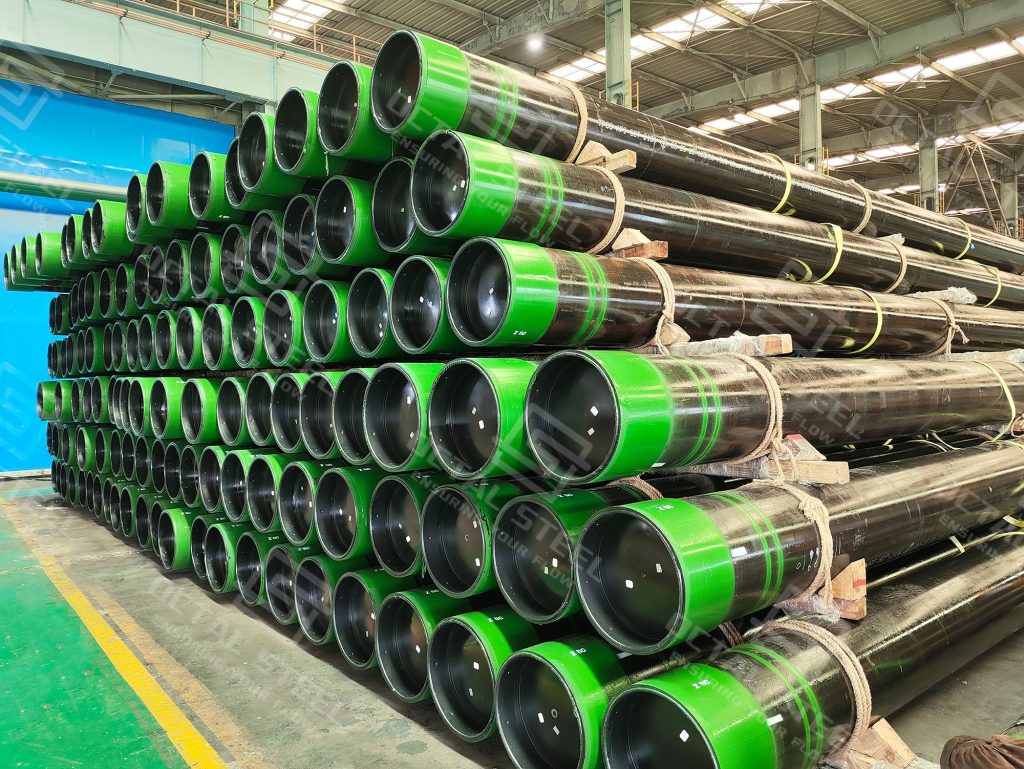
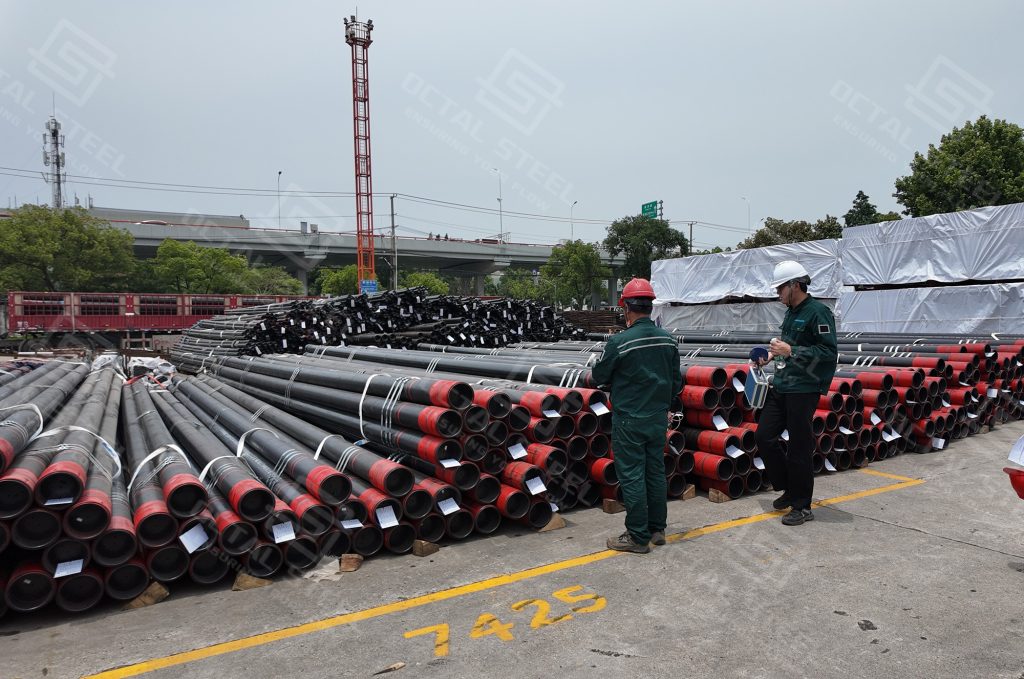
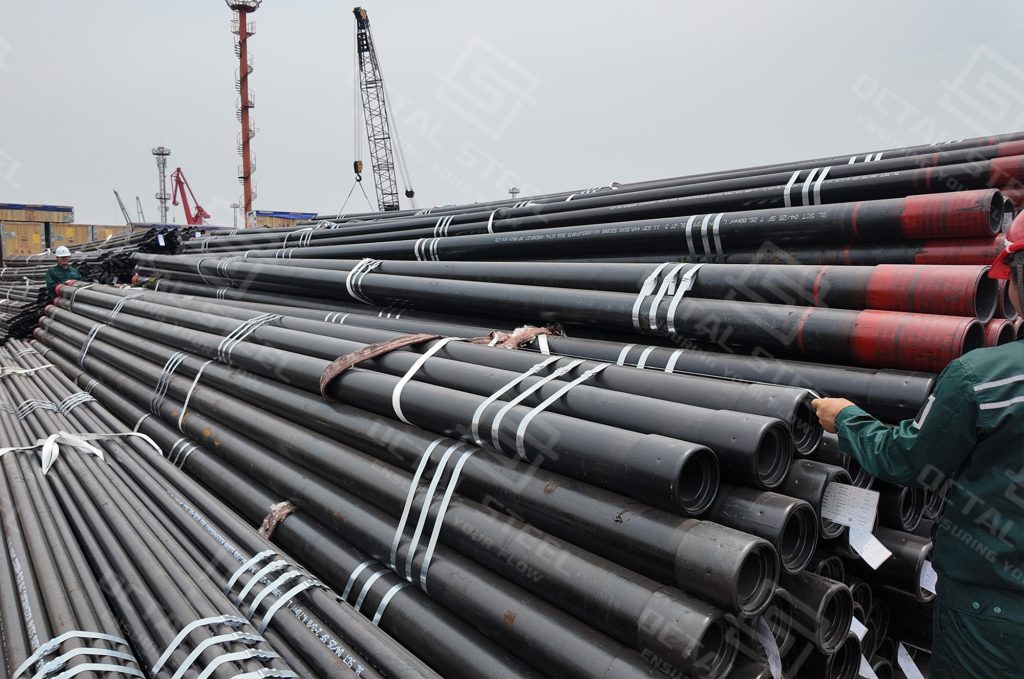
Acceptance of casing and tubing should cover the pipe body, ends, connections and documentation as one traceable package.
| Inspection Item | Verification Requirement |
|---|---|
| Dimensions | Outside diameter, wall thickness, length, weight and straightness checked against API 5CT requirements and purchase specification. OD and wall thickness tolerances depend on the ordered size and applicable API 5CT tables. |
| Drift Test | Standard drift or specified special drift verified using the required drift mandrel diameter and length according to API 5CT. Confirms internal clearance for completion tools and downhole equipment. |
| Mechanical Properties | Yield strength, tensile strength, elongation and hardness tested according to the ordered grade. For example, API 5CT P110 requires minimum yield strength of 758 MPa and minimum tensile strength of 862 MPa. |
| Impact Testing | Impact testing applied where required by the grade, product type, size and purchase specification. Results are recorded together with the applicable test temperature and absorbed energy requirements. |
| Hydrostatic Testing | Each pipe tested according to API 5CT requirements. Test pressure and holding time depend on pipe size, wall thickness, grade and applicable specification. |
| Non-Destructive Examination (NDE) | Inspection methods such as UT, EMI or other specified NDE are selected according to manufacturing route, product type and applicable acceptance requirements. |
| EW Weld Seam | For electric-welded products, weld seam inspection confirms weld integrity and acceptance according to the applicable API requirements. |
| Threads and Couplings | Connection type, thread dimensions, gauging, coupling condition and end finish verified according to API 5B requirements. |
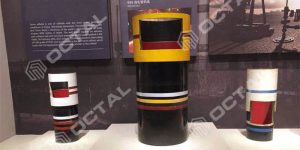
| Marking | Pipe marking includes required identification such as manufacturer, grade, size, weight designation, heat number and applicable specification information. |
| Traceability | Heat and lot identification maintained from raw material through manufacturing records, inspection reports, MTC (Mill Test Certificate) and packing documentation. |
API 5CT permits different NDE methods depending on the product and acceptance level, including ultrasonic testing, flux-leakage testing and eddy-current testing. Electric-welded product also requires weld-seam inspection appropriate to the specified grade and acceptance level.
The higher-control grades receive additional attention. Under the current Addendum, L80 13Cr, C90, T95, C110, C125 and Q125 require full-body wall-thickness measurement with 100% coverage of the surface area covered by the automatic system, with the minimum measured wall thickness recorded for each length.
Grades C90, T95, C110, C125 and Q125 also fall under full-body, full-length NDE provisions in the current standard. The exact method, reference notch level and acceptance criteria should be taken from the applicable API 5CT requirement and the approved ITP rather than applying one generic NDT rule to every grade.
This is also why a purchasing statement such as “100% NDT” is incomplete unless it identifies what is inspected, which method is used and which acceptance level applies.
API 5CT and Sour Service Requirements
API 5CT compliance defines the mechanical and manufacturing requirements of casing and tubing, but sour-service suitability still depends on the actual well environment. When hydrogen sulfide (H₂S) is present, material selection is normally evaluated together with NACE MR0175 / ISO 15156, considering factors such as H₂S partial pressure, temperature, chloride concentration, pH, stress level and required corrosion resistance.
For example, a well containing H₂S partial pressure above the limits defined by the applicable sour-service evaluation criteria may require additional material qualification rather than simply selecting a higher-strength casing grade. Excessive hardness, unsuitable microstructure or improper heat treatment can increase the risk of sulfide stress cracking (SSC) under these conditions.
API 5CT includes SSC-related requirements for grades such as C90, T95, C110 and C125. These grades require controlled manufacturing and heat treatment to achieve their specified mechanical properties. For instance, C110 has a minimum yield strength range of 758–828 MPa and maximum hardness requirements, which means the heat-treatment condition and hardness control become part of the qualification review.
The same consideration applies to L80 grades. L80 Type 1, L80 9Cr and L80 13Cr may have similar strength levels, but their chemical composition and corrosion behavior are different. L80 13Cr is often selected for environments where chromium alloy resistance is required, while conventional L80 selection depends more on the actual H₂S and corrosion conditions.
For sour-service applications, the final specification normally combines the API 5CT grade, manufacturing route, heat-treatment condition, hardness requirement and applicable NACE/ISO qualification requirements to match the intended well environment.
Octal API 5CT Project Supply Experience
Octal has supplied API 5CT casing and tubing for international oilfield projects involving multiple grades, sizes, connections and length requirements. These projects required strict control of material identification, inspection records, packing and shipment documentation throughout the supply process.
API 5CT Supply References
| Customer / Location | Product | Specification | Supply Details |
|---|---|---|---|
| Halliburton, Luanda, Angola | API 5CT Casing | K55 / L80 / P110 | 20 in. × 133 lb/ft K55; 13-3/8 in. × 72 lb/ft L80; 9-5/8 in. × 53.5 lb/ft P110; 7 in. × 32 lb/ft P110, R3 length |
| PDVSA, Venezuela | API 5CT N80Q Casing | N80Q, BTC connection | 280,000 ft supplied, including 5-1/2 in. × 17 lb/ft, 7 in. × 23 lb/ft and 9-5/8 in. × 43.5 lb/ft, R3 length |
| Venezuela Oilfield Project | API 5CT N80 Seamless Tubing | N80, EUE connection | 3-1/2 in. OD × 9.3 lb/ft, R2 length |
These references represent different operating environments and project requirements, from large-diameter casing supply to specialized tubing applications. Octal continues to support oilfield customers with API 5CT products configured for their specific drilling and completion programs.
Delivery from Octal
FAQ
Q1:What is the difference between API 5CT and API 5B for OCTG products?
A1:API 5CT defines the requirements for casing and tubing products, including grades, dimensions and mechanical properties. API 5B covers thread dimensions, gauging and inspection requirements for standard API connections. The two standards are normally referenced together for OCTG casing and tubing orders.
Q2:How do I select the correct API 5CT casing grade for a well project?
A2:Grade selection depends on the required mechanical strength, pressure conditions, corrosion environment and service requirements. Higher-strength grades such as P110, C110 or Q125 may be selected for higher loading conditions, while sour-service wells require additional review according to NACE MR0175 / ISO 15156 requirements.
Q3:How can buyers verify that API 5CT casing and tubing meet the ordered specification?
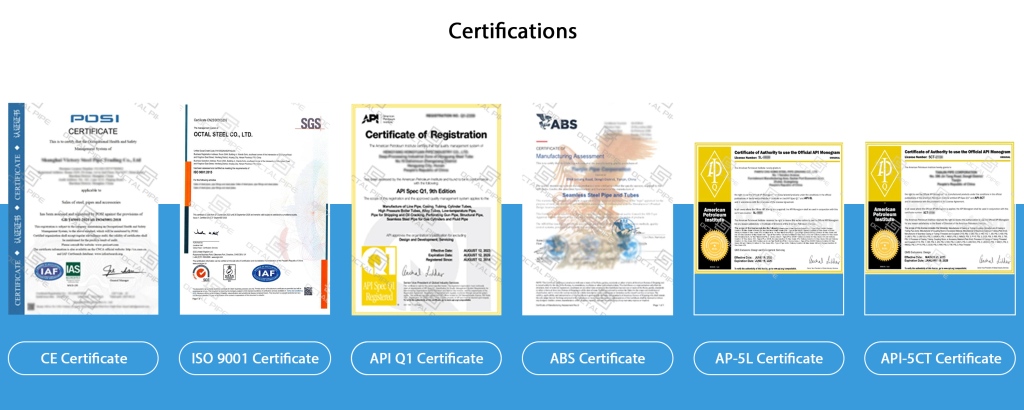
A3:Compliance verification normally includes checking the MTC, heat number traceability, dimensional inspection records, mechanical test results, hydrostatic test records and connection inspection documents against the purchase specification. The supplied pipe should match the ordered grade, size, weight, connection and heat-treatment condition.
Q4:Can API 5CT casing and tubing be supplied with premium connections?
A4:Yes. API 5CT casing and tubing can be supplied with standard API connections or customer-specified premium connections. Premium connection requirements normally include additional details such as thread design, torque requirements, sealing performance and inspection criteria according to the connection owner’s specification.


Tags:API 5CTCasing and tubingCasing PipeOCTG pipeTubing
Related Products
Related Resources
Recent News


Hot Topic


Octal is located in China recognized as a leading supplier, distributor, and manufacturer union in providing piping solutions for oil and gas company. Product ranges in Steel Pipe, Casing and Tubing, Steel Plate, Sucker Rod, Steel Pipe Fittings, Valves, and Equipment for pipelines.
Contact Info
Unit 2544, 25/F, Tower A, Wanda Plaza, Wenfeng District, Anyang, Henan, China & Building A, No.18 Dirun Road, Zhengdong New District, Zhengzhou, Henan, China
+86 372 2157660 / +86 186 3727 1277
[email protected]