Your Responsible Supplier Partner for Oil and Gas Products.

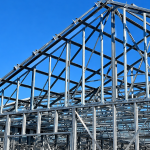
Steel Trusses
Recent Products


Rencent Articles




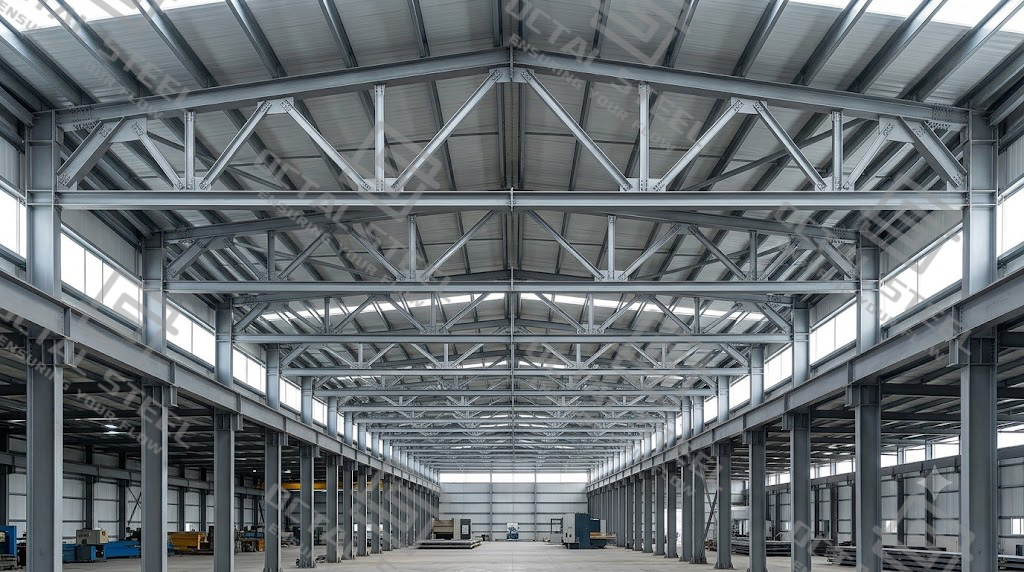
Steel Trusses
Types: Pratt, Warren, pitched, parallel-chord, north-light and tubular trusses
Members: Top chords, bottom chords, verticals, diagonals, gusset plates and splice assemblies
Materials: Structural plates, rolled sections, angles, channels and hollow structural sections
Fabrication: Cutting, drilling, profiling, assembly, welding, cambering and trial fit-up
Connections: Shop-welded nodes, gusset-plate joints and site-bolted splices
Protection: Blasted, shop-primed, coated or galvanized where specified
Inspection: Material identity, geometry, node position, welds, holes, piece marks and packing references
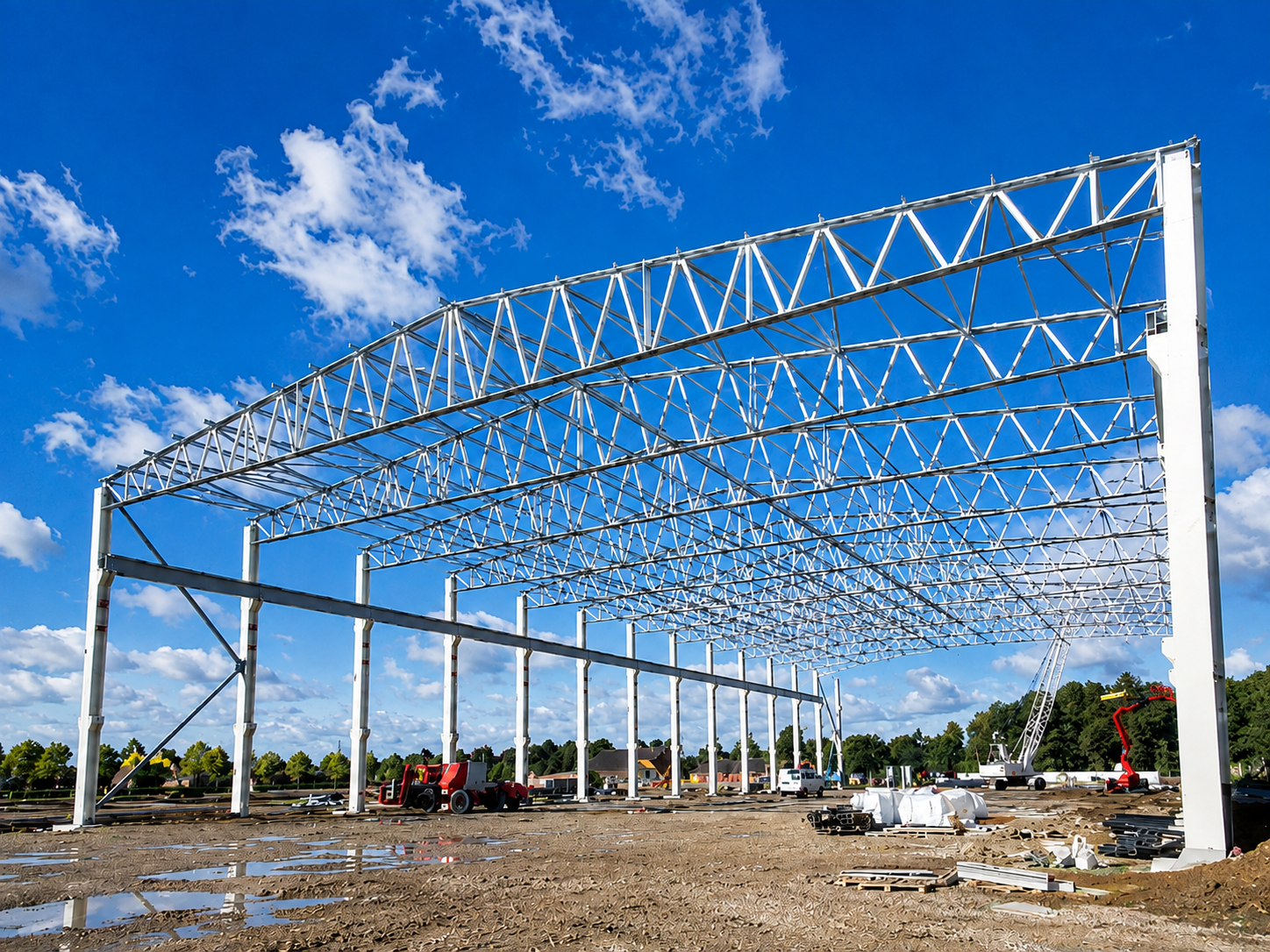
Steel trusses are fabricated structural frameworks in which top chords, bottom chords and internal web members form a connected series of triangular or project-specific panels. Roof, cladding, suspended-service and maintenance loads enter the truss through its panel points and are transferred through the members primarily as axial tension and compression before reaching the columns, walls or main supporting frame.
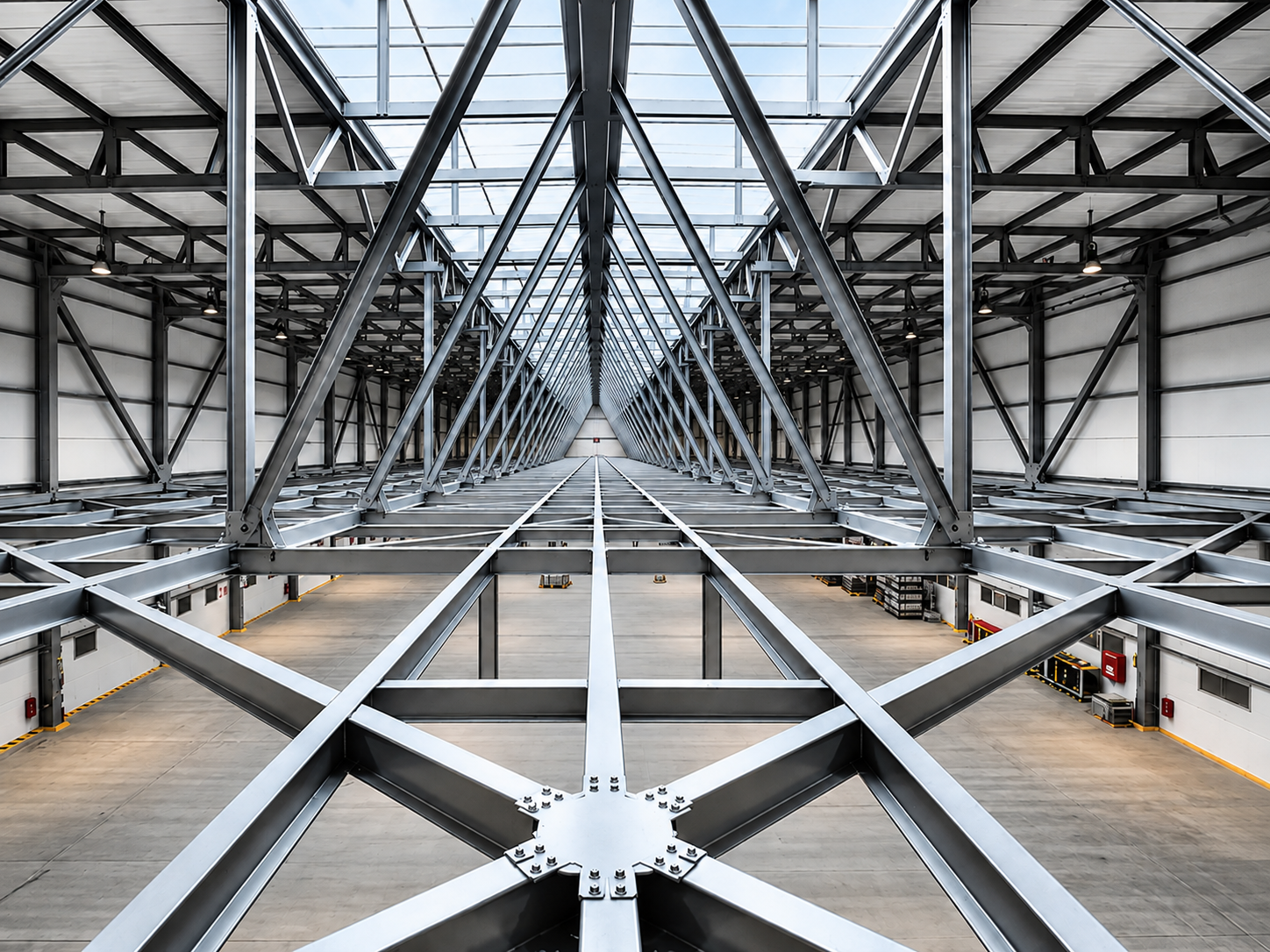
This load path allows structural steel trusses to cover large areas with fewer intermediate columns than a conventional closely supported framing arrangement. The open space between web members can also accommodate ducts, cable trays, sprinkler lines and other building services when those interfaces are included in the approved structural design. Industrial steel trusses are therefore used in factories, warehouses, logistics buildings, aircraft hangars, terminals, sports facilities and other structures requiring unobstructed internal space.
A steel truss is not selected by span or external shape alone. Its geometry depends on the support arrangement, roof profile, truss depth, panel spacing, permanent and imposed loads, wind or snow requirements, suspended equipment, member restraint, transport limits and erection sequence. Octal Steel supplies fabricated steel trusses according to approved structural drawings, truss schedules, material specifications and connection details. The supply scope can include chord and web members, gusset plates, bearing assemblies, field splices, secondary attachments, surface protection, assembly marking and export packing.
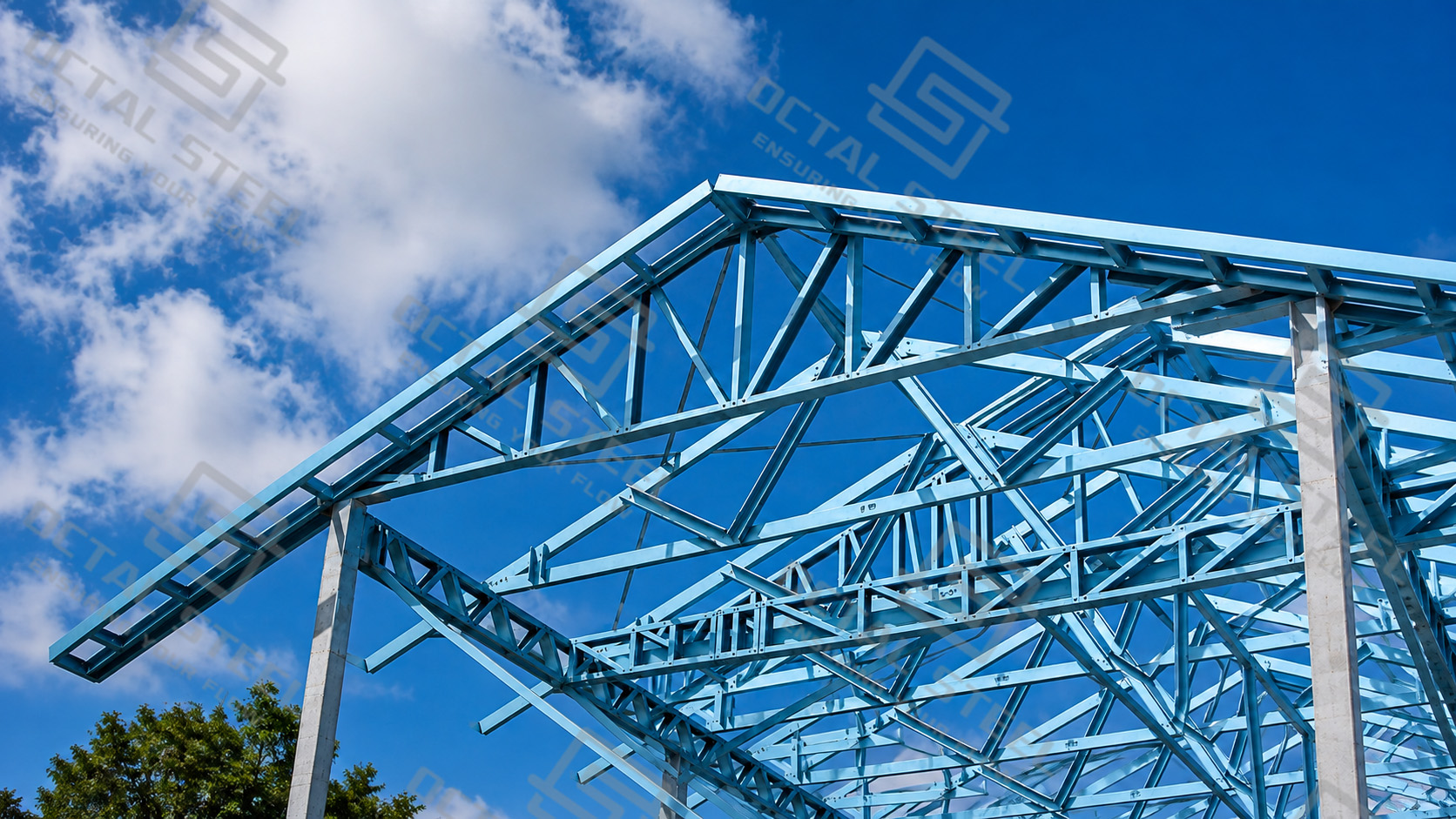
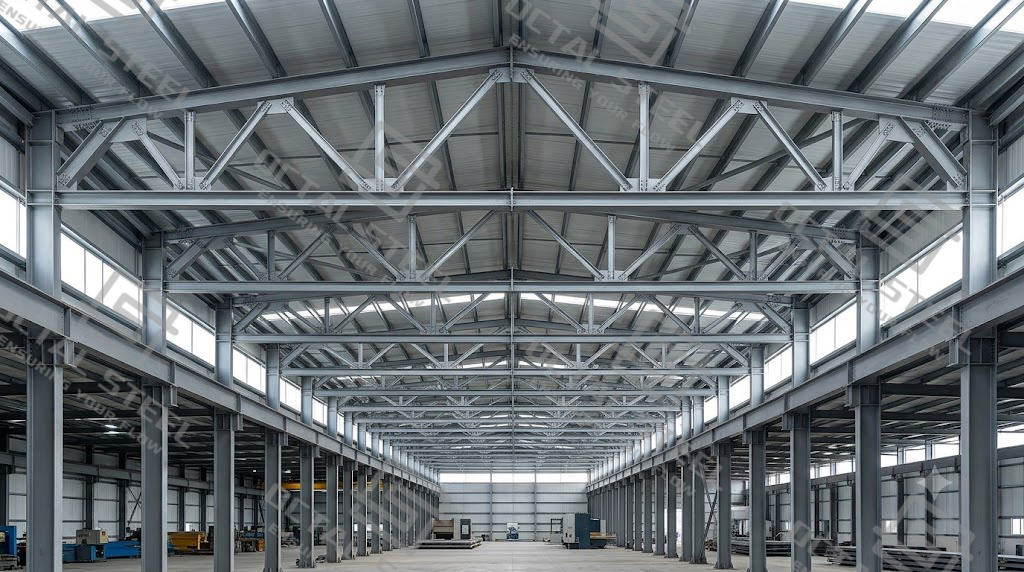
Steel Truss Supply Range
| Product Item | Available Scope |
|---|---|
| Truss Configurations | Pratt, Warren, pitched, trapezoidal, parallel-chord, north-light, tubular and project-specific structural steel trusses |
| Member Sections | Angles, channels, T-sections, rolled H or I sections, fabricated sections, rectangular hollow sections, square hollow sections and circular hollow sections |
| Main Components | Top chords, bottom chords, vertical and diagonal web members, gusset plates, bearing plates, stiffeners, splice plates and bracing interfaces |
| Material Specifications | Project-specified structural steel grades compatible with the selected plate, rolled-section or hollow-section product standard |
| Connection Forms | Welded gusset-plate nodes, directly welded tubular nodes, bolted panel-point connections and combined shop-welded/site-bolted assemblies |
| Fabrication | Material cutting, end profiling, drilling, edge preparation, jig assembly, welding, straightening, cambering and trial fit-up |
| Surface Condition | Mill finish, blasted, shop-primed, multi-layer coated or galvanized where technically suitable |
| Inspection | Material verification, dimensional inspection, weld inspection, specified NDT, trial-assembly review and piece-mark verification |
| Delivery Form | Complete trusses, transportable truss segments or component assemblies prepared for controlled site erection |
| Packing | Timber-supported bundles, transport frames or individually secured members with visible piece and assembly marks |
The final supply combination is defined by the approved project documents. Substituting a tubular member for an angle, changing a welded node to a bolted connection or dividing a truss into additional transport segments can alter member forces, connection eccentricity and erection behavior. Such changes require engineering review before material release or fabrication.
How a Steel Truss Transfers Loads
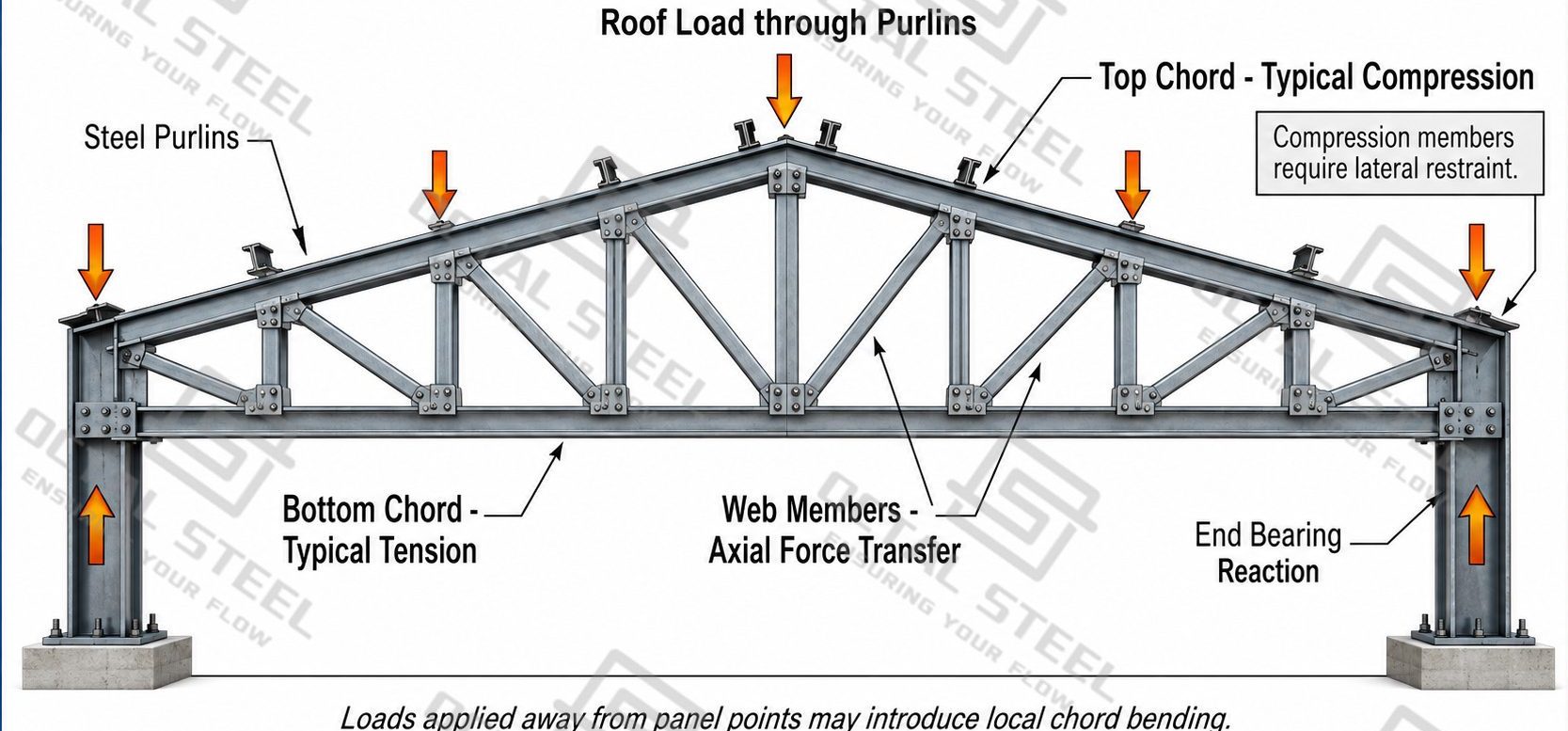
Under a typical downward roof-loading condition, the top chord of a simply supported steel roof truss generally works in compression while the bottom chord generally works in tension. Vertical and diagonal web members transfer the shear between the chords as axial forces. The resulting forces travel through the end nodes and bearing assemblies into the columns or supporting frame.
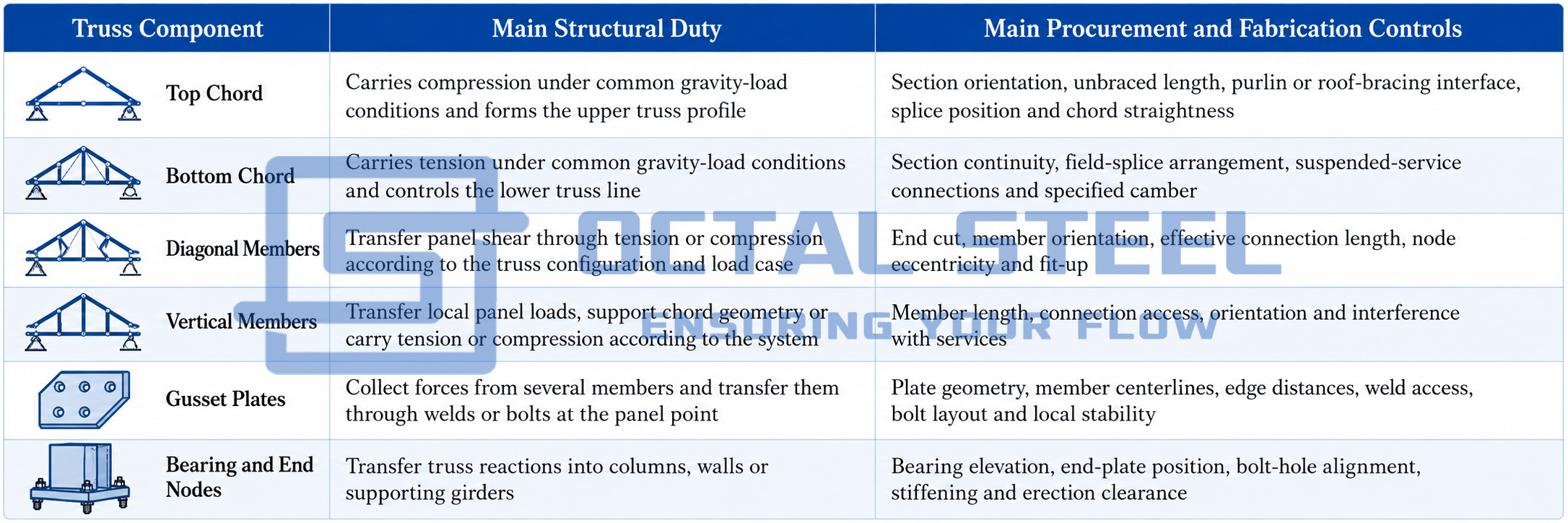
This simplified load path explains the material efficiency of a truss, but a fabricated structure is not a perfect pin-jointed model. Welded nodes, gusset-plate stiffness, connection eccentricity, chord continuity and loads applied away from the panel points can introduce secondary bending. Compression members also require adequate restraint because their capacity can be controlled by in-plane or out-of-plane buckling rather than material strength alone.
Types of Steel Trusses and Selection
Steel truss types are distinguished by chord profile and web-member arrangement. The configuration affects force direction, connection count, fabrication access, usable roof space and the location of site splices. A type name is useful during early discussion, but the final product must be identified by approved geometry and member schedules rather than by the type name alone.
| Steel Truss Type | Structural Arrangement | Industrial Use and Main Selection Controls |
|---|---|---|
| Pratt Steel Truss | Diagonals generally slope toward the centre of the span, with vertical members dividing the panels. | Used for gravity-dominated roofs, industrial buildings and other long-span structures. Selection depends on panel loads, compression-member restraint, roof profile and connection geometry. |
| Warren Steel Truss | Repeating triangular panels with alternating diagonals; vertical members may be added where loads enter the chord. | Provides regular geometry and repeated panel details. Local point loads must align with suitable panel points or be addressed by the approved design. |
| Pitched or Trapezoidal Roof Truss | Sloping top chord with a horizontal, slightly sloped or shaped bottom chord. | Supports pitched industrial roofs while coordinating drainage, ridge height, building clearance, purlins and suspended services. |
| Parallel-Chord Steel Truss | Top and bottom chords remain parallel across the span. | Used in flat or low-slope roofs, equipment-support structures and locations where a uniform structural depth is required. |
| North-Light Truss | Asymmetrical or repeated saw-tooth roof profile designed around roof-light orientation and drainage. | Used in production buildings requiring controlled natural lighting. Roof glazing, drainage, wind action and repeating bay geometry must be coordinated together. |
| Tubular or Pipe Truss | Chords and web members use CHS, RHS or SHS sections with directly welded or plated nodes. | Provides clean exposed geometry and reduced external crevice areas, but requires accurate member profiling, node welding and control of chord-wall deformation. |
Truss selection depends on span, roof profile, gravity and uplift loads, suspended equipment, lateral restraint and erection requirements. After the truss configuration is confirmed, the chord sections, web members and connection details must be coordinated as one structural system.
Chord, Web Member and Connection Details
Structural steel truss members may be produced from open sections or hollow sections. Angles, channels and T-sections provide accessible surfaces for gusset plates and bolted or welded connections. HSS, RHS, SHS and CHS members create a cleaner external profile and can provide useful resistance in more than one direction, but the node requires accurate end profiling and controlled welding to the chord wall.
Member selection cannot be separated from connection design. A web member may have sufficient axial capacity but still be unsuitable when the available face cannot accommodate the required weld length, bolt group or gusset-plate geometry. The connection may also move the member force away from the intended centreline and introduce local bending. For this reason, chord sizes, web sections, node plates and weld details must be reviewed as one assembly rather than purchased as unrelated steel items.
Gusset-Plate Connections
Open-section trusses commonly use gusset plates at the panel points. Diagonals and verticals connect to the plate, while the plate connects to the chord through welds, bolts or a combined arrangement. Fabrication control includes the intersection of member centrelines, plate orientation, weld access, bolt-hole edge distance and the unsupported plate area between connected members.
Welded Tubular Nodes
In tubular steel trusses, profiled web members may be welded directly to the chord to form T, K, X or combined node arrangements. The end profile must match the chord surface closely enough to maintain the specified joint geometry and welding access. Chord-wall thickness, member angle, gap, weld sequence and local deformation are controlled by the approved node drawing.
Transport and Erection Splices
Long-span steel trusses are frequently divided into sections that can be transported, lifted and assembled safely. A field splice may use bolted chord plates, bolted gusset assemblies, welded joints or a combination of shop-welded and site-bolted details. The splice position is selected as part of the structural and erection plan; it should not be moved merely to simplify packing.
Download:Steel Truss Types and Connection Selection Guide
Steel Truss Fabrication
Steel truss fabrication begins by converting the approved general-arrangement and shop drawings into identifiable chord sections, web members, plates and connection components. Material identity must remain linked to the individual parts while they are cut, drilled and prepared for assembly.
- Material preparation and profiling: Rolled sections, plates and hollow sections are cut to their finished or assembly lengths. Web-member ends are coped, mitred or profiled to match the gusset plate or chord surface. Bolt holes and splice details are produced according to the final connection drawings.
- Jig assembly and dimensional setting: Chords are positioned to the required span, depth and profile before the web members are installed. Assembly jigs control the panel-point positions, member centrelines and overall truss geometry. This stage is especially important where several identical trusses must fit the same column and purlin grid.
- Welding sequence and distortion control: Members are tack-assembled and checked before final welding. The welding sequence must control shrinkage, chord curvature, node rotation and out-of-plane distortion. Welding procedures, welder qualifications, inspection and acceptance requirements follow the code and project specification stated in the contract documents.
- Camber and final geometry: Specified upward camber is distinguished from unintended sweep, twist or local distortion. The completed truss is checked for span, depth, panel dimensions, bearing elevation, chord alignment and splice geometry.
- Trial fit-up and release marking: Large connections, transport splices or repeated truss assemblies may be trial-fitted before surface treatment. Matching components are then assigned consistent piece marks and orientation marks so that the same identity can be followed through inspection, packing and site assembly.
Steel trusses must be welded and inspected according to the standards specified in the project documents. Before fabrication begins, the welding method, welder qualifications, inspection scope and acceptance requirements must be confirmed.
Industrial Applications of Steel Trusses
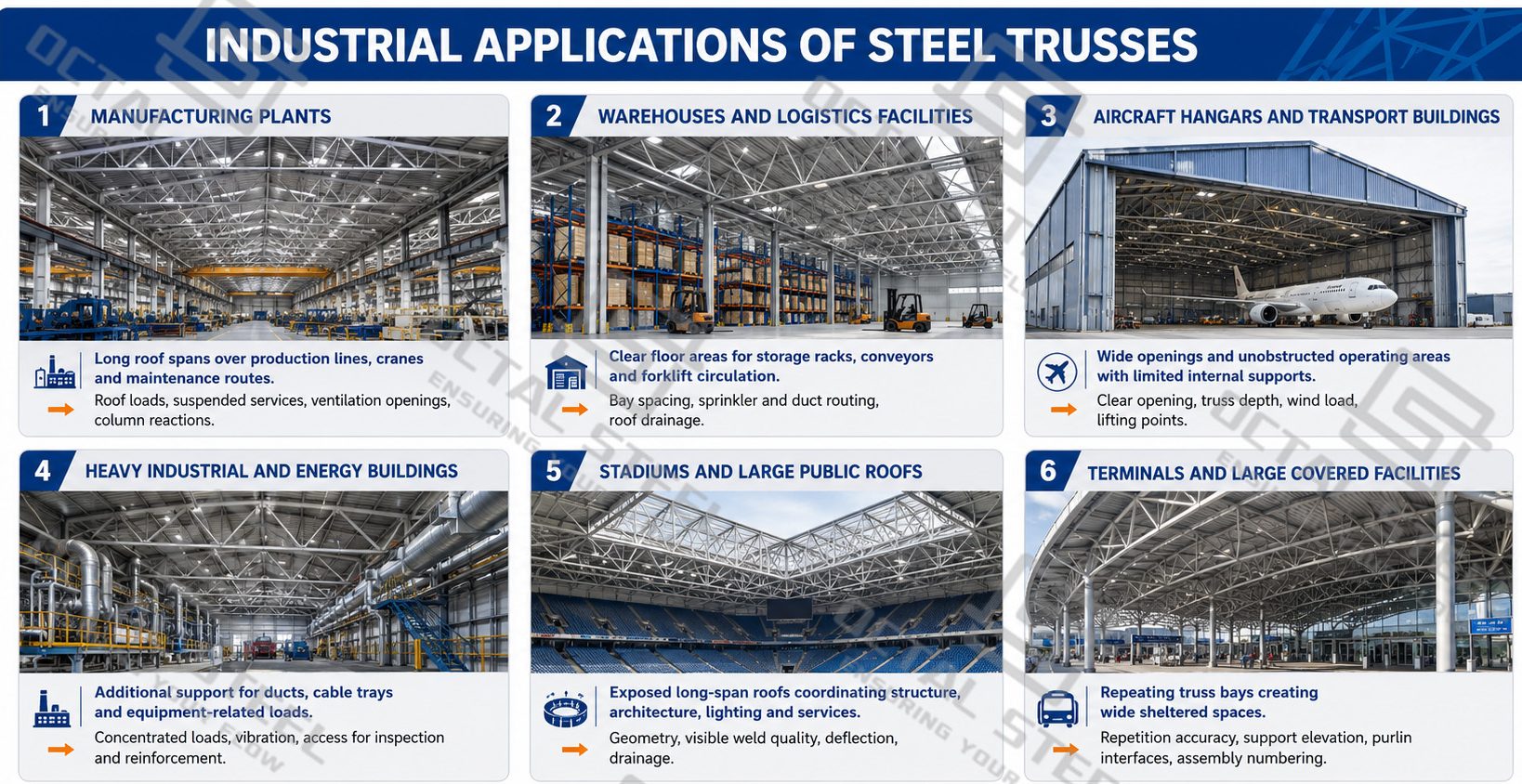
These applications require more than a general “long-span” description. The truss must be coordinated with roof cladding, purlins, lateral bracing, columns, suspended systems and the intended construction sequence. Industrial guides consistently identify factories, warehouses, hangars, terminals and sports buildings as major steel roof truss applications, but the final configuration remains project-specific.
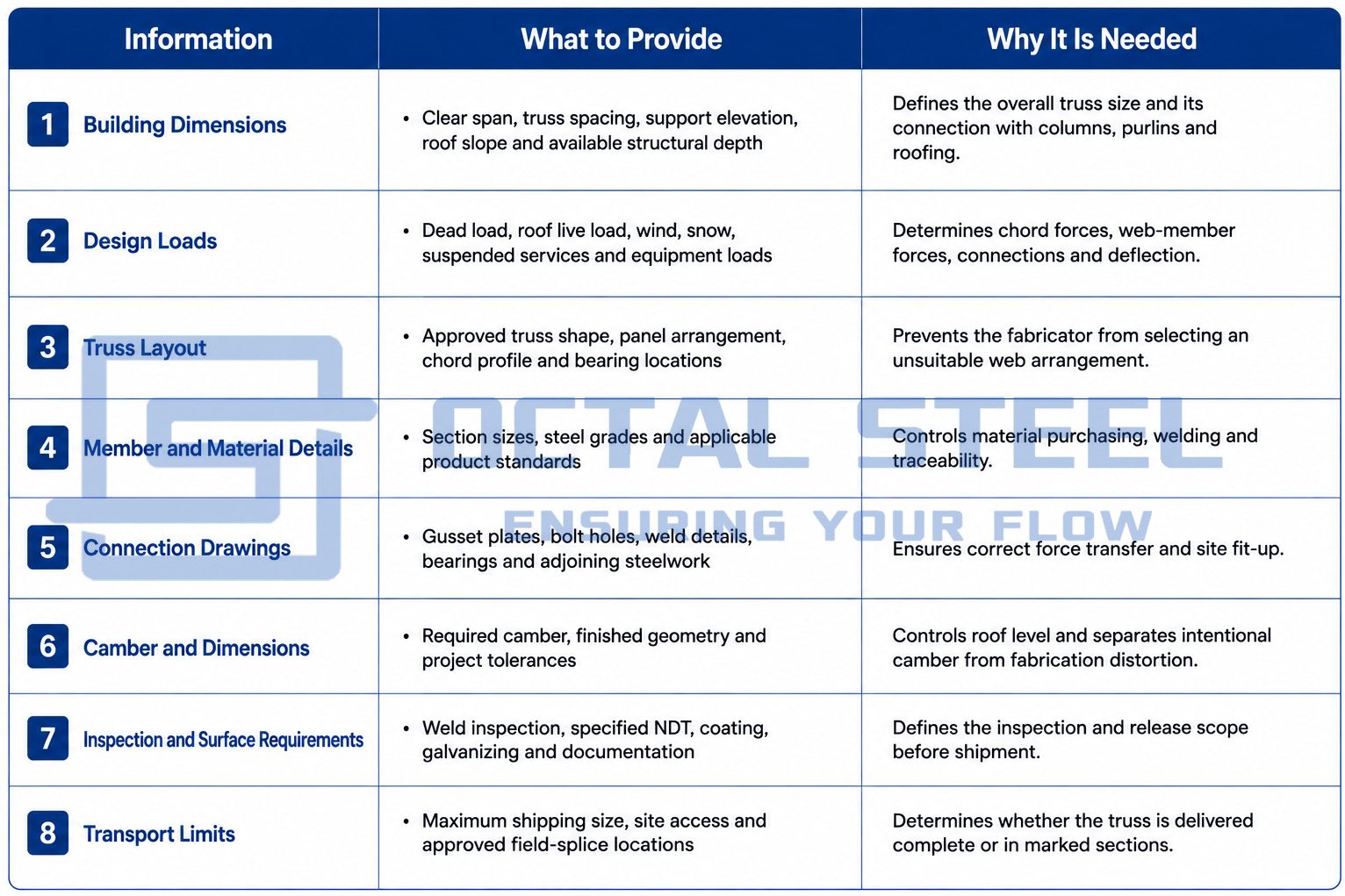
Inspection verifies the complete assembly against the approved truss drawings rather than checking only the material grade or nominal span.
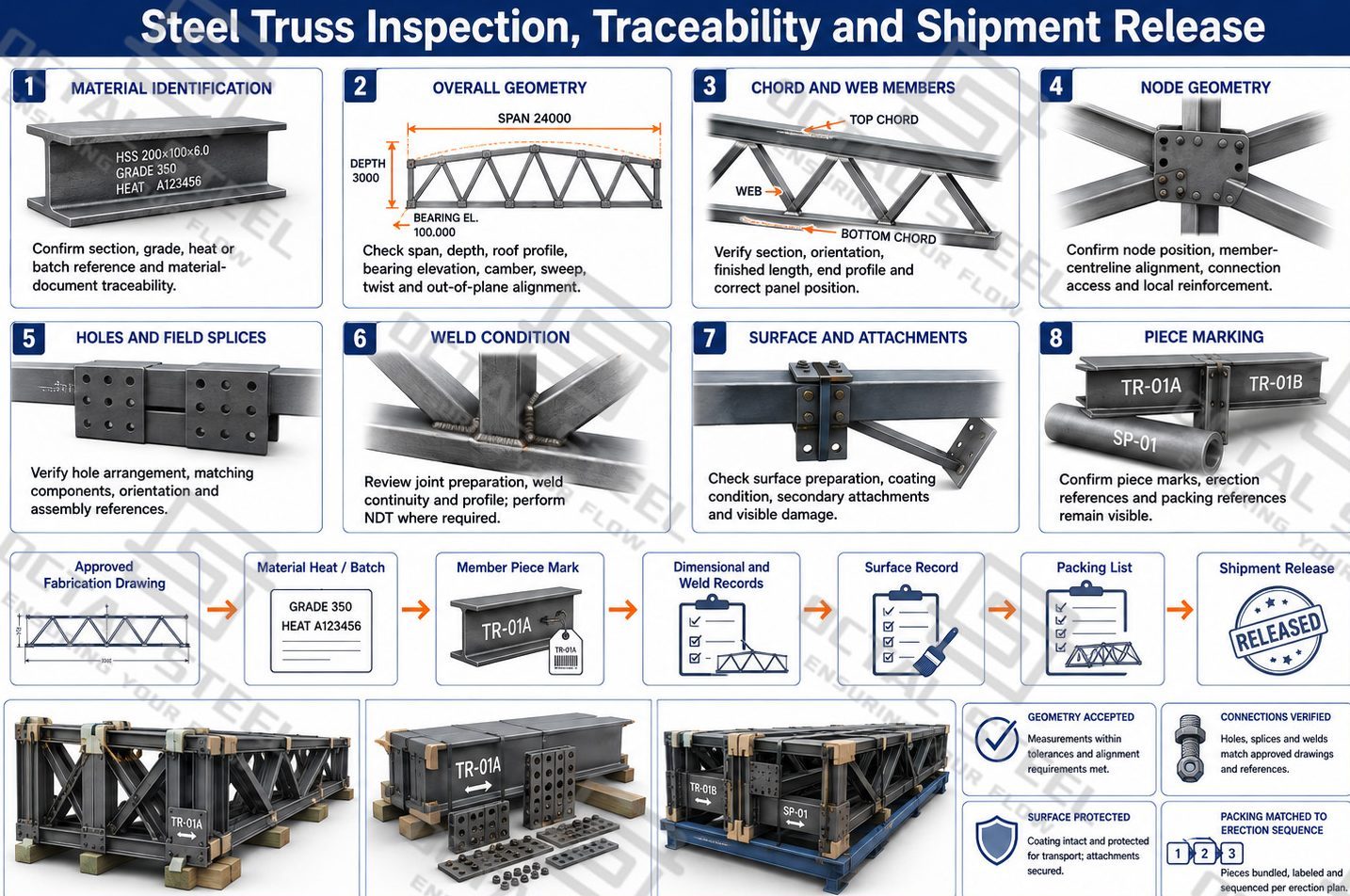
The release documents may include material certificates, dimensional reports, welding records, NDT reports, coating inspection records, trial-fit records, piece-mark schedules and packing lists. A structurally correct truss can still cause site delay if a field splice is reversed, holes do not align, bearing elevations differ or the assembly marks do not correspond with the erection drawing.
Surface Protection and Shipment
Surface protection is selected according to atmospheric exposure, moisture, chemicals, marine influence, maintenance access and the required service life. Fabricated steel trusses may be supplied with a blasted surface, shop primer, multi-layer coating or hot-dip galvanizing where the member and connection design permit it.
Trusses contain more nodes, overlapping plates and member intersections than ordinary straight beams. Coating access, water traps, back-to-back sections and field-splice areas therefore need specific attention. Where hollow members are galvanized, vent and drain details must be incorporated before fabrication and coordinated with the approved galvanizing procedure.
Large steel roof trusses may be shipped as complete assemblies or as marked transport segments. Members are supported to prevent local distortion, rubbing damage and uncontrolled movement during transport. Splice plates, bolts and smaller components are grouped with the correct truss marks, while the packing list identifies the delivery and erection sequence.
Where fire resistance is required, the truss must be incorporated into an approved fire-protection system. Ordinary structural steel should not be described as inherently fireproof.
Download:Steel_Truss_Fabrication_Inspection_and_Shipment.pdf
Steel Truss Supply from Octal
Octal supplies industrial and structural steel trusses as part of a coordinated structural steel package. Chord and web sections, gusset plates, bearings, field splices, secondary connections and surface requirements can be reviewed against the same approved drawing set, reducing the risk that separately procured components arrive with incompatible geometry.
Before production, Octal reviews the truss configuration, material schedule, node details, adjoining column and purlin interfaces, transport limits and inspection scope. Fabrication may include member profiling, drilling, jig assembly, controlled welding, cambering, trial fit-up, surface treatment and assembly marking. Each delivered truss or truss segment can be linked to its fabrication drawing, material documents, inspection records, piece mark and packing-list reference, supporting traceability and installation-sequence control.
FAQ
Q: What information is required for a steel truss quotation?
A: Provide the structural drawings, clear span, truss spacing, roof profile, load schedule, member and material specifications, connection details, camber, inspection scope, surface protection, transport limits and delivery destination.
Q: Can long-span steel trusses be delivered in several sections?
A: Yes. Large trusses may be divided at engineered field splices to meet transport, lifting and site-access limits. Splice positions and connection details must be approved before fabrication.
Q: Which sections can be used for structural steel trusses?
A: Chords and web members may use angles, channels, T-sections, rolled or fabricated sections, RHS, SHS or CHS. Selection depends on member force, buckling restraint, node geometry, welding access and the applicable project design.
Q: How are matching truss components identified for erection?
A: Chords, web assemblies, splice plates and connection parts use coordinated piece marks and orientation marks that correspond with the fabrication drawings, inspection records and packing list.