Your Responsible Supplier Partner for Oil and Gas Products.

Distribution Transformers
Recent Products


Rencent Articles






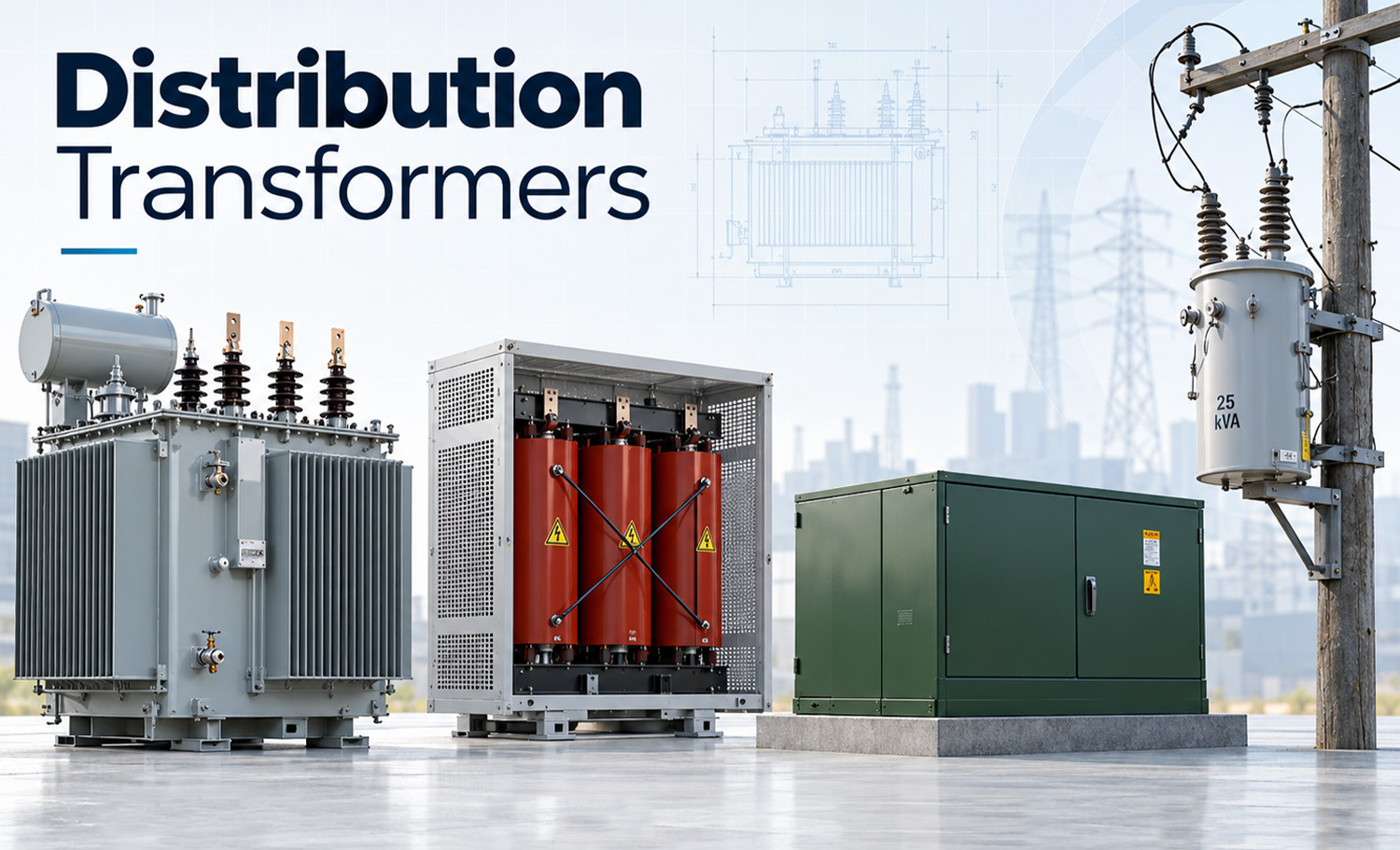
Distribution Transformers
Product Types: Oil Immersed / Dry Type / Pad Mounted / Pole Mounted
Rated Capacity: 5–2,500 kVA, depending on transformer type
Phase: Single-phase / Three-phase
Voltage: Primary and secondary ratings available for different distribution systems
Insulation: Mineral Oil / Ester Fluid / Cast Resin / VPI
Cooling: ONAN / AN / AF, as applicable
Distribution transformers reduce medium-voltage electricity to levels suitable for buildings, industrial equipment and local distribution networks. The required capacity, voltage ratio, insulation system and cooling arrangement depend on the electrical load and the conditions at the installation site.
Four common configurations are oil immersed, dry type, pad mounted and pole mounted transformers. Oil immersed and dry type transformers differ in their insulation construction, while pad mounted and pole mounted units are designed for different installation environments. The categories can overlap, as pad mounted and pole mounted transformers often use oil insulation.
Octal Steel covers all four types, with configurations for utility networks, commercial buildings and industrial facilities. Available options include different capacity ratings, voltage levels, cooling methods and protection arrangements to suit the intended distribution system.
Distribution Transformer Standards
Applicable transformer standards depend on the transformer type, voltage rating, installation arrangement and project requirements. The IEC 60076 series covers general power transformer requirements, while additional IEC and IEEE standards address specific transformer constructions, performance and testing.
The following standards are relevant to the four transformer types covered in this article.
| Standard | Scope |
|---|---|
| IEC 60076 series | General power transformer design, performance, insulation and testing requirements, as applicable. |
| IEC 60076-11 | Requirements for dry-type power transformers. |
| IEEE C57.12.00 | General requirements for liquid-immersed distribution, power and regulating transformers. |
| IEEE C57.12.90 | Test methods for liquid-immersed distribution and power transformers. |
| IEEE C57.12.01 | General requirements for dry-type distribution and power transformers. |
| IEEE C57.12.20-2023 | Overhead-type liquid-immersed distribution transformers rated up to 500 kVA, within the specified voltage limits. |
| IEEE C57.12.34-2022 | Three-phase, compartmental-type pad mounted transformers rated up to 10 MVA, within the specified voltage limits. |
| IEEE C57.12.38-2025 | Single-phase, compartmental-type pad mounted transformers rated up to 250 kVA, within the specified voltage limits. |
IEC 60076-11 applies specifically to dry-type transformers, while IEEE C57.12.20, C57.12.34 and C57.12.38 cover defined ranges of overhead-type or pad mounted distribution transformers. Their capacity and voltage limits apply to the equipment within each standard’s scope, not to every transformer of that type.
The applicable standards and editions should be confirmed against the project specification and local utility requirements. Voltage ratings, connection arrangements, enclosure design and factory testing must also meet the requirements agreed for the selected transformer.
Distribution Transformer Specifications
Distribution transformer specifications vary according to rated capacity, primary and secondary voltage, insulation construction and installation conditions. Oil immersed and dry type transformers differ in their insulation systems, while pad mounted and pole mounted transformers are designed for specific installation arrangements. The following table summarizes common configurations and the main specifications associated with each type.
| Parameter | Oil Immersed | Dry Type | Pad Mounted | Pole Mounted |
|---|---|---|---|---|
| Typical Capacity | 30–2,500 kVA | 100–2,500 kVA | 15–2,500 kVA | 5–315 kVA |
| Phase | Single-phase / Three-phase | Mainly three-phase | Single-phase / Three-phase | Single-phase / Three-phase |
| Insulation | Mineral oil / Ester fluid | Cast resin / VPI | Usually liquid-immersed | Usually liquid-immersed |
| Cooling | ONAN; other designs as specified | AN / AF | Usually ONAN | Usually ONAN |
| Installation | Indoor or outdoor, depending on design | Commonly indoor | Ground-mounted cabinet | Pole-mounted structure |
| Key Selection Factors | Losses, cooling, tank design | Insulation, ventilation, temperature rise | Feed arrangement, cabinet and protection | Primary winding voltage, mounting and protection |
The four transformer types are not entirely separate categories. Oil immersed and dry type refer to the insulation method, while pad mounted and pole mounted describe the installation arrangement. A pad-mounted or pole-mounted transformer may also use oil insulation. Capacity, voltage ratings and accessory requirements vary with the distribution network and the conditions at the installation site.
Oil Immersed Transformers
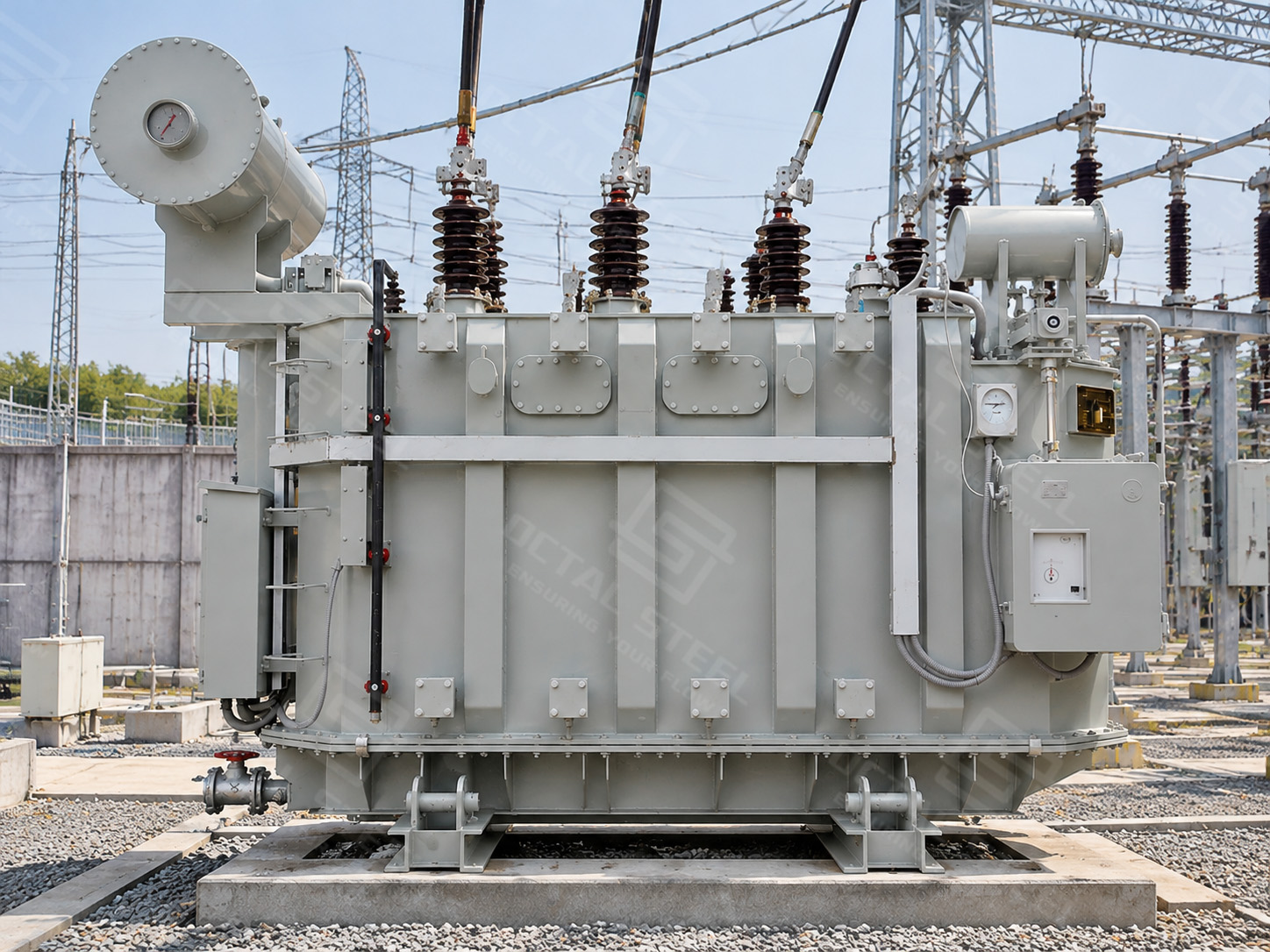
Oil immersed transformers use an insulating liquid around the core and windings to provide dielectric insulation and transfer heat to the tank and cooling surfaces. Mineral insulating oil is widely used, while natural ester fluids are available for designs where fire performance or environmental considerations influence the choice of insulating liquid.
The oil preservation system is an important part of the construction. Hermetically sealed designs isolate the insulating liquid from direct contact with ambient air, with expansion accommodated by the tank construction. Conservator designs use an expansion vessel above the main tank. The selected arrangement affects tank construction, monitoring accessories and maintenance requirements.
For conventional distribution applications, representative capacities range from 30 to 2,500 kVA, with common primary voltage options including 6, 6.3, 10, 10.5 and 11 kV and a typical low-voltage rating of 0.4 kV. Actual ratings, vector group, tap positions and insulation levels depend on the selected design. ONAN cooling is common, and copper or aluminium windings can be specified according to the required performance and budget.
Oil immersed transformers are widely used at outdoor distribution points, industrial facilities, commercial buildings and utility substations. Their thermal design supports a broad range of distribution duties, but the installation must provide suitable access for inspection and account for oil containment and local fire or environmental requirements.
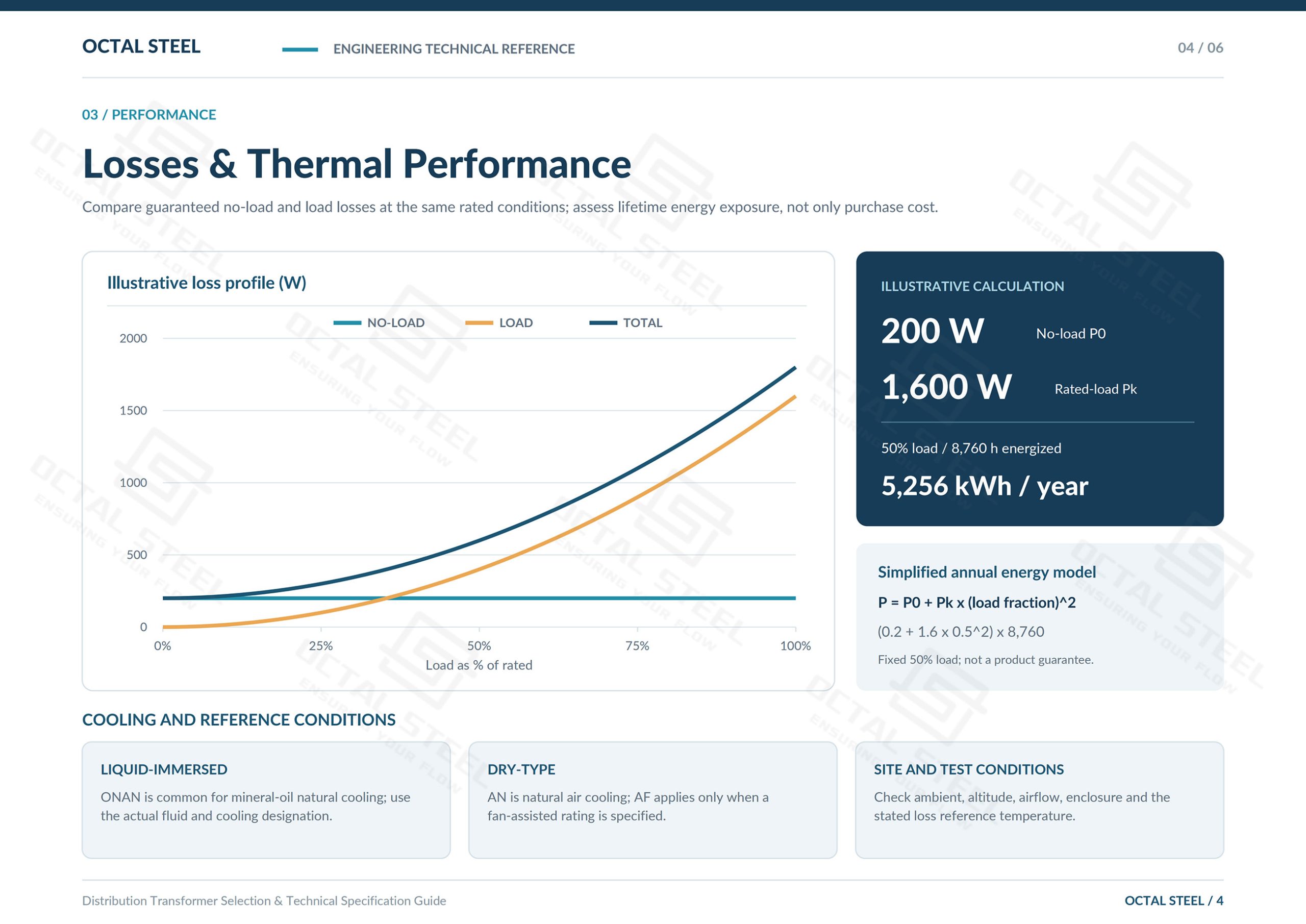
Electrical losses deserve particular attention when comparing models. No-load loss occurs whenever the transformer is energized, even if the connected load is low. Load loss increases with winding current. For equipment that remains energized throughout the year, the guaranteed no-load loss can therefore have a meaningful effect on operating costs.
For conventional small and medium distribution configurations, the indicative price range is USD 1,500–35,000 per unit. Final pricing depends on rated capacity, voltage class, winding material, guaranteed losses, tank construction, accessories and testing requirements. Larger power transformers and specially engineered designs require separate quotations.
Dry Type Transformers
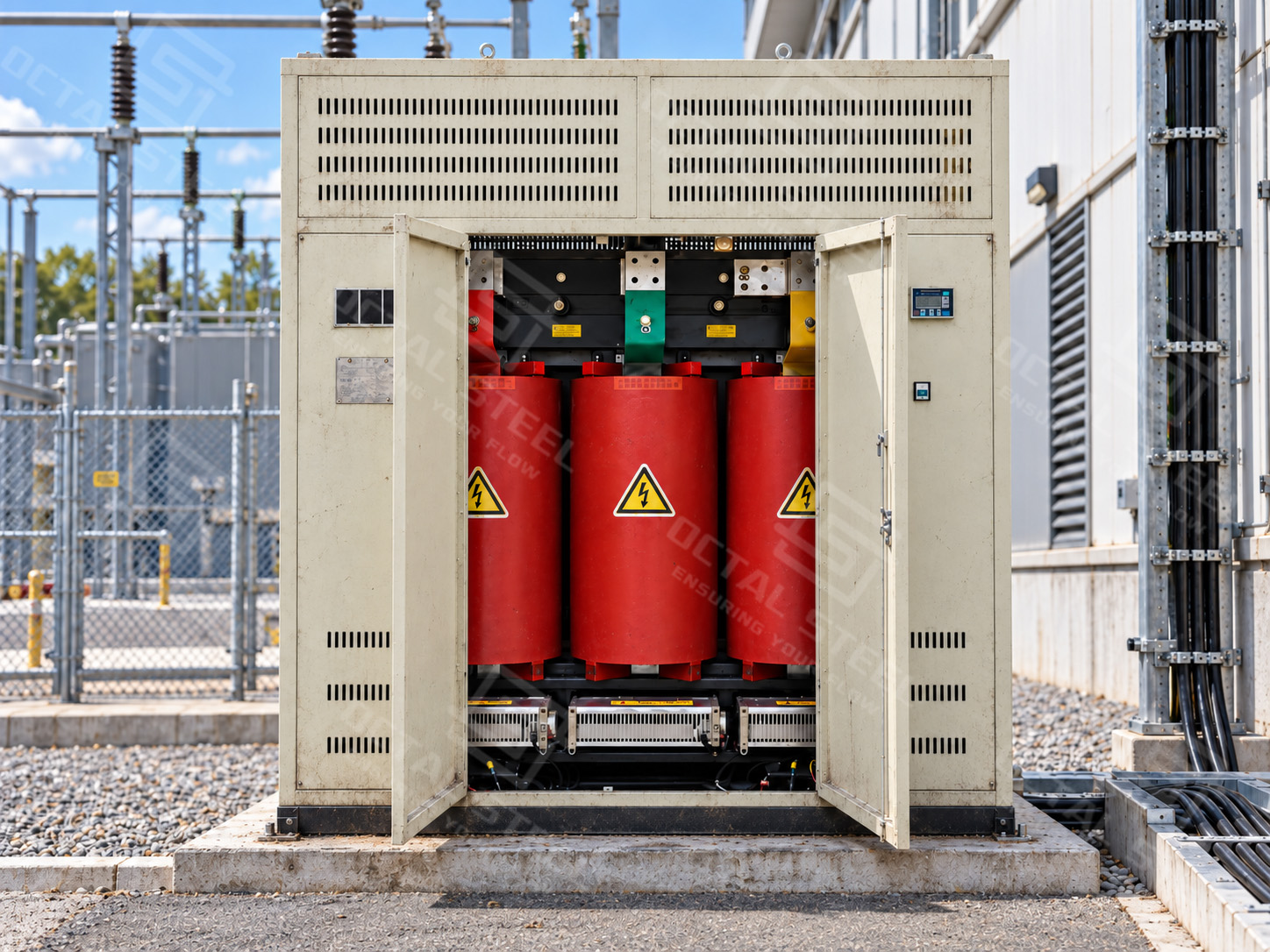
Dry type transformers use solid insulation systems rather than an insulating liquid. Two common constructions are cast resin and vacuum pressure impregnation (VPI), which differ in how the windings are insulated and protected.
In a cast resin transformer, specified windings are encapsulated in a cured resin system. VPI construction uses an insulating varnish or resin applied through a vacuum-pressure impregnation process, followed by curing. The suitability of either design depends on the operating environment, required insulation system, thermal performance and installation conditions.
Representative distribution configurations range from 100 to 2,500 kVA, with common medium-voltage primary ratings such as 6, 6.3, 6.6, 10 and 11 kV and a typical secondary rating of 0.4 kV. Three-phase construction is common. Cooling may be AN (natural air) or AF (forced air), where the additional forced-air rating is specifically designed and stated by the manufacturer.
Dry type transformers are frequently installed in commercial buildings, factories, electrical rooms and infrastructure facilities where liquid containment is undesirable or the project specification calls for a dry insulation system. They avoid insulating-oil leakage, but still require appropriate ventilation, clearances and environmental protection.
Ambient temperature, altitude, humidity, dust and enclosure design can all affect performance. For example, a transformer installed in a poorly ventilated electrical room may have less thermal margin than the same model operating in a well-ventilated space. Cast resin construction also does not eliminate the need for electrical inspection and maintenance.
The purchase price depends on capacity, winding material, insulation construction, losses, enclosure and cooling arrangement. For conventional small and medium distribution configurations, an indicative price range is USD 3,000–35,000 per unit. Larger ratings, special low-loss requirements, higher voltage classes and customized enclosures may fall outside this range.
Pad Mounted Transformers
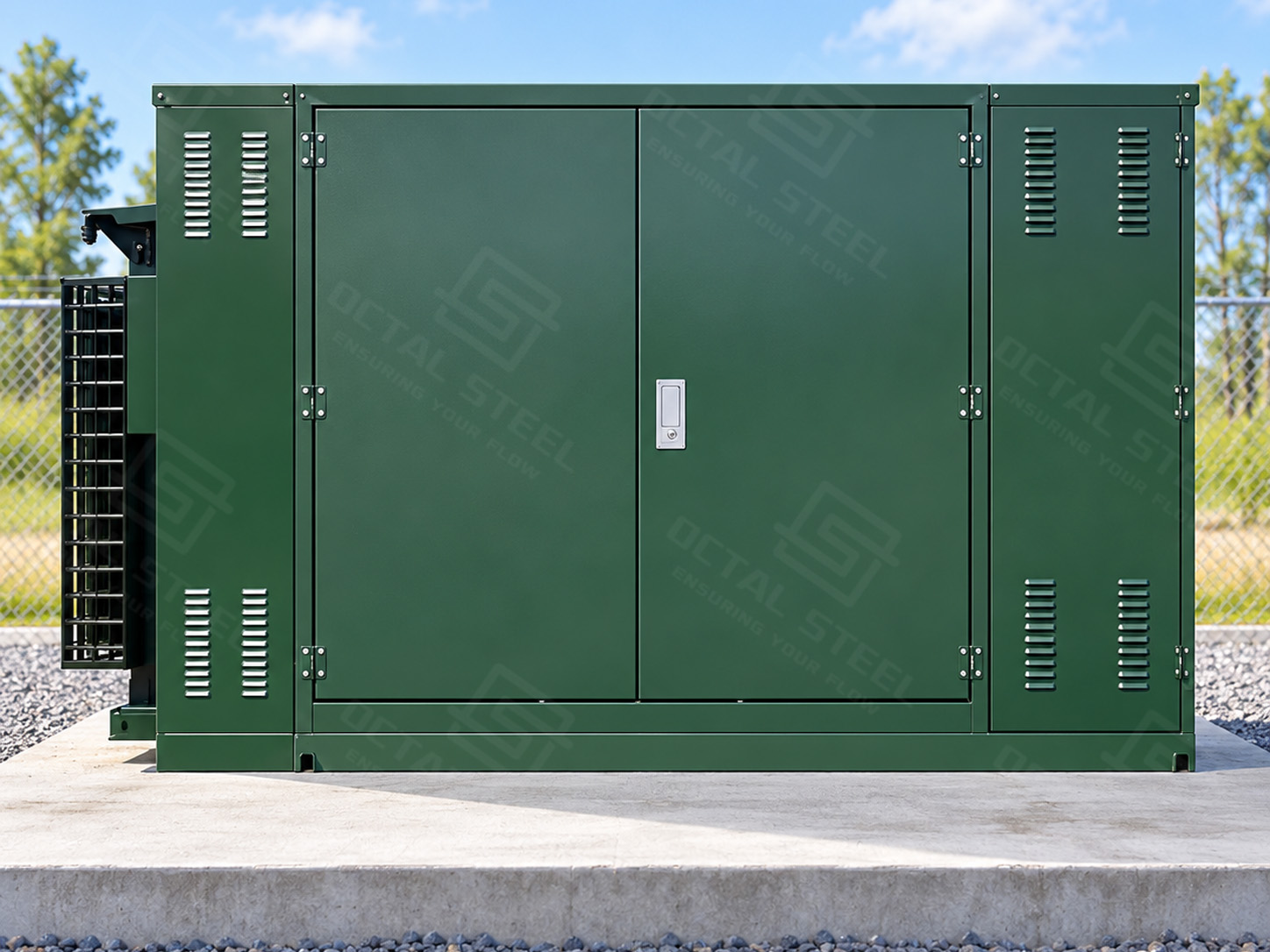
Pad mounted transformers are installed on a concrete foundation and enclosed in a grounded metal cabinet. They are commonly used in underground distribution networks, where medium-voltage cables enter the transformer compartment and low-voltage connections supply nearby buildings or facilities.
The compartmental arrangement separates the high-voltage and low-voltage connection areas. Depending on the design, the cabinet may include separable insulated connectors, bushings, loadbreak switches, fuses, surge arresters and monitoring devices. The actual accessories depend on the electrical arrangement and protection scheme.
Two important configuration choices are radial feed and loop feed. A radial-feed unit has one incoming primary circuit. A loop-feed unit provides incoming and outgoing cable connection points, allowing it to form part of a loop distribution network. The choice affects cable terminations, switching arrangements and network operation.
High-voltage construction can also be dead-front or live-front. Dead-front designs use insulated separable connectors to reduce exposed energized parts within the accessible high-voltage compartment. Live-front arrangements use a different connection design and must be selected according to the applicable utility and installation requirements.
Representative capacity ranges are 15–250 kVA for single-phase units and 75–2,500 kVA for three-phase units. Common primary voltage options include 4.16, 12.47, 13.2, 13.8, 24.94 and 34.5 kV. Secondary configurations may include 120/240 V, 208Y/120 V, 480Y/277 V and 600Y/347 V, depending on the selected design and destination market.
Most conventional units use liquid insulation and natural cooling. Mineral oil is common, while ester fluids can be specified for applicable designs. The cabinet, foundation, cable bending radius and access for operation and maintenance must all fit the installation layout.
Pad mounted transformers are particularly suitable for residential developments, commercial campuses, industrial facilities and underground utility networks. The enclosure provides a compact, ground-level installation, but its dimensions and compartment arrangement must be coordinated with the site before the foundation and cable interfaces are finalized.
For conventional distribution configurations, the indicative price range is USD 3,000–80,000 per unit. The wide range reflects differences in capacity, voltage rating, switching and protection equipment, enclosure construction, winding material and inspection scope. Large-capacity units and projects with extensive switching or utility-specific requirements may need separate quotations.
Pole Mounted Transformers
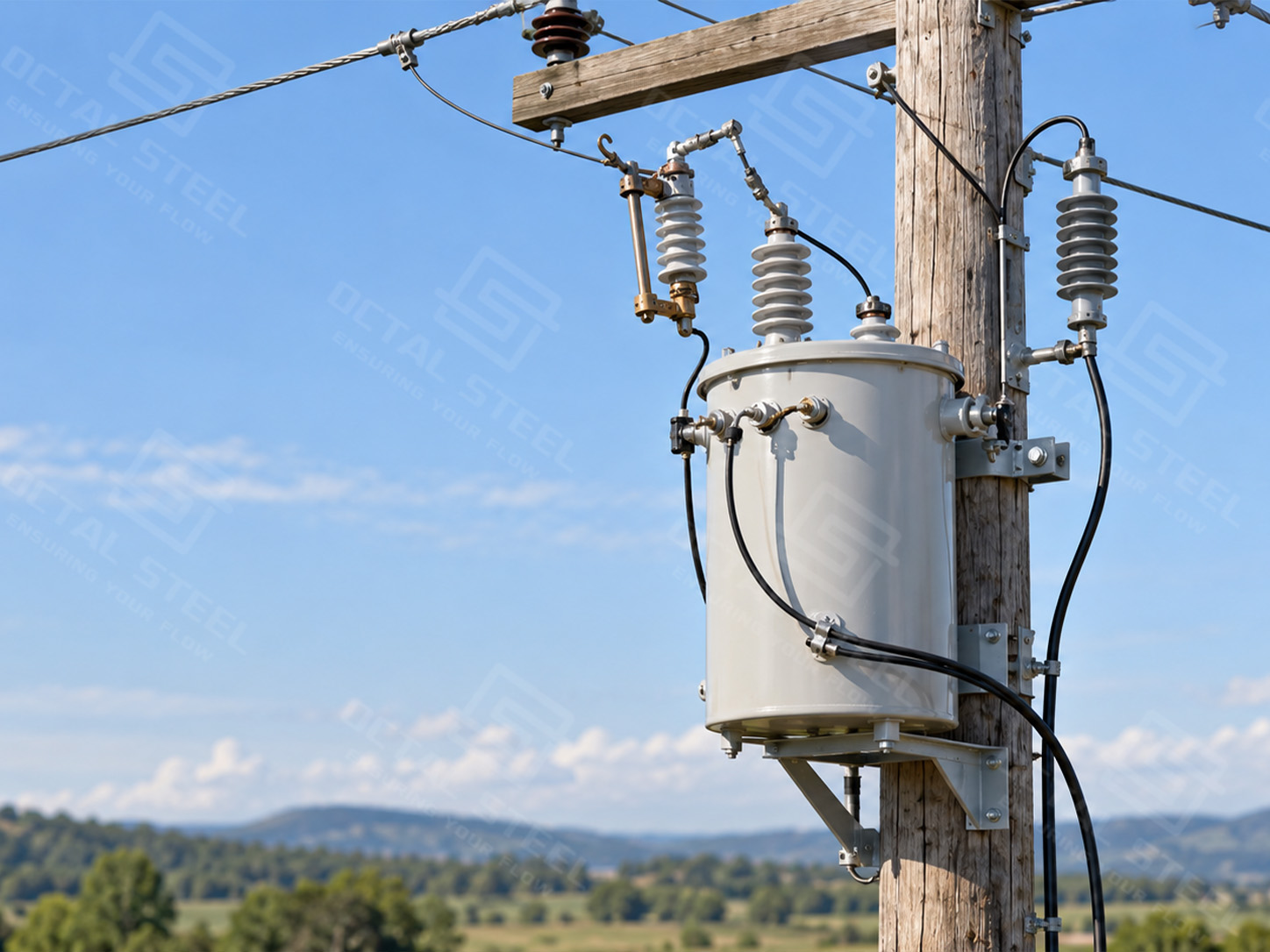
Pole mounted transformers are installed on utility poles or supporting structures and are commonly connected to overhead distribution lines. They are widely used for residential distribution, rural electrification, agricultural pumping and smaller commercial loads where an overhead network is the established supply arrangement.
Both single-phase and three-phase designs are available. Representative ratings range from 5 to 167 kVA for single-phase units and 30 to 315 kVA for three-phase units. Common primary voltage options include 2.4, 4.16, 7.2, 12.47, 13.2, 13.8, 24.94 and 34.5 kV, subject to the selected winding arrangement and system requirements. Secondary ratings may include 120/240 V, 240/480 V, 208Y/120 V, 480Y/277 V and 400/230 V.
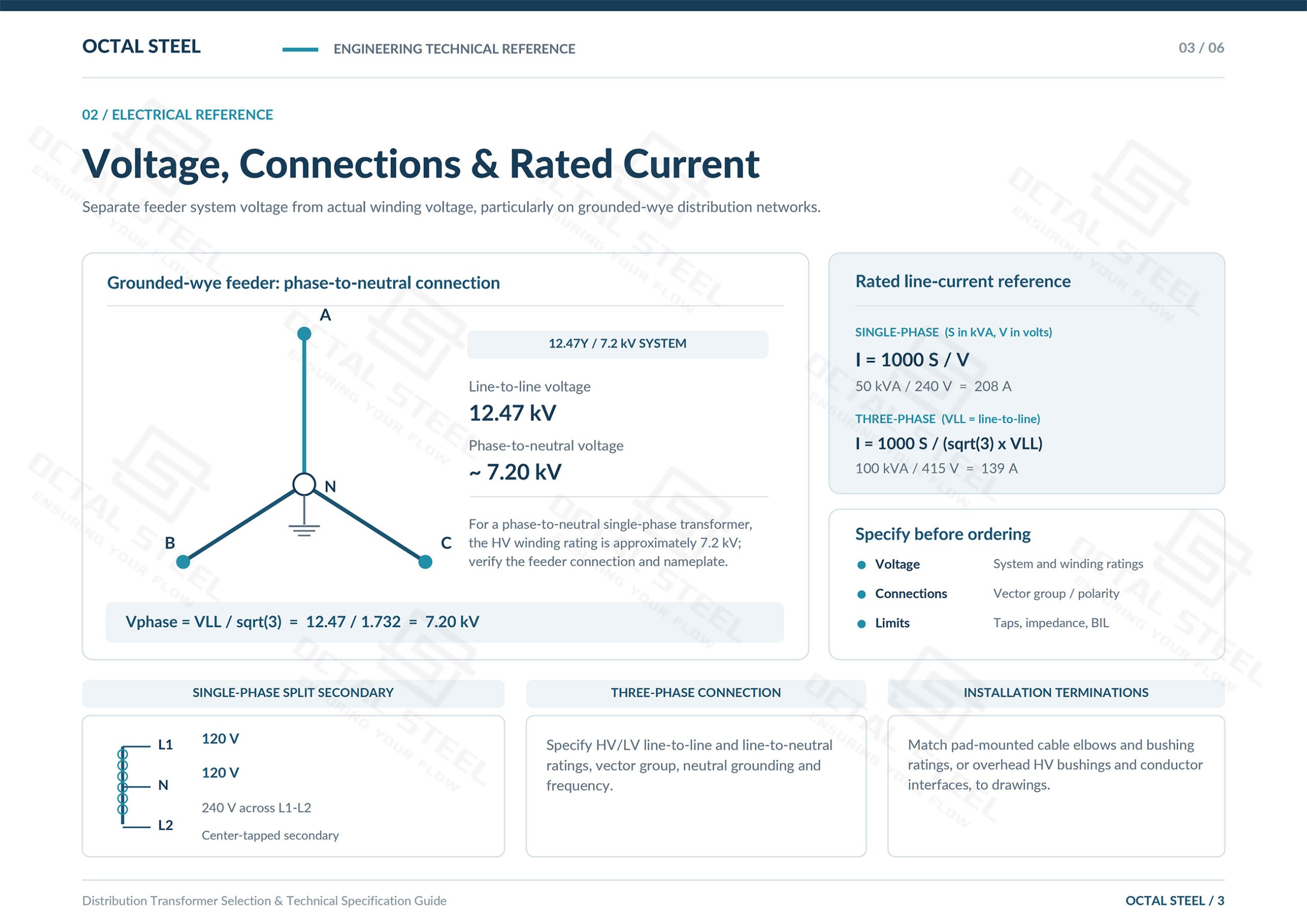
A critical point in North American grounded-wye systems is the difference between line-to-line system voltage and phase-to-neutral winding voltage. For example, a 12.47Y/7.2 kV distribution system has approximately 7.2 kV between one phase conductor and neutral. A single-phase transformer connected phase-to-neutral must have the appropriate primary winding rating; the feeder’s 12.47 kV line-to-line designation does not mean that 12.47 kV is applied across that winding.
Protection can be conventional or completely self-protected (CSP), depending on the model. Conventional arrangements may use separately installed fuse cutouts and surge arresters. Selected CSP designs integrate specified protective functions, which may include an internal primary fuse and a low-voltage circuit breaker. The exact arrangement must match the transformer design and the distribution system’s protection coordination.
Installation requirements are also important. Pole loading, mounting brackets, crossarm or platform arrangement, conductor clearances, lifting provisions and access for replacement all affect whether the selected unit can be installed as planned. For replacement projects, existing pole hardware and conductor connections may need to be checked alongside the electrical ratings.
For standard pole mounted distribution configurations, indicative prices generally range from USD 800–5,000 per unit. Higher-capacity three-phase models, specialized protection packages, higher voltage ratings and customized utility requirements may exceed this range.
How to Choose the Right Distribution Transformer
Choosing a distribution transformer involves more than matching the rated kVA. The insulation system, available installation space, cable arrangement and operating conditions all influence which configuration is appropriate for the project.
| Project Requirement | Suitable Configuration to Consider | Main Technical Considerations |
|---|---|---|
| Indoor electrical room or building distribution | Dry type | Insulation construction, ventilation, temperature rise, enclosure and fire requirements |
| Outdoor distribution point with liquid insulation | Oil immersed | Cooling, insulating liquid, tank design, losses and maintenance access |
| Underground primary cables and a ground-level cabinet | Pad mounted | Radial or loop feed, dead-front or live-front design, cabinet layout and cable interfaces |
| Overhead distribution in rural or residential networks | Pole mounted | Primary winding voltage, single-phase or three-phase design, pole loading and protection |
| Industrial loads with high continuous demand | Capacity and construction selected from the actual duty | Maximum demand, load profile, starting current, losses and future expansion |
Detailed electrical ratings, installation interfaces and specification requirements are covered in the Distribution Transformer Selection & Technical Specification Guide (PDF).
Rated Capacity and Load Profile
Rated capacity should be based on the expected maximum demand, load diversity and operating pattern. Motor loads may require additional consideration during starting, while facilities with substantial nonlinear loads may need a specific assessment of harmonics and additional heating.
A transformer selected too close to the expected maximum demand may leave insufficient room for expansion. Oversizing it unnecessarily can also increase purchase cost and may affect the overall efficiency of the installation. The load profile and planned growth should therefore be considered together.
Voltage, Phase and Connection
The primary and secondary ratings must match the supply system and connected equipment. Phase arrangement, neutral requirements, vector group and grounding also influence compatibility. A voltage label alone may not provide enough information, particularly where the stated system voltage differs from the actual winding voltage.
For pad mounted and pole mounted units, connection details are especially important because the transformer must interface with existing cables or overhead conductors. Replacement projects should account for terminal positions and mounting arrangements as well as electrical ratings.
Losses, Impedance and Temperature Rise
No-load loss, load loss and short-circuit impedance influence operating cost, voltage regulation and system fault performance. Guaranteed loss values should be compared under the same reference conditions, while impedance must be compatible with the network and any intended parallel operation.
Temperature-rise limits and cooling ratings must also correspond to the specified ambient conditions and installation environment. A transformer intended for a hot outdoor site or a restricted electrical room may need a different thermal design from one installed in a cooler, well-ventilated location.
Installation and Maintenance
Installation conditions can change the preferred design even when two transformers have the same electrical rating. A dry type transformer needs sufficient ventilation and clearance around its cooling surfaces. A pad mounted unit requires a suitable foundation, cable access and room to operate the cabinet. A pole mounted transformer must suit the supporting structure and overhead connection arrangement.
For liquid-immersed equipment, access for inspection, insulating-liquid management and any required containment measures should be considered. The maintenance arrangements should fit the site and the project owner’s operating practices.
Factory Testing
Factory testing checks whether the completed transformer meets its specified electrical ratings and performance requirements. Tests commonly include winding resistance, voltage ratio, phase relationship, no-load loss, load loss, short-circuit impedance and dielectric performance, with the exact scope determined by the applicable standard and purchase specification. Temperature-rise and partial-discharge tests may also be required for particular designs or projects.
Construction checks differ between transformer types. For oil immersed transformers, inspection covers the tank, seals, bushings, cooling surfaces and specified accessories. Dry type transformers require checks of the winding insulation, resin encapsulation or VPI treatment, electrical clearances and ventilation arrangement.
For pad mounted transformers, the inspection also covers the high-voltage and low-voltage compartments, cable connection points, grounding and specified switches or fuses. Pole mounted transformers require checks of the bushings, mounting brackets, lifting points and external protection arrangement. For CSP models, the integrated protective components must match the approved configuration.
The nameplate, approved drawings and factory test reports should correspond to the unit being shipped. Voltage ratings, terminal positions, connection diagrams and mounting dimensions deserve particular attention on replacement orders, where differences from the existing installation can delay fitting or require changes to site connections. Any third-party inspection and witness points should be agreed before production.
Why Choose Octal Steel
At Octal Steel, transformer enquiries are approached around the actual project requirements. Rated capacity, primary and secondary voltage, phase arrangement, insulation system, cooling method and protection configuration need to work together. The installation also matters: an otherwise suitable transformer may still require changes if its terminal positions, cabinet dimensions or mounting arrangement do not fit the site.
Technical documentation is part of the same process. The equipment schedule, drawings, nameplate data and test records should describe the transformer being supplied, rather than a generic product family. This is particularly important for replacement projects and repeat orders, where maintaining the correct electrical ratings and connection details can prevent avoidable installation work.
Octal Steel covers oil immersed, dry type, pad mounted and pole mounted transformers for different distribution applications. We focus on understanding what each project actually needs, providing suitable product options and keeping communication clear throughout the enquiry process. Attention to product details, consistent documentation and practical coordination helps reduce misunderstandings between quotation, production and delivery.
FAQ
1. What is the difference between an oil immersed transformer and a pad mounted transformer?
Oil immersed describes the insulation and cooling construction, while pad mounted describes the installation arrangement. A pad mounted transformer is commonly oil immersed, so the two terms refer to different aspects of the same equipment rather than mutually exclusive product types.
2. Which transformer is suitable for an indoor industrial facility?
A dry type transformer is often considered for indoor electrical rooms because it does not use an insulating liquid. The final choice depends on the load, voltage, ventilation, ambient conditions, fire requirements and project specifications. Oil immersed equipment may also be suitable in installations specifically designed for it.
3. What information is needed for an accurate transformer quotation?
The main details are rated capacity, primary and secondary voltage, phase, frequency, installation type, winding material, cooling arrangement and applicable standards. Buyers should also identify required losses, impedance, tap range, accessories, testing, quantity and delivery destination. Existing nameplate data and drawings are valuable for replacement projects.
4. Can a transformer be supplied with copper or aluminium windings?
Both materials are used in distribution transformer designs. Their electrical resistance, winding dimensions, weight and cost differ, so the comparison should consider the specified losses, temperature rise, rated performance and overall design rather than conductor material alone.
5. Can spare parts be ordered after the transformer has been delivered?
Spare parts may be available depending on the transformer model and component design. Confirm the availability of compatible parts, such as bushings, cooling fans, fuses and protective devices, before finalizing the purchase.