Your Responsible Supplier Partner for Oil and Gas Products.

Steel Wire Rope
Recent Products

Rencent Articles


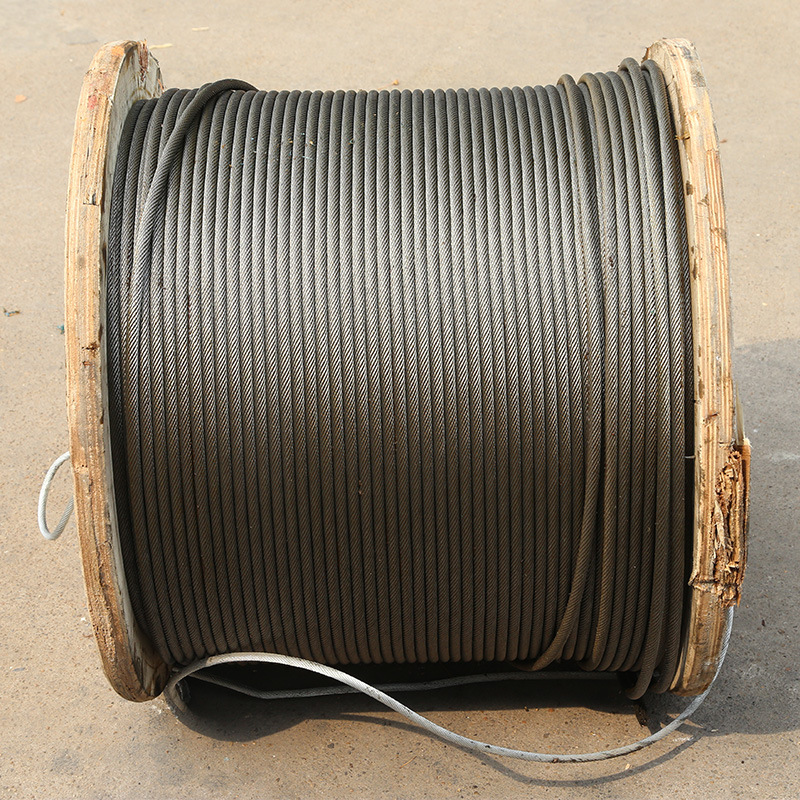
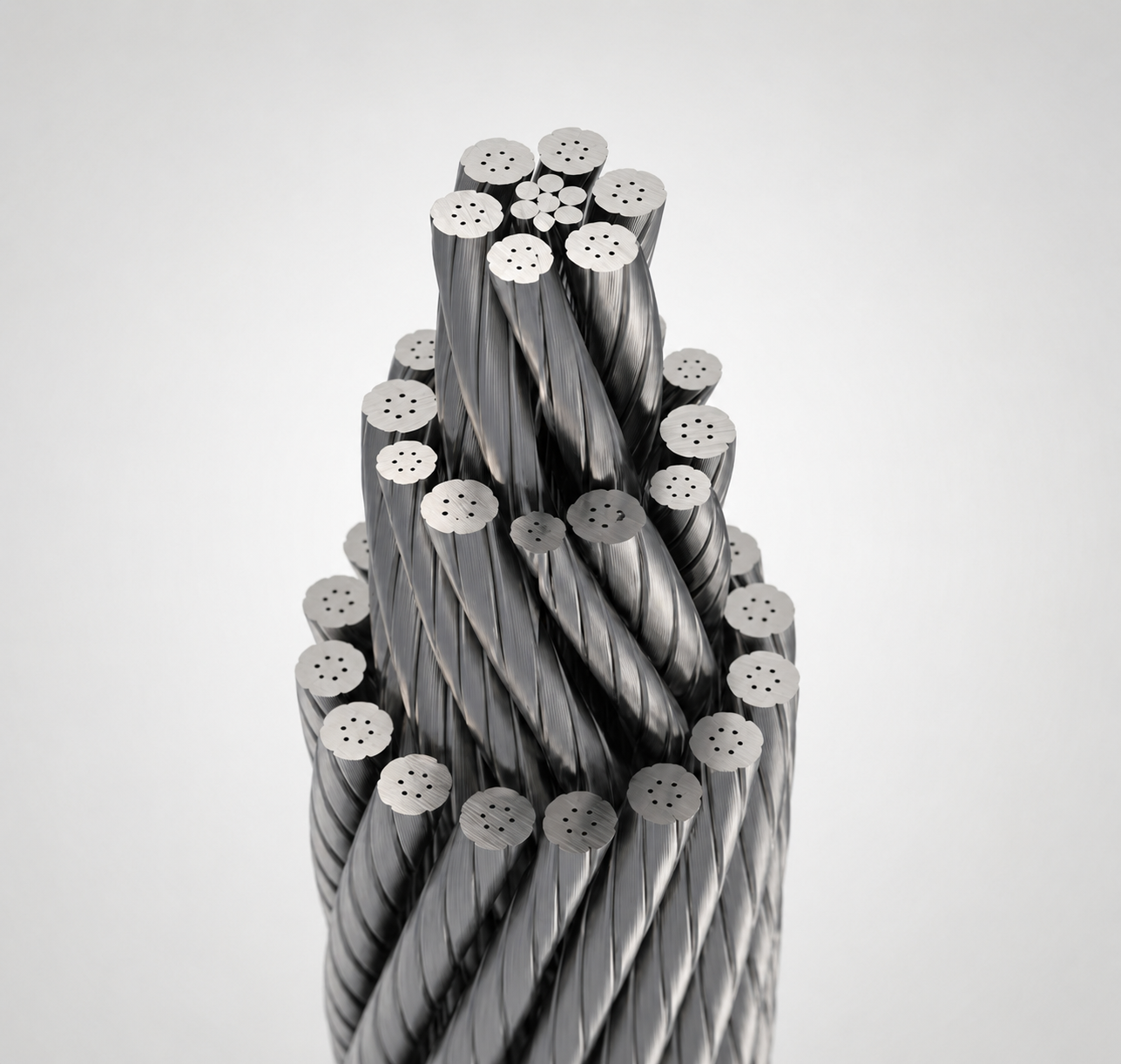
Steel Wire Rope
Supply Range of Diameters: Small diameter to large-diameter rope
Construction Type: 1×19, 7×7, 7×19, 6×19, 6×36, 19×7, 35Wx7, 19×37
Core Type: FC, WSC, IWRC, IWR or protected core design
Material: Carbon steel, galvanized steel, 304 stainless steel, 316 stainless steel
Tensile Strength: 1570 MPa, 1670 MPa, 1770 MPa, 1960 MPa, 2160 MPa
Packing: Coil, reel, wooden drum, steel reel or customized offshore reel
Steel wire rope is a load-bearing rope made from multiple high-tensile steel wires. The wires are twisted into strands, and the strands are laid around a central core to form the finished rope. Depending on the working condition, it can be supplied in carbon steel, galvanized steel, 304 stainless steel, 316 stainless steel, or high-tensile wire with special lubrication or corrosion protection.
The rope is used to transmit tensile force in lifting, hoisting, pulling, winching, suspension and load-control systems. Common applications include crane systems, marine equipment, bridge construction, offshore handling, mining, elevator systems and heavy-duty rigging.
A correct steel wire rope selection is not based on diameter alone. Construction, core type, material or coating, tensile strength grade, minimum breaking load, reel length, end termination, working condition and inspection documents all affect final performance.
Steel Wire Rope Specifications
A complete steel wire rope specification should describe the finished rope clearly enough for production, inspection and shipment release. The most important items are shown below.
| Item | Common Options / Review Points |
|---|---|
| Product Type | Galvanized steel wire rope, stainless steel wire rope, non-rotating wire rope, compacted wire rope, large-diameter cable-laid rope |
| Material | Carbon steel, galvanized steel, 304 stainless steel, 316 stainless steel |
| Construction | 1×19, 7×7, 7×19, 6×19, 6×36, 8×19, 19×7, 35Wx7, 19×37, or project-specific construction |
| Core Type | FC, WSC, IWRC, IWR or special rope core design |
| Tensile Strength | 1570 MPa, 1670 MPa, 1770 MPa, 1960 MPa, 2160 MPa when required |
| Diameter Range | Small diameter rope for control and rigging; large-diameter rope for crane, bridge, marine and heavy lifting systems |
| Surface Finish | Bright, galvanized, stainless steel, lubricated, coated or marine corrosion-protected |
| Breaking Load | Minimum breaking load in kN or tons, confirmed by rope construction, diameter and certificate |
| Packing | Coil, reel, wooden drum, steel reel or customized offshore reel |
| Documents | MTC, breaking load certificate, dimension report, inspection certificate, certificate of conformity and packing list |
For engineering projects, the rope marking, certificate and packing list should show the same product identity:
diameter → construction → core type → material / coating → tensile strength → minimum breaking load → reel number → shipment document
This chain helps avoid wrong-rope delivery, certificate mismatch and site acceptance delay.
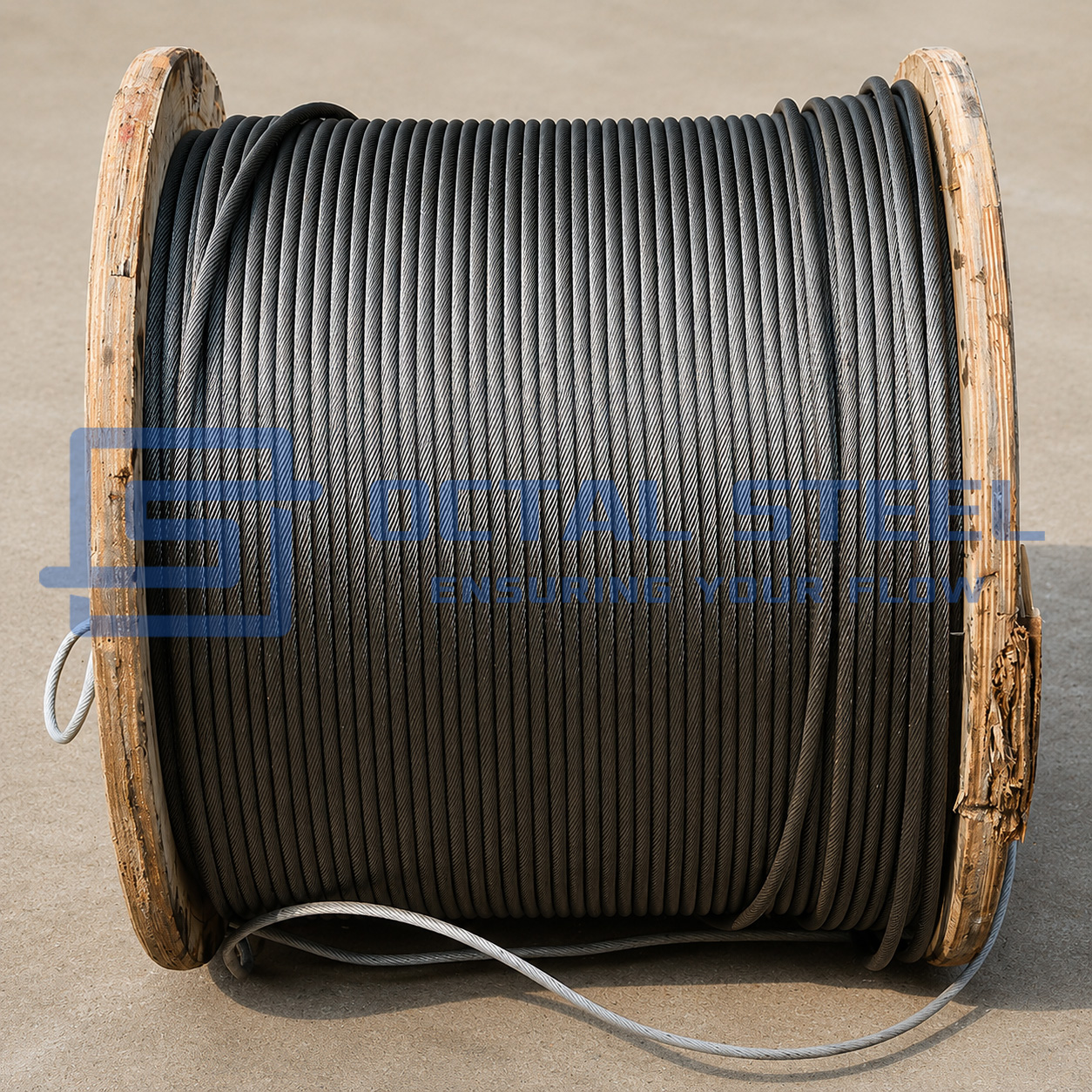
Heavy-Duty and Offshore Steel Wire Rope Solutions
Standard lifting rope and specialized engineering rope are often evaluated differently. For bridge construction, offshore projects, deep-water operations and heavy lifting systems, rope selection extends beyond diameter and construction. Minimum breaking force, rotation behavior, continuous rope length, corrosion protection, reel design and inspection certification become critical acceptance criteria for project approval and long-term service performance.
Large Diameter Steel Wire Rope for Heavy Lifting
Large-diameter steel wire rope is used where high breaking force, long service length and stable load distribution are required in bridge construction, offshore engineering, heavy lifting, mining, crane systems and special rigging assemblies.
Compared with small-diameter general-purpose rope, these ropes must be reviewed by nominal diameter, reference weight, rope construction, tensile strength grade and minimum breaking force.
Steel Wire Rope Minimum Breaking Force Reference:
| Nominal Diameter (mm) | Reference Weight (kg/100m) | 1570 MPa | 1670 MPa | 1770 MPa | 1870 MPa | 1960 MPa | 2160 MPa |
|---|---|---|---|---|---|---|---|
| 12 | 73.4 | 94 | 100 | 106 | 112 | 117 | 129 |
| 14 | 100 | 128 | 136 | 144 | 152 | 159 | 176 |
| 16 | 131 | 167 | 177 | 188 | 199 | 208 | 229 |
| 18 | 165 | 211 | 225 | 238 | 251 | 264 | 290 |
| 20 | 204 | 261 | 277 | 294 | 310 | 325 | 359 |
| 22 | 247 | 315 | 335 | 356 | 376 | 394 | 434 |
| 24 | 294 | 375 | 399 | 423 | 447 | 469 | 516 |
| 26 | 345 | 440 | 469 | 497 | 525 | 550 | 606 |
| 28 | 400 | 511 | 543 | 576 | 608 | 638 | 703 |
| 30 | 459 | 586 | 624 | 661 | 698 | 732 | 807 |
| 32 | 522 | 667 | 710 | 752 | 795 | 833 | 918 |
| 34 | 590 | 753 | 801 | 849 | 897 | 940 | 1040 |
| 36 | 661 | 844 | 898 | 952 | 1010 | 1050 | 1160 |
| 38 | 736 | 941 | 1000 | 1060 | 1120 | 1170 | 1290 |
| 40 | 816 | 1040 | 1110 | 1180 | 1200 | 1300 | 1430 |
| 42 | 900 | 1150 | 1120 | 1300 | 1370 | 1430 | 1580 |
| 44 | 987 | 1260 | 1340 | 1420 | 1500 | 1570 | 1740 |
| 46 | 1079 | 1380 | 1470 | 1550 | 1640 | 1720 | 1900 |
Highlighted example: 42 mm | 900 kg/100m | 2160 MPa | Minimum Breaking Force: 1580 kN.
Typical Large-Diameter Rope Constructions
| Rope Construction | Typical Review Direction |
|---|---|
| 7X[6X37(b)+IWR] type steel cable rope | Large-diameter cable rope for heavy-duty lifting and engineering applications |
| 8X[6X37+IWR]+IWRC steel cable rope | Multi-strand steel cable rope with independent wire rope core support |
| 8X[6X61+IWR]+IWRC steel cable rope | More complex large-diameter construction for high-load service |
These large cable rope types are different from common small-diameter 7×19 or 6×36 ropes. Their acceptance depends heavily on diameter, reference weight, tensile strength grade and minimum breaking force.
Main Review Points
- Nominal Diameter – determines rope size, equipment compatibility and load capacity.
- Reference Weight – affects transportation, installation, reel handling and lifting plans.
- Rope Construction – influences flexibility, strength distribution and bending fatigue performance.
- Tensile Strength Grade – common grades include 1570 MPa, 1670 MPa and 1770 MPa.
- Minimum Breaking Force – a primary acceptance indicator for heavy lifting applications.
- Reel or Drum Packing – influences unloading, storage and field installation.
- Inspection Certificate – supports shipment release and project acceptance.
Typical large-diameter data may cover nominal diameters from 192 mm to 260 mm, reference weight in kg/100 m, tensile strength grades such as 1570 / 1670 / 1770 MPa, and minimum breaking force values in kN. Final values should always be verified against the approved product data sheet and inspection certificate.
Deep Sea Non-Rotating Steel Wire Rope
For deep-water winch systems, ROV deployment and offshore lifting operations, non-rotating steel wire rope is selected to control torque, improve load stability and maintain underwater positioning accuracy.
A deep-sea rope may require long continuous reel length, multi-layer strand construction, high wire tensile strength, marine corrosion protection, low rotation behavior and class-approved inspection documents. Project-specific designs may include 19×37 construction, 2160 MPa wire strength, right-hand regular lay, marine lubrication systems, special reel packing and continuous lengths reaching several thousand meters.
For this type of rope, rotation control is a critical performance requirement. Excessive rope rotation under load can cause suspended equipment to spin, create uneven spooling on the winch drum and reduce operational accuracy during subsea handling.
Typical Review Points for Deep-Sea Rope
- Rotation-resistant or non-rotating rope design
- ROV handling, deep-sea winch and offshore lifting applications
- Multi-layer strand constructions such as 19×37
- High tensile wire grades such as 1960 MPa or 2160 MPa
- Long continuous rope length for deep-water systems
- Multi-layer reverse-lay structures for torque reduction
- Marine lubricant systems and corrosion protection
- Breaking load certificate, class certificate, MTC and inspection reports
For deep-sea and offshore rope systems, final rope diameter, minimum breaking load and working load parameters should be confirmed through the manufacturer’s certificate, project specification and applicable class approval requirements. Wire tensile strength, minimum breaking load, working load limit and safety factor should always be evaluated as separate technical values rather than interchangeable ratings.
Download:Steel_Wire_Rope_Data_Visual_Reference_Corrected
Steel Wire Rope Construction: What Do 7×19, 6×36 and 19×7 Mean?
Steel wire rope construction describes how individual wires are arranged into strands and how those strands are closed around the rope core.
In a construction such as 7×19, the first number means the number of strands, and the second number means the approximate number of wires in each strand. So 7×19 steel wire rope means the rope has 7 strands, and each strand contains about 19 wires.
This is a structure code, not a diameter. A buyer still needs to confirm diameter, core type, material, tensile strength, breaking load and application.
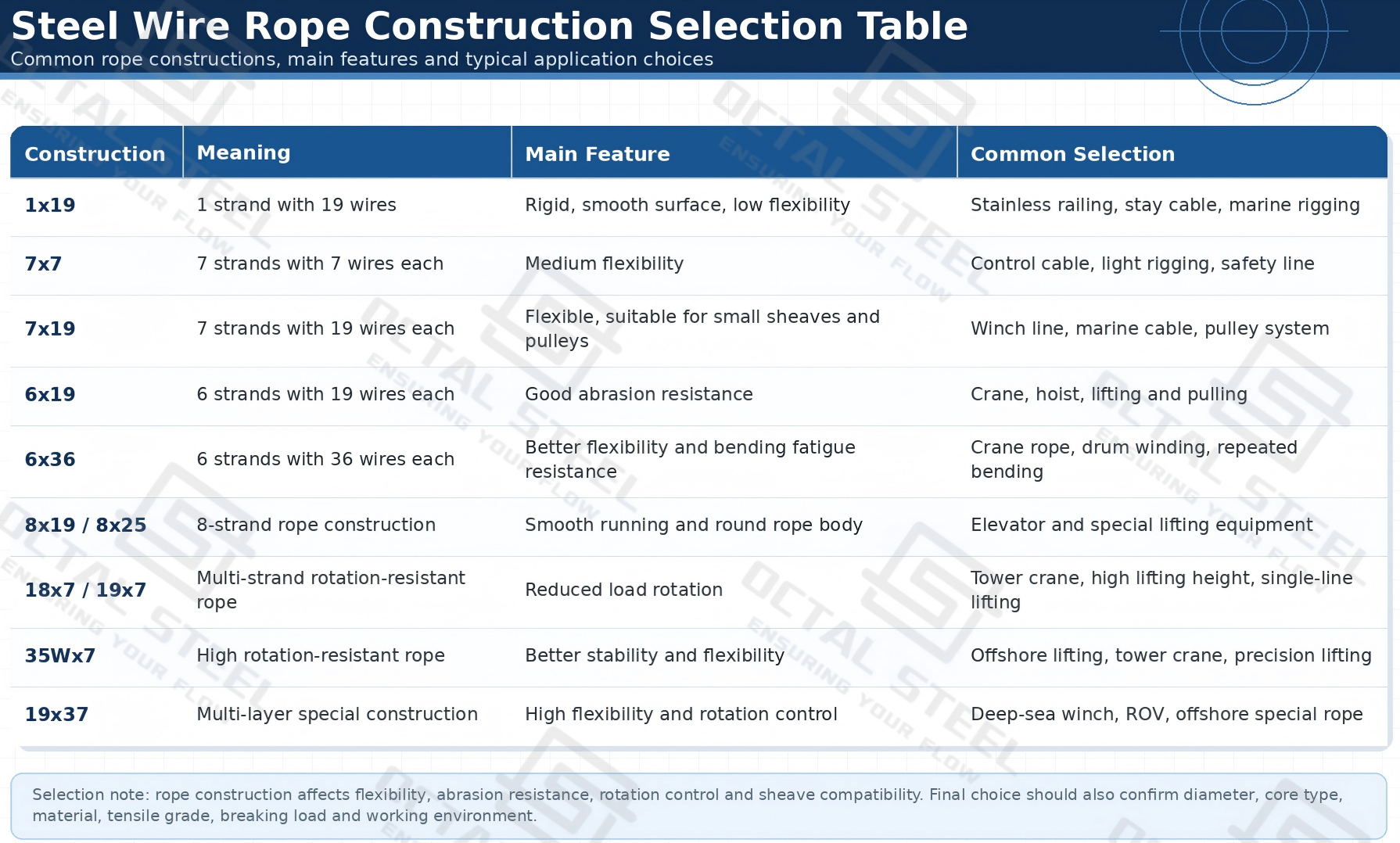
For general commercial inquiries, 7×19, 6×19 and 6×36 are among the most frequently requested constructions. For stainless architectural cable, 1×19 and 7×19 are common. For high-lift and rotation-control applications, 19×7 and 35Wx7 are more important.
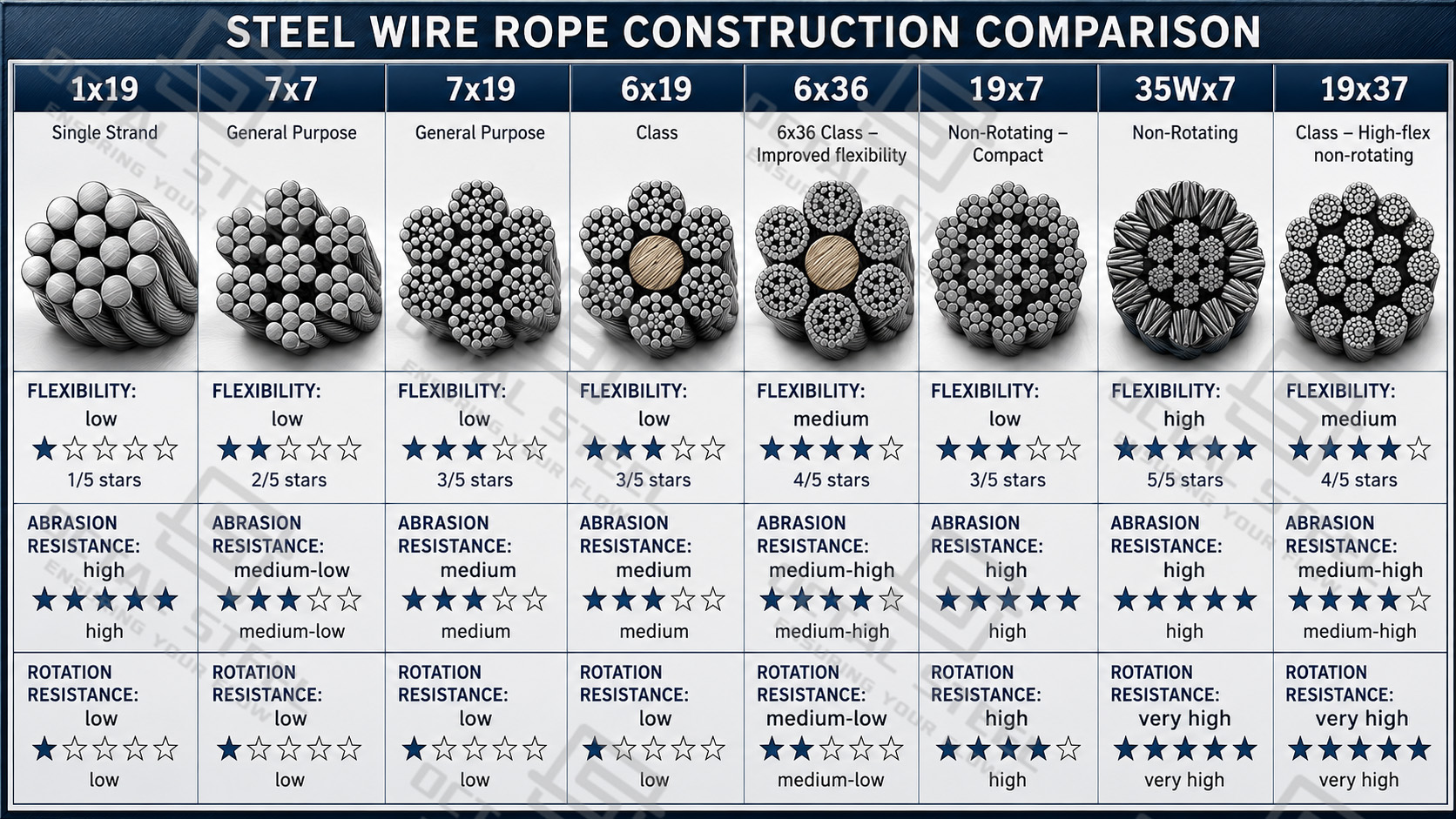
Construction Selection: Flexibility, Abrasion and Rotation Control
Steel wire rope construction should be selected according to bending condition, surface wear and rotation control requirement.
7×19 steel wire rope is preferred when flexibility is important, especially for small sheaves, pulleys, winch lines and control cable systems.
6×19 steel wire rope is often reviewed where abrasion resistance and stronger outer wires are needed for lifting, pulling and general crane service.
6×36 steel wire rope provides better bending fatigue resistance and is suitable for repeated drum winding or frequent sheave contact.
For high lifting height or suspended loads that must not spin freely, 19×7, 18×7, 35Wx7 or 19×37 rotation-resistant steel wire rope may be required. These ropes should be matched with the equipment, load condition and inspection requirements.
Download:Steel_Wire_Rope_Construction_Data_Guide.pdf
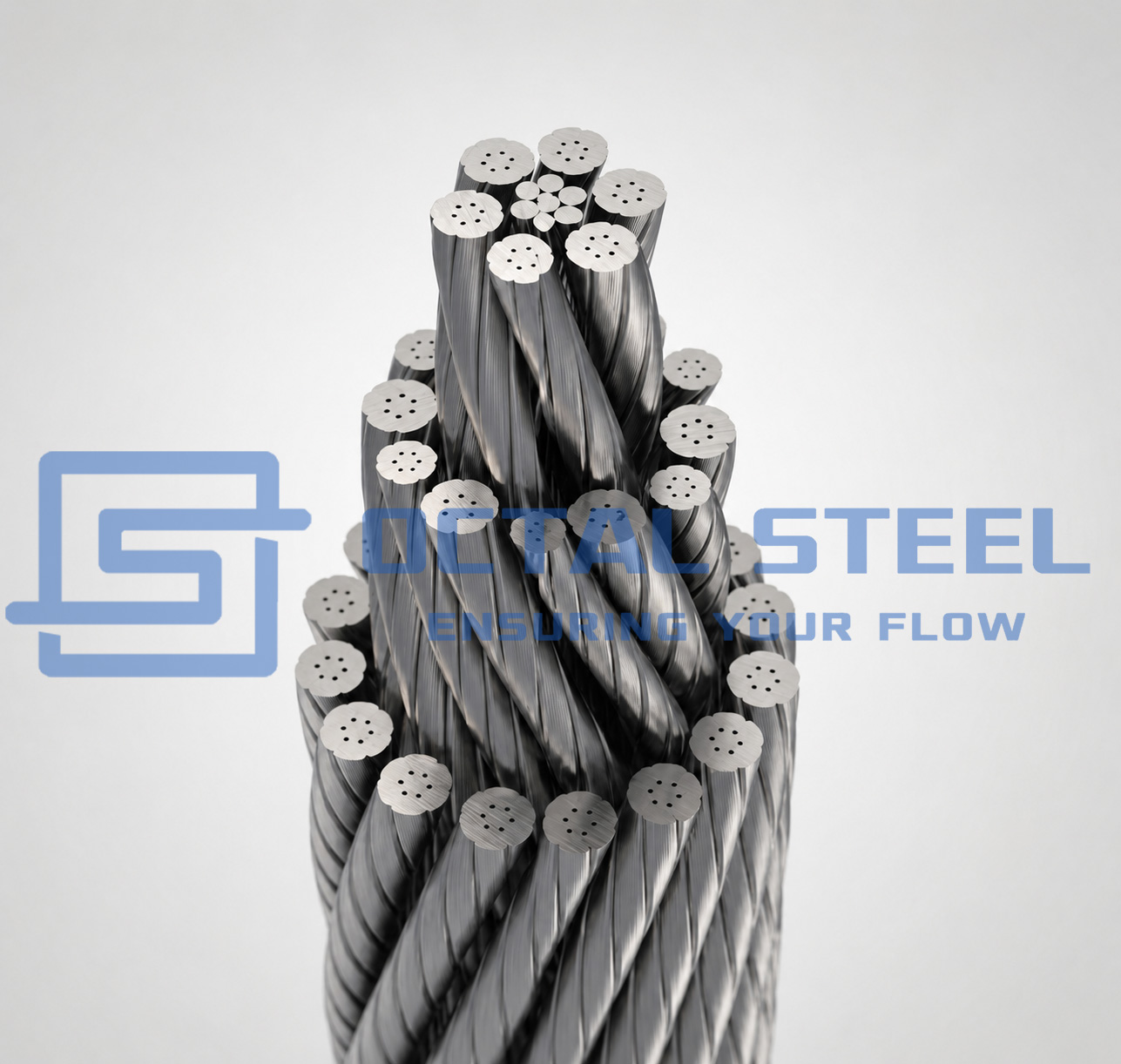
Steel Wire Rope Core Types: FC, WSC, IWRC and IWR
The rope core supports the outer strands, keeps the rope shape stable and affects strength, flexibility, crushing resistance and service life. For the same rope diameter and construction, different core types may lead to different performance in lifting, winch operation, drum winding and marine service.
| Core Type | Full Name | Main Advantage | Common Use | Selection Note |
|---|---|---|---|---|
| FC | Fiber Core | Better flexibility and lubricant retention | Light to medium-duty rope, flexible handling, lower drum pressure | Not the first choice for heavy lifting or multi-layer drum winding |
| WSC | Wire Strand Core | Better support than fiber core | General steel-core rope, moderate load and support requirement | A simple steel core option when higher support is needed |
| IWRC | Independent Wire Rope Core | Higher strength, better crushing resistance and stronger rope support | Heavy lifting, winch rope, crane rope, multi-layer drum winding | Preferred when rope stability and load capacity are important |
| IWR | Independent Wire Rope / Rope Sub-Core | Used in complex or large-diameter rope structures | Cable-laid rope, heavy-duty lifting, project-specific rope design | Usually reviewed for special rope construction rather than general-purpose rope |
| Protected Core Design | Plastic-coated or specially lubricated core | Better internal support, lubrication retention and corrosion control | Offshore, harsh service, high-duty-cycle rope, drum-pressure applications | Suitable when internal wear, corrosion or repeated bending must be controlled |
For heavy lifting, multi-layer drum winding and high contact pressure, IWRC wire rope is normally reviewed before selecting a softer FC wire rope. For flexible handling or light-duty applications, FC may be suitable, but the final choice should still match the rope construction, load condition, drum design and inspection requirement .
tainless Steel and Galvanized Steel Wire Rope
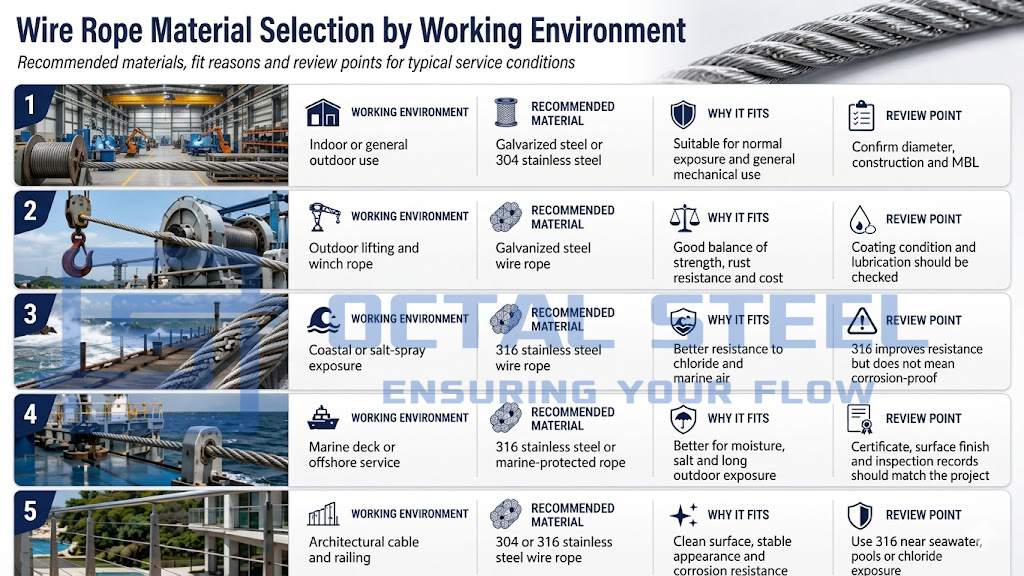
Stainless steel wire rope and galvanized steel wire rope are the most common material choices for corrosion control. Both can be used for lifting, rigging, winch and cable assemblies, but they are selected for different environments. Galvanized wire rope focuses on economical outdoor rust protection, while stainless steel wire rope is used where cleaner appearance, chloride resistance or long-term corrosion exposure is more important.
Stainless steel wire rope is selected when corrosion resistance, clean surface appearance and long-term exposure performance are important. 304 stainless steel wire rope is suitable for general indoor and outdoor use, while 316 stainless steel wire rope offers better resistance to chloride, salt-spray and marine exposure.
Galvanized steel wire rope uses zinc coating to improve rust resistance in outdoor lifting, winch rope, crane rope, marine deck equipment and general rigging applications. It is usually more economical than stainless steel, but coating life should be reviewed in long-term seawater, chemical or high-abrasion conditions.
For general outdoor use, galvanized steel wire rope is often practical. For coastal, marine, chemical or offshore environments, 316 stainless steel wire rope or a special corrosion-protection system should be reviewed. Final selection should still be checked by diameter, construction, end fitting and minimum breaking load.
7×19 Steel Wire Rope
7×19 steel wire rope is selected when flexibility is more important than maximum abrasion resistance. The construction contains many smaller wires, allowing the rope to bend more easily around pulleys, small drums and control systems.
It is commonly used for:
- winch lines
- marine cable
- control cable
- garage door cable
- fitness equipment
- light-duty lifting assemblies
- pulley systems
The main advantage of 7×19 is high flexibility. It is usually more flexible than 1×19 or 7×7 when bending is frequent. Common material options include galvanized steel, 304 stainless steel and 316 stainless steel.
However, 7×19 is not the best answer for every rope application. It is not ideal for severe abrasion, very heavy lifting or large drum pressure without proper design review.
A complete request should not stop at “7×19 steel wire rope.” It should include diameter, material, core type, tensile strength, breaking load, length and end termination.
MBL, WLL and Safety Factor
Minimum breaking load is not the same as working load limit.
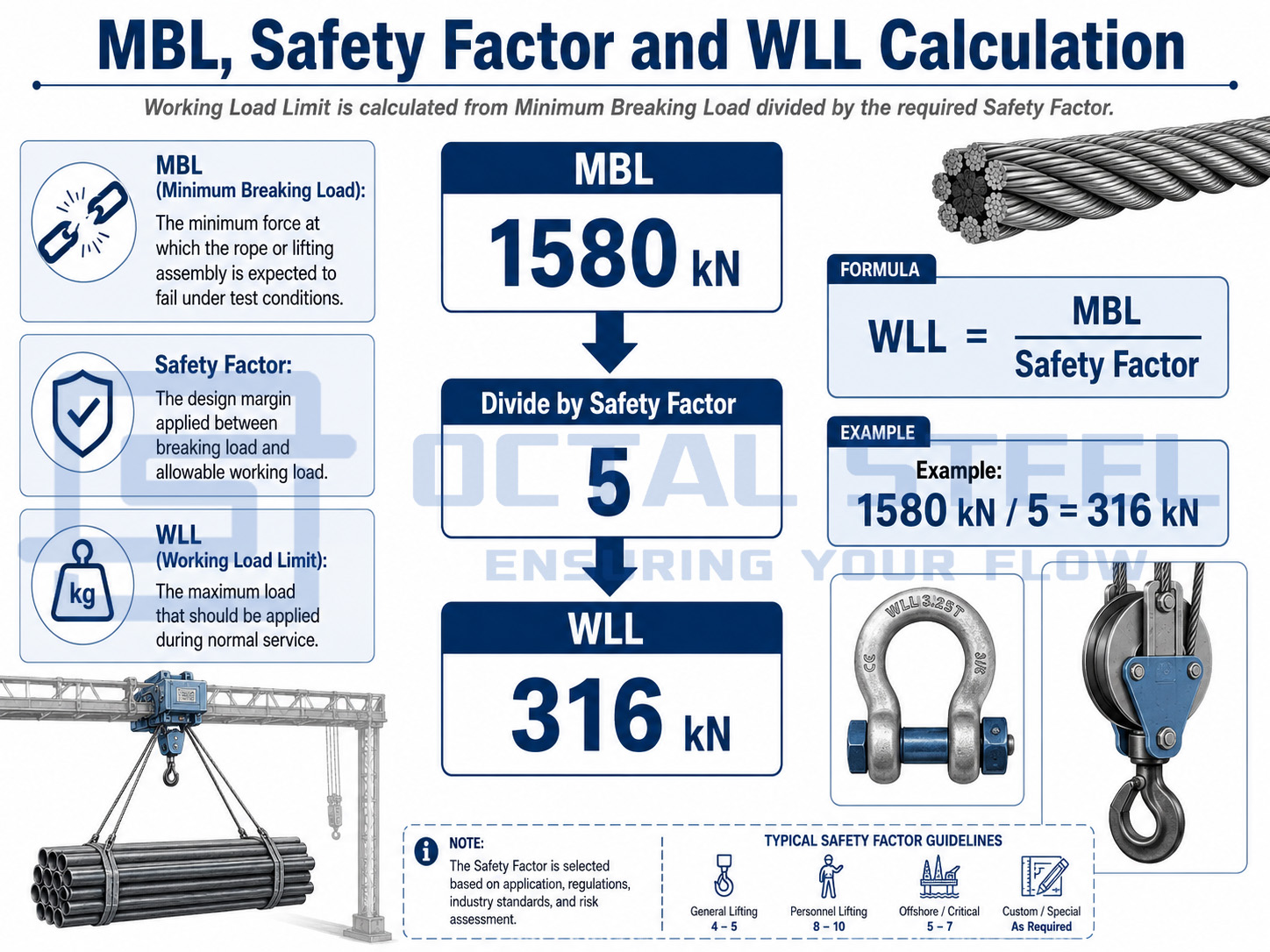
MBL / Minimum Breaking Load is the minimum breaking force confirmed by test or standard table. It is the main strength acceptance value.
WLL / Working Load Limit is the maximum load allowed in actual use. It must be lower than MBL after applying the required safety factor.
Safety Factor is the ratio between breaking load and working load. It is required for safe lifting and design approval.
Proof Load is a test load applied before acceptance when required. It verifies rope or assembly performance without reaching the breaking point.
The basic relationship is:
MBL ÷ Safety Factor = WLL
A common selection mistake is to choose a rope only by diameter or tensile strength. A higher tensile strength grade does not automatically mean the finished rope can be used for a higher working load. The finished rope construction, metallic area, core type, termination and safety factor must also be reviewed.
Steel Wire Rope Applications and Selection Logic
Steel wire rope selection should follow the working condition, not only the product name.
For crane and hoist lifting, the main review points are MBL, fatigue resistance, IWRC core and sheave compatibility. The rope must carry load repeatedly while bending over sheaves and drums.
For winch and drum winding, crushing resistance, lay direction, lubrication and drum groove match should be checked. Multi-layer winding can damage a rope quickly if the core support is not suitable.
For marine and offshore rigging, galvanized or 316 stainless material, corrosion control and inspection certificate are important. The rope may face salt spray, deck abrasion, moisture and long outdoor exposure.
For architectural railing and cable systems, 1×19 or 7×7 stainless steel wire rope is often selected for appearance, tension stability and corrosion resistance.
For control cable and pulley systems, 7×7 or 7×19 construction is commonly reviewed because flexibility and diameter consistency are more important than extreme breaking force.
For heavy lifting and bridge work, large-diameter cable-laid rope, high breaking force and reel handling must be reviewed together.
For deep-sea ROV and subsea winch, rotation resistance, long length, high tensile strength and corrosion protection are key selection points.
The correct rope is the one that matches load, bending cycle, drum pressure, corrosion exposure, rotation control and inspection requirement.
Inspection, Failure Risk and Replacement Points
Steel wire rope should be inspected before shipment and during use. The inspection focus depends on application, but the following points are commonly reviewed.
Diameter measurement helps detect wear, compression or manufacturing deviation.
Broken wire count indicates fatigue, overload or bending damage.
Surface corrosion may show coating loss, poor storage condition or unsuitable material selection.
Kink and birdcage deformation indicate rope structure damage and unsafe handling.
Drum crushing is common in multi-layer winding or high drum pressure.
Lubrication condition affects internal friction, corrosion resistance and service life.
End fitting inspection controls socket, thimble, splice or swaged fitting failure.
Certificate review confirms construction, diameter, MBL and material identity.
For shipment release, the rope marking, reel label, inspection certificate and packing list should match the purchase order. For lifting and offshore projects, third-party inspection or class witness may be required.
Documents and Ordering Checklist
A clear inquiry helps avoid wrong rope selection, delayed production and certificate mismatch. The following information should be confirmed before production.
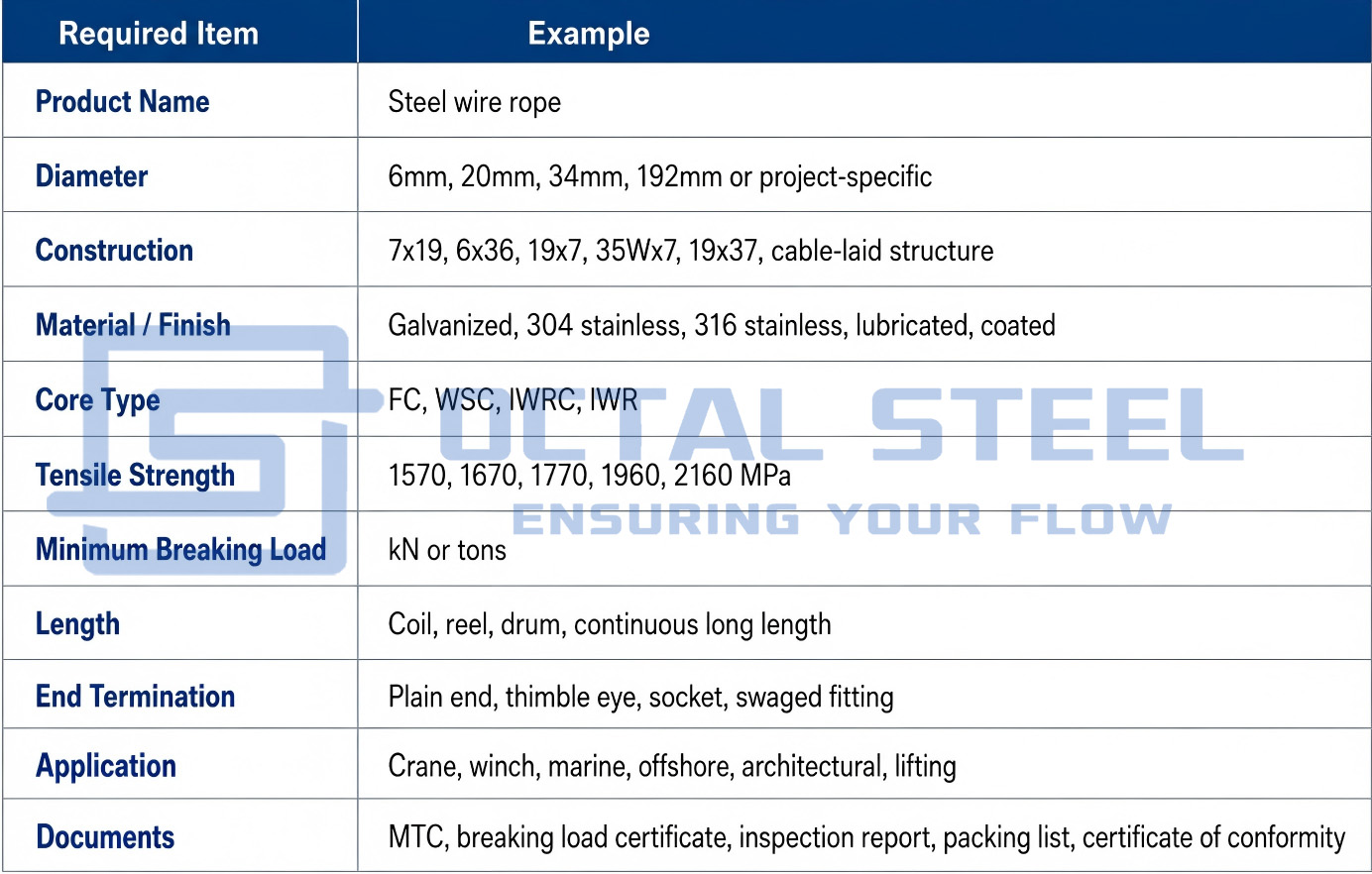
The final specification should be reviewed together with load condition, equipment interface, working environment and document requirements.
Common document package may include:
- MTC
- breaking load certificate
- dimension inspection report
- inspection certificate
- certificate of conformity
- packing list
- third-party inspection certificate when required
Social Share