Your Responsible Supplier Partner for Oil and Gas Products.

API 620
Hot Topic



Rencent Articles


Recent Resources

API 620
Covers large, field-assembled, welded low-pressure aboveground storage tanks
Applies to tanks with gas or vapor space pressures up to 15 psig
Includes temperature routes through Annex Q and Annex R
Used when storage duty goes beyond ordinary atmospheric tank service
Different from API 625 tank system scope and API 650 atmospheric tank scope
Helps define the correct design, annex, and inspection route early
API 620 is the standard generally used for the design and construction of large, field-assembled, welded, low-pressure aboveground storage tanks. In practical project terms, it is the code route buyers usually see when the storage duty has moved beyond ordinary atmospheric tank service but is still within the low-pressure range defined by the standard. API’s public description states that API 620 covers tanks with a single vertical axis of revolution, including flat-bottom tanks, for gas or vapor spaces not more than 15 psig, with metal temperatures not greater than 250°F. The basic rules apply to areas where the lowest recorded 1-day mean atmospheric temperature is -50°F; Annex R addresses refrigerated products from +40°F to -60°F, and Annex Q addresses liquefied gases at temperatures not lower than -325°F.
API 620 becomes important when the project needs a clear code route for a large welded low-pressure storage tank, but the storage duty, temperature condition, or approval path requires closer definition than a simple atmospheric tank specification. In practical terms, the key issue is to determine whether the project should remain within the API 620 tank design and construction route, or whether it also needs to be evaluated together with standards such as API 625 for refrigerated tank systems or API 650 for atmospheric welded storage tanks. This distinction affects annex selection, design basis, inspection scope, and the final documentation route.
API 620 Scope and Boundary
API 620 defines an important low-pressure tank design and construction route, but its scope still has clear boundaries. The table below shows where API 620 applies and where the project may need to be checked against other standards.
| Aspect | Within API 620 Scope | Outside API 620 by Itself / Needs Further Check |
|---|---|---|
| Main application | Large, field-assembled, welded, low-pressure aboveground storage tanks | Not every refrigerated or special storage project automatically falls fully under API 620 |
| Tank form | Tanks with a single vertical axis of revolution, including flat-bottom tanks | Horizontal tanks are not directly covered by the standard |
| Service basis | Low-pressure storage with gas or vapor space above liquid, or storage of gases or vapors alone | Lift-type gas holders are outside the stated scope |
| Project focus | Tank design and construction route | Full refrigerated tank system responsibilities are not defined by API 620 alone |
| Temperature route | API 620 can extend into low-temperature service through relevant annexes such as Annex Q and Annex R | Broader refrigerated storage system requirements may need API 625 together with API 620 |
| Engineering boundary | Useful when the project is still centered on the storage tank itself | When the project also involves insulation concept, accessories, quality assurance, or commissioning at system level, API 625 becomes important |
| Comparison with other codes | Suitable where the storage duty has moved beyond ordinary atmospheric tank service but remains within API 620 low-pressure tank scope | Where the service is closer to ordinary atmospheric welded storage, API 650 may be the more natural comparison route |
Key Design Limits in API 620
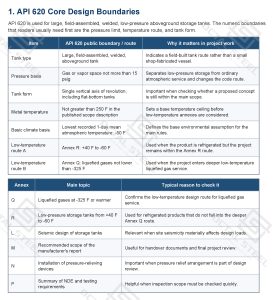
The main design limits in API 620 are the pressure boundary, temperature route, and tank form. According to API’s public scope description, API 620 applies to large, field-assembled, welded, low-pressure aboveground storage tanks with a single vertical axis of revolution, including flat-bottom tanks. The standard covers tanks designed for metal temperatures not greater than 250°F and for gas or vapor space pressures not more than 15 psig. Its basic rules apply to installations where the lowest recorded 1-day mean atmospheric temperature is -50°F.
API 620 also distinguishes low-temperature service through different annex routes. Annex R applies to refrigerated products from +40°F to -60°F, while Annex Q applies to liquefied gases at temperatures not lower than -325°F. These limits matter because they affect whether the project remains within the API 620 tank design route or needs to be read together with other standards. Where the service is closer to ordinary atmospheric welded storage, API 650 is often the more natural comparison route, since its general scope is for tanks with internal pressures approximating atmospheric pressure and non-refrigerated service with maximum design temperature of 93°C (200°F) or less.
Important Annexes in API 620
Several annexes in API 620 are especially important because they affect code route, design review, inspection scope, and final project documentation.
Annex Q applies to storage of liquefied gases at temperatures not lower than -325°F.
API 620 Annex-Q Public Reference-OctalSteel
Annex R applies to low-pressure storage tanks operating between +40°F and -60°F.
API 620 Annex R Public Reference-Octal Steel
Annex L covers seismic design of storage tanks.
API 620 Annex L Seismic Public Reference-OctalSteel
Annex N addresses the installation of pressure-relieving devices.
API 620 Annex N Public Reference-pressure-relieving devices
Annex P provides a summary of NDE and testing requirements.
In practical project work, these annexes matter because buyers and engineers are not only checking the tank itself. They also need to confirm the applicable temperature route, seismic requirements, inspection scope, pressure-relief arrangement, and the completeness of the final documentation package.
API 620 vs API 625 vs API 650
The difference between API 620, API 625, and API 650 is not only technical wording. It changes how the project is defined, what the supplier is expected to deliver, and what the buyer will need to review before release.
API 620 is mainly the route for a large, field-assembled, welded, low-pressure storage tank. It becomes relevant when the project has moved beyond a simple atmospheric storage concept but is still being evaluated primarily as a tank design and construction job. In that situation, the main review points are usually the tank form, design pressure, temperature route, applicable annexes, material route, welding and NDE requirements, and the final manufacturer’s report. API’s published scope for 620 also points to key boundaries such as gas or vapor space not more than 15 psig, single vertical axis of revolution, and low-temperature routes through Annex Q and Annex R.
API 625 becomes the more relevant reference when the project is no longer just about the tank shell. Its published scope is for low-pressure, aboveground, vertical, cylindrical tank systems storing refrigerated liquefied gases, and it explicitly extends into responsibilities, storage concept selection, performance criteria, accessories/appurtenances, quality assurance, insulation, and commissioning. It also applies to tank systems of 800 m³ and larger for products that must be refrigerated to remain liquid. In practical terms, API 625 is the broader system-level route when the owner is not only buying a tank, but also defining how that tank will function as part of a refrigerated storage package.
API 650 is the more natural comparison when the duty is still ordinary welded storage at approximately atmospheric pressure, rather than a low-pressure refrigerated route. Its published title and long-standing use position it around welded tanks for oil storage, not refrigerated liquefied gas tank systems. That means API 650 is often the wrong shortcut when a project has already moved into low-pressure refrigerated service, but it remains the logical reference when the service stays close to standard atmospheric storage practice.
From a buyer’s point of view, the practical distinction is this:
with API 620, the question is usually whether the tank itself is designed and documented on the correct low-pressure code route;
with API 625, the question becomes whether the entire refrigerated tank system has been defined properly, including insulation, accessories, QA, and commissioning scope;
with API 650, the project is still closer to a conventional atmospheric welded storage route. That is why these standards should not be treated as interchangeable names for the same kind of tank.
From Design Basis to Release Package
In API 620 work, the tank is not complete when fabrication is finished. The code route has to remain traceable from the original design basis to the final release package. That chain normally starts with the specified edition, design pressure, design metal temperature, and applicable annex route, then continues through the calculation package, material traceability, WPS/PQR, welder qualifications, weld map, and required NDE records. Where applicable, it also extends to heat treatment records, test reports, nameplate data, and final identification records consistent with the approved drawings.
FAQ
Q1: When should API 620 be used instead of API 650?
API 620 is generally used for large welded low-pressure storage tanks, while API 650 is the more natural route for atmospheric welded storage tanks.
Q2: Is API 620 enough for refrigerated storage projects?
Not always. If the project goes beyond the tank itself into insulation, accessories, quality assurance, and commissioning, API 625 may also need to be considered.
Q3: What is the difference between Annex Q and Annex R in API 620?
Annex Q applies to liquefied gases at temperatures not lower than -325°F, while Annex R applies to low-pressure refrigerated storage tanks operating between +40°F and -60°F.
Q4: What are the main design limits in API 620?
The public API scope highlights three key limits: large field-assembled welded aboveground tanks, gas or vapor space not more than 15 psig, and metal temperatures not greater than 250°F.

The resource belongs to the product
Oil Storage Tank
Click permalink to view detail & more descripton.
Social Share