Your Responsible Supplier Partner for Oil and Gas Products.

API 650
API 650
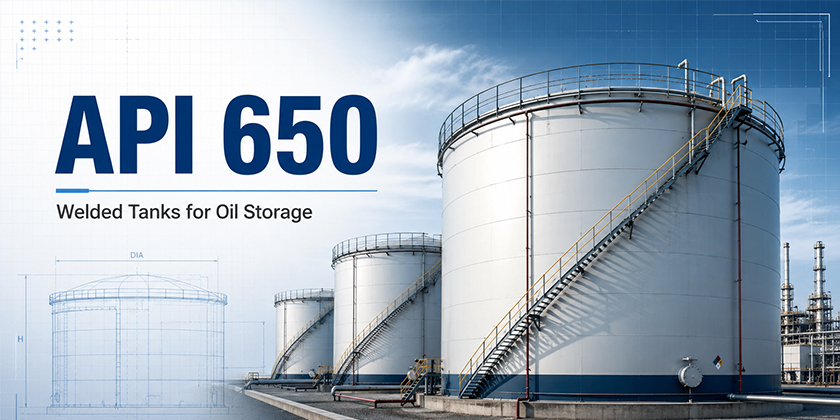
API 650 is the principal standard for welded, vertical, cylindrical aboveground tanks used to store oil and other liquids at approximately atmospheric pressure. It establishes requirements for tank materials, shell and bottom design, welding, inspection, testing, and fabrication documentation. Its general provisions apply to non-refrigerated service at design temperatures up to 93°C (200°F), while Annex M provides additional requirements for elevated-temperature service up to 260°C (500°F).
Steel plate selection under API 650 depends on the material group, governing thickness, design metal temperature, allowable stress, delivery condition, and impact-testing route. Lower shell courses carry the highest liquid head and may require higher-strength or improved-toughness plate, while upper courses, roofs, bottoms, annular plates, nozzles, and reinforcement areas may use different material specifications. Common plate routes include ASTM A36, A283, A285, A516, A573, A633, A662, A737, and A841, subject to the limits and conditions of the specified API 650 edition.
API 650 Welded Tanks for Oil Storage Standard and Latest Edition
The current published API 650 latest edition is the 13th Edition, issued in March 2020. Project documents should identify the exact edition, errata and contractual amendments instead of stating only “latest edition,” because material tables, annex references and purchaser options must remain consistent throughout design and fabrication.
The standard establishes requirements for:
- plate, structural, piping and forged materials;
- shell, bottom, roof and annular-plate design;
- allowable design and hydrostatic-test stresses;
- welding procedures and welder qualification;
- impact testing and minimum design metal temperature;
- radiographic, ultrasonic, magnetic-particle, penetrant and visual examination;
- tank erection, hydrostatic testing, marking and documentation.
API 650 does not select a plate grade from the stored product name alone. The material route is developed from the tank dimensions, liquid specific gravity, maximum filling height, design metal temperature, corrosion allowance, design temperature and applicable annexes.
Information That Controls API 650 Tank Material Selection
The following data should be fixed before shell plate grades and material groups are finalized.
| Design Input | Effect on Material Selection |
|---|---|
| Design metal temperature | Determines the required toughness route and whether impact testing can be exempted. |
| Shell-course thickness | Thicker plates may cross the impact-exemption boundary even when the same grade is used. |
| Tank diameter and liquid height | Increase hydrostatic stress in the lower shell courses and can require higher-strength or thicker plate. |
| Stored-liquid specific gravity | Directly affects shell design pressure from the liquid head. |
| Corrosion allowance | Adds ordered thickness but does not replace the required structural thickness. |
| Maximum design temperature | Affects allowable stress and may bring Annex M into the design basis. |
| Plate delivery condition | As-rolled, normalized, normalized-rolled, or TMCP condition changes toughness and fabrication control. |
| Annular-bottom requirement | The shell-to-bottom region may require a different plate specification or impact-test route. |
| Internal corrosion environment | May lead to stainless steel, duplex stainless steel, lining, coating, or additional corrosion allowance. |
| Hydrostatic-test condition | Requires a separate allowable-stress check using the hydrotest liquid level and test stress. |
A single tank may therefore contain several plate specifications. Lower shell courses can use a higher-strength or improved-toughness grade, while upper courses, roof plates and noncritical attachments use a more economical material where permitted.
Common Carbon Steel Plate Materials for API 650 Tanks
API 650 includes several carbon-steel and high-strength plate routes. The following table summarizes commonly encountered specifications; final eligibility, thickness limits, heat-treatment condition and material-group assignment must be checked against the edition stated in the purchase order.
| Plate Specification | Common Grades | Material Characteristic | Typical API 650 Use |
|---|---|---|---|
| ASTM A36/A36M | A36 | General structural carbon steel | Roof plates, upper shell courses, structural members, and other moderate-temperature components where permitted. |
| ASTM A283/A283M | Grades C and D | Low- and intermediate-strength structural carbon steel plate | Thin shell, roof, or bottom applications within the applicable thickness and temperature limits. |
| ASTM A285/A285M | Grade C | Low- and intermediate-tensile-strength pressure-vessel plate | Lower-strength tank plate where thickness and design temperature remain within the permitted route. |
| ASTM A516/A516M | Grades 55, 60, 65, and 70 | Carbon steel pressure-vessel plate for moderate and lower temperatures | Shell courses, annular plates, and components requiring a defined strength and toughness route. |
| ASTM A573/A573M | Grades 58, 65, and 70 | Structural carbon-manganese-silicon plate with improved notch toughness | Tank shells and critical plates where improved toughness is needed. |
| ASTM A633/A633M | Selected grades permitted by the standard | Normalized high-strength low-alloy structural plate | Thicker or lower-temperature shell components requiring normalized material. |
| ASTM A662/A662M | Grades B and C | Carbon-manganese-silicon pressure-vessel plate for moderate and lower temperatures | Higher-strength tank shell and pressure-retaining plate routes. |
| ASTM A737/A737M | Selected permitted grades | High-strength low-alloy pressure-vessel plate | Shell courses requiring increased strength with controlled toughness. |
| ASTM A841/A841M | Applicable grades and classes | Pressure-vessel plate produced by thermo-mechanical controlled processing | High-strength plate where TMCP properties and mill control are specifically required. |
The grade number in ASTM A516 and ASTM A573 represents the minimum tensile-strength class in ksi. For example, ASTM A516 Grade 70 belongs to the 70 ksi, or approximately 485 MPa, minimum tensile-strength class. It does not mean that the material has a 70 ksi minimum yield strength.
Higher strength can reduce the calculated shell thickness, particularly in lower courses, but it does not automatically make a plate more suitable. Weldability, toughness, thickness range, heat input, forming behavior and local mill availability must be reviewed together.
ASTM A36 vs ASTM A516 for API 650 Tanks
ASTM A36 is a general structural plate and is often economically attractive for roof plates, structural members and less-demanding shell locations. It should not be treated as the automatic material for every shell course.
ASTM A516 is produced as pressure-vessel plate in four strength levels. Grades 60, 65 and 70 are frequently considered when the design requires higher allowable stress, greater plate thickness or a more clearly defined lower-temperature material route.
The choice between A36 and A516 is therefore not a simple quality comparison. It depends on:
- required shell thickness;
- minimum design metal temperature;
- material-group assignment;
- impact-test exemption;
- plate delivery condition;
- welding procedure;
- availability in the required width and thickness.
API 650 Material Groups and Impact Testing
API 650 assigns listed plate specifications to material groups. These group numbers are used with the governing thickness and design metal temperature to determine whether Charpy impact testing is required.
A material group is not a commercial quality ranking. Group I is not automatically “worse” than Group VI, and a higher group number does not mean that every plate can be used at any temperature. The group identifies the toughness route used by the standard.
The normal evaluation sequence is:
- Establish the design metal temperature for the tank location and service.
- Identify the plate specification, grade and delivery condition.
- Determine the applicable material group from API 650 Tables 4.4a or 4.4b.
- Establish the governing plate thickness for the component.
- Use the minimum permissible design metal temperature curves in Figures 4.1a or 4.1b.
- Determine whether impact testing is exempted.
- Where testing is required, compare the Charpy results with the applicable acceptance table.
This process is especially important for:
- thick lower shell courses;
- annular bottom plates;
- shell nozzles and manholes;
- reinforcement plates;
- tanks installed in cold climates;
- material substitutions made after design approval.
Increasing ordered thickness because of corrosion allowance can also affect the governing thickness used for impact-test determination. A material that was exempt at one thickness may require testing at a greater thickness.
Material Selection by Tank Component
API 650 storage tanks are not fabricated from one interchangeable plate grade. Each component sees a different combination of membrane stress, local load, corrosion exposure and welding restraint.
| Tank Component | Main Material Requirement | Common Selection Logic |
|---|---|---|
| Lower shell courses | Strength, toughness, and weldability under the highest liquid head | A516, A573, A633, or another listed higher-strength route may be considered. |
| Upper shell courses | Lower hydrostatic stress with adequate toughness | A36, A283, A285, or another permitted lower-strength plate may provide an economical material route. |
| Annular bottom plates | Toughness and resistance to stress at the shell-to-bottom junction | Often selected separately from ordinary bottom plate and checked closely against the applicable impact-testing requirements. |
| Bottom plates | Corrosion allowance, weldability, flatness, and leak-tight fabrication | Material strength is often less critical than corrosion protection, weld integrity, and bottom leak control. |
| Roof plates | Dead load, environmental load, and corrosion resistance | Thin carbon steel plate is common; the roof type and support arrangement control the final material and thickness. |
| Shell nozzles and manholes | Local reinforcement, thickness compatibility, and notch toughness | Plate, pipe, and forging materials must be coordinated with the shell material and design metal temperature. |
| Reinforcement plates | Compatible strength, toughness, and weldability | Usually coordinated with the shell course receiving the opening. |
| Wind girders and structural members | Structural strength and fabrication availability | Structural steel grades may be used where permitted by the governing standard. |
| Anchor components | Tensile capacity, weldability, and foundation-load transfer | Material specifications are selected from the applicable structural steel or bolting requirements. |
Using a stronger lower-shell material and a lower-strength upper-shell material can reduce total steel weight without applying the highest-cost grade to every course. The transition must remain visible in the shell-course drawing, plate schedule, weld map and heat-number traceability records.
Stainless Steel, Duplex, Aluminum and Mixed-Material Tanks
The main body of API 650 is commonly associated with carbon steel, but the standard also provides dedicated material routes for other tank constructions.
Austenitic Stainless Steel — Annex S
Annex S covers austenitic stainless steel storage tanks. Plate is commonly ordered to ASTM A240/A240M, which covers chromium, chromium-nickel and chromium-manganese-nickel stainless plate, sheet and strip.
Grades such as 304L and 316L may be considered depending on the stored liquid, chloride concentration, cleaning method, temperature and corrosion study. Stainless steel selection should not be reduced to a simple 304-versus-316 comparison. Weld condition, sensitization resistance, surface contamination, pickling and passivation requirements also affect service performance.
Duplex Stainless Steel — Annex X
Annex X provides the special route for duplex stainless steel tanks. Duplex grades combine higher strength with improved resistance to certain forms of chloride corrosion, but require tighter control of welding heat input, interpass temperature, filler metal and ferrite balance.
Stainless and Carbon Steel Mixed Construction — Annex SC
Annex SC addresses tanks combining stainless steel and carbon steel. Mixed construction can reduce alloy cost, but introduces additional control of dissimilar-metal welding, galvanic contact, contamination, weld consumables and surface segregation during fabrication.
Aluminum Tanks — Annex AL
Annex AL covers aluminum storage tanks. Aluminum is not treated as a simple substitute for carbon steel because its allowable stresses, welding procedures, thermal behavior and corrosion characteristics follow a separate design route.
API 650 Material Selection by Service Condition
The stored liquid influences corrosion and compatibility, while API 650 establishes the structural and fabrication framework. Product compatibility still requires a separate corrosion review.
| Service Condition | Practical Material Direction | Additional Control |
|---|---|---|
| Crude oil or refined fuel at ambient temperature | Carbon steel is normally the first material route | Corrosion allowance, bottom protection, water settlement, and internal coating requirements |
| Large tank with thick lower shell courses | Higher-strength carbon steel plate may reduce course thickness | Toughness, welding heat input, plate width, and mill availability |
| Cold-site installation | Improved-toughness or normalized plate may be required | Design metal temperature and Charpy impact testing |
| Elevated-temperature storage | Carbon steel may remain applicable under Annex M | Reduced allowable stress, thermal movement, and cyclic temperature effects |
| Chloride-bearing or corrosive liquid | Austenitic or duplex stainless steel may be considered | Corrosion study, weld procedure, and surface-treatment controls |
| Corrosive bottom-side environment | Carbon steel with lining, coating, or cathodic protection may be selected | Foundation moisture, soil-side corrosion, and leak-detection design |
| High-specific-gravity liquid | Lower shell courses may require increased thickness or strength | Actual product specific gravity and maximum liquid level |
| Mixed-material construction | Stainless steel can be limited to wetted or corrosion-critical zones | Annex SC, dissimilar welding, and contamination control |
No API 650 plate grade is universally corrosion resistant. A material that satisfies the structural calculation can still be unsuitable for the stored chemical, water phase, vapor space or cleaning medium.
API 620 vs API 650
The difference between API 620 vs API 650 starts with the tank pressure and temperature route, not with the plate grade alone.
| Item | API 650 | API 620 |
|---|---|---|
| Primary tank type | Vertical, cylindrical, aboveground welded storage tanks | Large, field-assembled welded low-pressure tanks |
| Pressure basis | Approximately atmospheric, with special provisions for small internal pressure | Gas or vapor-space pressure up to 15 psig |
| General temperature route | Non-refrigerated service up to 93°C (200°F) | Metal temperature up to 250°F under the basic scope |
| Special temperature route | Annex M for elevated temperature; special material annexes for stainless, duplex, and aluminum | Annex R and Annex Q for refrigerated and liquefied-gas service |
| Material selection focus | Shell stress, material group, thickness, design metal temperature, and impact testing | Low-pressure tank geometry, temperature annex, stress level, and toughness requirements |
| Typical application | Crude oil, fuels, water, and other atmospheric liquid storage | Low-pressure gas/vapor storage and selected refrigerated duties |
Using an API 650 plate grade does not convert a low-pressure tank into an API 650 design. The governing standard must be selected first; plate specifications are then chosen within that design route.
Material Documentation and Traceability
Material control should remain continuous from the steel mill to the erected tank. A normal project package may include:
- material test certificates identified by heat number;
- plate specification, grade, thickness and delivery condition;
- heat and product chemical analysis where required;
- tensile and Charpy impact results;
- normalization, heat-treatment or TMCP records;
- plate identification and cutting-transfer records;
- shell-course plate map;
- bottom and annular-plate map;
- material substitution approvals;
- welding procedure specifications and qualification records;
- welder qualification records;
- weld-consumable certificates;
- radiographic or ultrasonic examination reports;
- magnetic-particle and penetrant examination reports;
- vacuum-box and hydrostatic-test records;
- tank nameplate and final data book.
EN 10204 3.1 or 3.2 certification may be added by the purchase specification, but it should be stated contractually rather than assumed to be an automatic API 650 requirement.
After plate cutting, the original heat identity must be transferred to the remaining pieces or maintained through an approved traceability system. A plate certificate without a plate map does not by itself show where each heat was installed in the completed tank.
API 650 Tank Material Ordering Checklist
An API 650 material inquiry should state:
- API 650 edition, errata and project amendments;
- tank diameter, shell height and roof type;
- stored liquid and design specific gravity;
- maximum operating and design temperatures;
- design metal temperature;
- design pressure and vacuum;
- shell-course plate schedule;
- material specification, grade and material group;
- plate thickness, width and delivery condition;
- corrosion allowance;
- impact-testing requirements;
- annular-plate and bottom-plate material;
- stainless, duplex, aluminum or mixed-material annex where applicable;
- welding and NDE requirements;
- mill certificates, plate map and final documentation package.
What is the difference between API 620 and API 650 tank materials?
Both standards can use carbon steel and special alloy routes, but the allowable materials, stresses, toughness requirements and annexes are tied to different pressure and temperature scopes. The tank design standard must be established before selecting the plate grade.
As we know, ASTM A650 standard specification covers welded tanks for oil storage, then what kind of materials (Steel Plate) for making API 650 tanks?
Here we list a below pictures:
ASTM A650 tanks material group 1-4
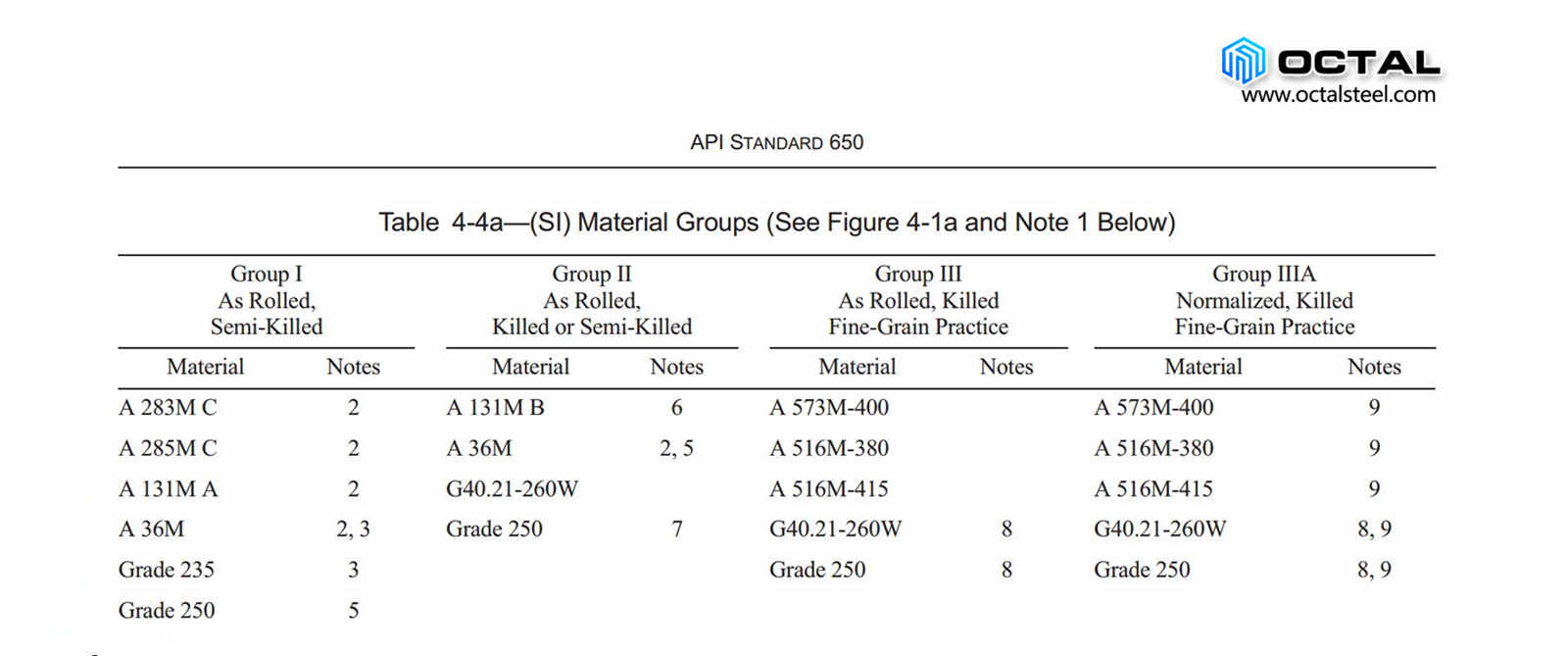
ASTM A650 tanks material group 5-8
FAQ
What steel plate is commonly used for API 650 tanks?
Common routes include ASTM A36, A283, A285, A516, A573, A633, A662, A737 and A841, subject to the applicable API 650 edition, grade, thickness and temperature limits.
Is ASTM A516 Grade 70 always better than A36?
No. A516 Grade 70 has a higher strength class and a pressure-vessel plate route, but A36 may remain suitable for roof plates, structural members or thinner shell locations. The choice depends on stress, thickness, temperature, toughness and welding requirements.
How is the API 650 material group selected?
The material group is determined from the plate specification, grade and delivery condition in API 650 Tables 4.4a or 4.4b. It is then used with governing thickness and design metal temperature to evaluate impact-test exemption.
Does API 650 allow stainless steel tanks?
Yes. Austenitic stainless steel tanks are addressed by Annex S, duplex stainless steel tanks by Annex X and mixed stainless/carbon steel construction by Annex SC.


Tags:API 650 TanksOil and Gas Tankssteel plateTanks Plate
Related Products
Related Resources




Recent News

Hot Topic

Octal is located in China recognized as a leading supplier, distributor, and manufacturer union in providing piping solutions for oil and gas company. Product ranges in Steel Pipe, Casing and Tubing, Steel Plate, Sucker Rod, Steel Pipe Fittings, Valves, and Equipment for pipelines.
Contact Info
Unit 2544, 25/F, Tower A, Wanda Plaza, Wenfeng District, Anyang, Henan, China & Building A, No.18 Dirun Road, Zhengdong New District, Zhengzhou, Henan, China
+86 372 2157660 / +86 186 3727 1277
[email protected]