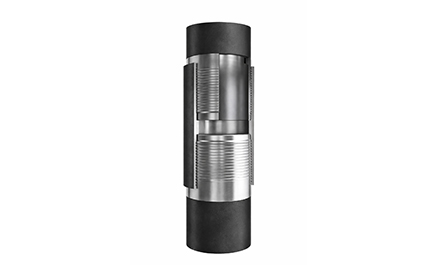
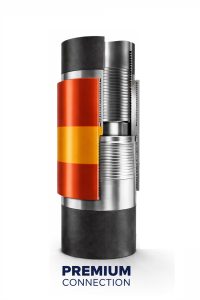
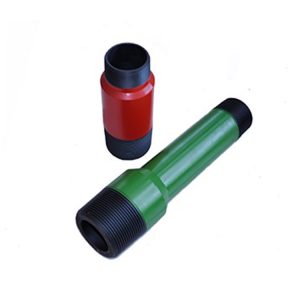
Product scope: OCTA-VT, OCTA-1T, OCTA-2T, OCTA-3T, OCTA-6/8, OCTA-BC
Connection type: premium connection / special thread for OCTG
Sealing system: gas-tight metal-to-metal seal with multi-seal design intent
Load capability: designed for pressure, bending, compression, and torque combined loads
Thread features: hook / buttress-type thread with controlled make-up behavior
Shoulder design: torque shoulder for torque stop and load transfer stability
Hydraulics: flush ID or streamlined bore options for clearance and flow performance
Applications: deep wells, ultra-deep wells, high-pressure gas wells, deviated/horizontal wells, workover operations
What Is a Premium Connection Special Thread and Why Use It?
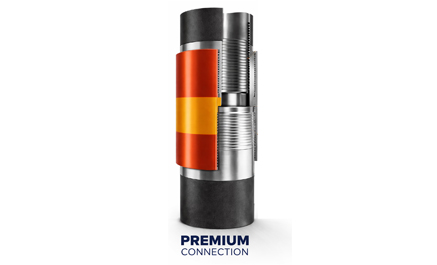
A premium connection (special thread) is an engineered OCTG connection designed to deliver gas-tight sealing and predictable make-up integrity under combined loads—internal pressure, temperature cycling, bending in deviated/horizontal wells, compression, and running torque. In practice, final series selection should be aligned to size/grade, service environment, sealing target, and operating profile, so the OCTA connection type fits the required load envelope and project acceptance criteria.
● Seal system: metal-to-metal sealing (often multi-seal) for gas-tight intent
● Torque shoulder: a controlled torque stop that stabilizes make-up and load transfer
● Thread form: hook/buttress variants engineered to distribute load and reduce galling sensitivity
● Hydraulics / drift: flush ID or stabilized ID features (lead-in chamfer, streamlined bore) to protect tool passage and flow stability
Projects typically specify premium connections when standard API threads become the risk point: gas wells requiring leak control, deep/ultra-deep wells with high combined loads, high-deviation/horizontal wells with bending, repeated make/break workover cycles, or operations requiring flush ID/large clearance for cementing and intervention tools. For global sourcing, the best practice is to lock the load envelope + sealing target + acceptance documents first, then match the connection family.
For these use cases, Octal Steel’s OCTA Premium Connection series provides a practical selection range—VT, 1T, 2T, 3T, 6/8, BC, etc.—to align sealing intent, torque-stop behavior, and drift/clearance requirements with your well conditions.Send your size/grade, service environment, and operating profile (pressure/temperature, deviation, and make/break cycles), and we will match the OCTA connection type and acceptance checkpoints before quotation.
Premium Connection Series
Reference note: “Equivalent connection” names below are provided for market familiarity only. Final selection should be confirmed by the required load envelope, sealing target, and project acceptance criteria.
NO.
Connection Type
Equivalent Connection
1
OCTA-1T
NEW VAM/WSP-3T
2
OCTA-2T
VAM TOP/WSP-5T
3
OCTA-3T
VAMFJL
4
OCTA6
HYDRIL PH6
5
OCTA8
HYDRIL CS
6
OCTACQ
TPCQ
7
OCTAG2
TPG2
8
OCTA-XC
BGXC/WSP-4T
9
OCTA-BC
An integral flush joint Interchangeable with BTC
10
OCTA-HC
High Torque Semi premium modified BTC
11
OCTA-511
Hydril Wedge 511
OCTA-VT
OCTA-VT is the entry-level selection concept within the OCTA Premium Connection series, used to match project requirements to the appropriate premium thread family. Rather than representing a single structural type, it serves as the starting point for evaluating sealing target, load envelope, and operational profile before moving into the detailed 1T, 2T, 3T, 6/8, or BC connection options.
In practical terms, OCTA-VT is used when the buyer is first defining whether the project needs a premium connection for gas-tight sealing, combined-load resistance, flush ID requirements, or higher running reliability than standard API threads can provide. Once these conditions are confirmed, the detailed OCTA connection family can be selected accordingly.
● Gas-tight intent via metal-to-metal sealing concept (seal verification defined in ITP)
● Make-up control method and expected make/break cycles
● Drift/clearance requirement for tools and cementing
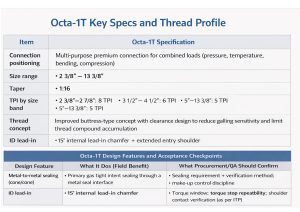
OCTA-1T
● Metal-to-metal sealing system
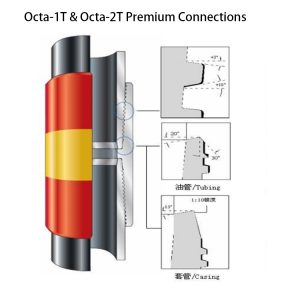
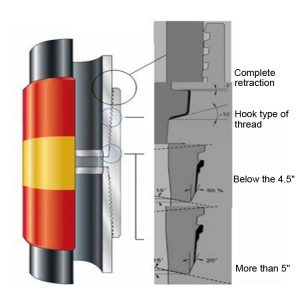
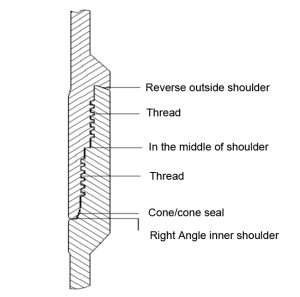
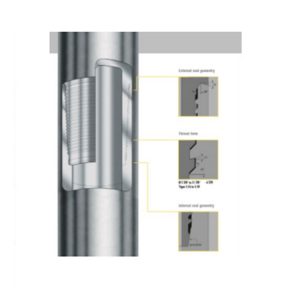
OCTA-1T uses a metal-to-metal seal stack with a cone/cone primary seal, reinforced by an additional sealing function at the reverse torque shoulder. This multi-seal intent improves sealing reliability and supports high internal-pressure service when make-up control and inspection are executed per procedure.
● Reverse torque shoulder and combined-load capability
The reverse torque shoulder provides a positive torque stop, improving make-up repeatability and reducing stress concentration at the connection. It strengthens resistance to compression, bending, and over-torque events, improving stability in deviated/horizontal running conditions.
● Hydraulics and lead-in protection
OCTA-1T includes a 15° internal lead-in chamfer and an extended entry shoulder to protect running tools and reduce entrance damage. A streamlined bore profile helps reduce turbulence and flow energy loss where hydraulics are sensitive.
OCTA-2T
OCTA-2T is an enhanced premium connection developed from the 1T concept for wells where pressure, temperature, bending, compression, and running torque create higher combined-load risk. It is typically specified for deep/ultra-deep wells and high-pressure gas wells, especially in high-deviation and long horizontal applications where connection stability under bending is a primary acceptance concern.
Key geometry and spec checkpoints (publishable parameters)
Thread form signal: hook-type concept with a negative load-flank angle (e.g., -3°) for load distribution and wear control under demanding running conditions Torque shoulder signal: negative-angle torque shoulder for accurate torque stop and improved combined-load transfer
Key advantages (what the design is intended to achieve)
1.Strong resistance to bending, compression, and torque, supporting a wider combined-load window.
2.Stable gas-tight performance under combined loads, including challenging deviated/horizontal profiles.
3.Integrity after repeated make/break, helping maintain sealing performance during workover operations.
4.Service-friendly handling and repairability for practical field use.
Design signals buyers should evaluate
1.Reinforced metal-to-metal sealing system designed to remain gas-tight under severe combined loads; sealing geometry is intended to reduce wear and protect seal integrity through repeated operations.
2.Improved hook/buttress-type thread concept with a -3° load-flank profile, aimed at increasing connection strength and compression resistance while reducing wear risk—even when thread compound is minimal.
3.Negative-angle torque shoulder providing a controlled torque stop to improve make-up accuracy, reduce circumferential stress at the connection, and improve performance under compression + external pressure and bending/torque combinations.
4.Streamlined bore / hydraulic-friendly internal profile, using lead-in and fit-up control to reduce turbulence and flow energy loss through the connection where hydraulics are sensitive.
OCTA-6 / OCTA-8
OCTA-6 and OCTA-8 are integral (coupling-less) premium connections developed for high-pressure gas wells and deep/ultra-deep applications where connection integrity and running efficiency are critical. The integral architecture keeps the internal diameter aligned with the pipe body, reducing restriction points and improving tool passage compared with coupling-based solutions.
Thread pitch options
● OCTA-6: 6 TPI
● OCTA-8: 8 TPI
In selection terms, the pitch choice is typically treated as a running-speed vs. load-transfer trade-off: fewer threads per inch reduce make-up turns, while higher pitch can support smoother running control under certain practices. Final selection should follow the project’s running procedure, torque control method, and expected make/break cycles.
Thread form and guiding faces
OCTA-6/8 use a two-step hook-type thread concept with defined faces to support stable stabbing and load transfer:
● Load flank: approximately 7.5° (primary load-bearing face)
● Guidance flank: approximately 20° (guiding/stabbing face)
This profile is intended to improve running behavior and reduce the likelihood of sticking/galling when make-up is controlled by procedure.
Shoulder stack and sealing system
The connection uses a multi-shoulder structure to control torque stop and combined-load behavior, typically including:
● Right-angle inner shoulder (internal support and alignment)
For sealing, OCTA-6/8 apply a metal-to-metal cone/cone seal as the primary sealing interface, supported by shoulder-assisted sealing behavior to maintain gas-tight intent under combined loads.
1. Where OCTA-6/8 fits best
2. High-pressure / ultra-high-pressure gas wells
3. Deep and ultra-deep wells
4. Operations requiring fast running with stable make-up control and reduced sticking sensitivity
5. Projects that benefit from integral ID continuity and coupling-less handling
OCTA-3T
OCTA-3T is selected when flush ID and maximum clearance are required—cementing, intervention tools, and tight-clearance operations—while maintaining premium sealing intent.
Section
Key Points (OCTA-3T)
What It Means for Selection / Acceptance
Integral flush design
Threads are machined directly on the plain-end pipe; the connection is fully flush with the pipe body (no ID restriction).
Best when flush ID/clearance is an acceptance requirement for cementing and intervention tools.
External torque shoulder step
Negative-angle torque shoulder provides torque stop and reinforces the external sealing surface; the shoulder also defines the make-up position.
Improves make-up repeatability and stability under combined loads (bending/compression/torque).
Multi-seal system
Internal and external seals are relatively independent, providing sealing for both internal and external sides; seal design intent remains consistent with pipe-body service performance.
Supports gas-tight intent with redundancy; define the sealing verification method in the ITP.
Hook-type thread
Tensile load capability designed to reach ≥60% of pipe body (as stated)
45° guiding face supports stabbing/make-up and reduces cross-threading
Suitable for workover / repeated make-break where running behavior matters; confirm load envelope and running procedure.
Flow-optimized design
Flush OD/ID (no thickening)
Smooth internal profile
Tighter internal diameter tolerance control
Reduces turbulence and pressure loss; helps keep hydraulics stable across the connection.
Main applications
Deep & ultra-deep wells; tight-clearance cementing; workover operations.
Use when you need flush ID + strong operational robustness under combined loads.
OCTA-BC
OCTA-BC is positioned as a semi-premium / BTC-upgrade direction for projects that need improved sealing behavior and running reliability while keeping procurement and field handling familiar.
Engineering signals and acceptance checkpoints
● Upgrade focus: torque control + sealing behavior tighter than standard API expectations
● Best used when the project is cost-sensitive but cannot accept standard-thread leakage/downtime risk
● Procurement should lock make-up discipline and inspection scope to avoid performance variance
RFQ inputs to lock
● Load envelope and sealing expectation
● Make-up torque limit and running procedure
● Inspection scope and documentation package
OCTA Premium Connection Series Coverage
OCTA Model
Reference Connection Family
Typical Positioning (for RFQ familiarity)
Selection Triggers (what buyers usually care about)
OCTACQ
TPCQ / TP-CQ
Gas-tight premium connection for casing/tubing with combined-load sealing focus.
Premium connection commonly positioned for strong bending/compression/torque resistance with reliable gas-tight sealing.
Deviated / horizontal profiles; higher bending/compression/torque envelope; preference for anti-galling and stable make-up under field variability.
OCTA-XC
BGXC / WSP-4T (reference families)
Premium connection family reference used for RFQ familiarity; final configuration depends on required load envelope and acceptance method.
When RFQ is written around a known reference family name; confirm sealing target, torque stop behavior, drift requirement, and inspection package.
OCTA6
TenarisHydril PH6 (reference)
Integral upset premium family reference typically used for heavy-wall/high-pressure tubing service.
High-pressure tubing; strict running guidelines; focus on make-up control, stabbing aids, and inspection discipline.
OCTA8
TenarisHydril CS (reference)
Integral upset premium family reference used where strong sealing and controlled make-up are required.
Projects specifying integral-upset reference families; confirm service window, make-up procedure, and compatibility constraints.
OCTA-HC
High-torque semi-premium (modified BTC family)
Semi-premium option typically selected when operating torque approaches/exceeds the comfort zone of API BTC-compatible running practice.
High operating torque; drilling applications needing improved torque capacity while maintaining familiar handling; confirm torque limits and acceptance method.
OCTA-511
TenarisHydril Wedge 511 (reference)
True flush integral connection widely used for large-diameter, high-clearance casing/liners with high torque and compression strength focus.
Need flush OD/ID and high clearance; surface casing, liners, horizontal/repair applications; confirm running guidelines, stabbing aids, and safety clamp practice.
Note: Reference connection families are shown for RFQ familiarity only. Final selection should be confirmed by required load envelope, sealing target, and project acceptance criteria.
Premium Connection Running and Make-Up Acceptance
Premium connections are “special” because gas-tight intent depends on a controlled seal system + torque shoulder + thread form, not just the thread name. In practice, failures come more from running discipline than design—over/under make-up, cross-threading, wrong compound practice, or seal-area damage. That’s why Octal Steel treats make-up control as an acceptance item: define the make-up method (manual vs computerized), the torque window/turn signature (if applicable), and the on-site checkpoints before PO.
For acceptance, keep it simple and auditable: pre-run thread/seal-area inspection, controlled stabbing, make-up verification within the approved window, and post make-up checks for torque stop position and damage. If repeated make/break is expected (workover), define the cycle expectation and inspection interval up front—this is what keeps premium performance consistent across different rigs and crews.
How OCTA Premium Threads Are Machined and Verified?
For OCTG connections with premium thread (special thread) designs, the real differentiator is dimensional discipline: lead, taper, pitch diameter, ovality, thread height, and seal-area geometry must stay within controlled limits so the metal-to-metal seal and torque stop behave consistently in the field. In production, this is managed through calibrated gauges and measurement systems capable of micron-level / sub-micron measurement resolution, covering all major thread callouts such as lead, taper, ovality, thread height, pitch diameter, and chamfer angle.
For Octal Steel’s OCTA Premium Connection, precision is controlled through a closed manufacturing-and-inspection loop: CNC threading with stable tooling control, calibrated gauges for key thread and seal features, and documented release via thread inspection and a gage report. This keeps premium thread acceptance anchored to measured geometry, not subjective feel.
FAQ
Q1: What is a premium connection (special thread) and when do you really need it? A1: A premium connection is an OCTG thread built for gas-tight sealing and stable make-up under combined loads (pressure, bending, compression, torque). You typically need it for gas wells, deep/ultra-deep wells, high-deviation/horizontal runs, or frequent workover make/break where standard API threads become the risk point.
Q2: What actually makes a premium thread “gas-tight”? A2: Gas-tight performance comes from a controlled seal system—often a metal-to-metal seal supported by a torque shoulder that creates repeatable contact stress. It’s not just the thread shape or compound; it’s the seal contact condition achieved at the correct make-up.
Q3: Why can a premium connection leak even if the design is correct? A3: Most field leaks come from running variables: wrong make-up torque/turn behavior, damaged seal areas, cross-threading, inconsistent compound practice, or poor handling/protectors. Premium threads are precise—so the running procedure and inspection discipline are part of the product.