Your Responsible Supplier Partner for Oil and Gas Products.

Steel Pipe Third Party Inspection
Steel Pipe Third Party Inspection
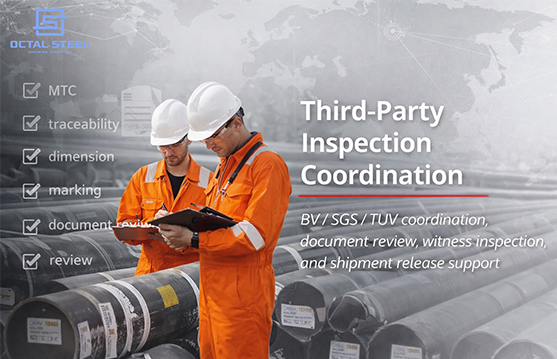
Third Party Inspection Service for Steel Products
Third party inspection (TPI) is an independent verification process used to confirm that steel products, dimensions, materials, markings, testing, and documents comply with the purchase order, project specification, and applicable standards before shipment. In export steel supply, TPI is not just an extra step in the workflow. It is a practical control point that helps buyers reduce mismatch risk between quotation, production, inspection, shipping documents, and final site acceptance.
At Octal Steel, third party inspection support is part of how we execute export steel orders. For many buyers, especially in pipeline, oil and gas, EPC, pressure equipment, and infrastructure projects, the concern is not only whether the goods are produced, but whether they are inspection-ready, document-ready, and shipment-ready. This is where our TPI coordination support becomes important.
How Octal Steel Supports Third Party Inspection
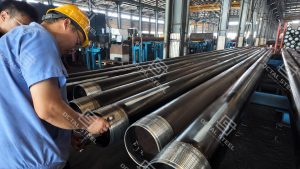
Octal Steel provides third party inspection support for steel products based on client-appointed inspection requirements. Our role is not limited to manufacturing or supply only. We also support the order at the inspection stage by coordinating inspection timing, preparing the required documents, checking product identification and traceability, and making sure the goods are ready for review before shipment.
In practical terms, this means helping align the production status, inspection scope, and shipment schedule. Many inspection delays do not come from the product itself. They come from missing records, incomplete marking, packing not ready for review, or poor coordination between the supplier, inspector, and buyer. Our job is to reduce these gaps so the order can move from “produced” to “approved for shipment” more smoothly.
| Inspection Agency / Type | Typical Role in Steel Orders | What Octal Steel Can Support |
|---|---|---|
| BV (Bureau Veritas) | Third-party inspection for material verification, dimensional checks, marking review, packing verification, and document review before shipment. | Inspection coordination, product readiness, document preparation, traceability check, packing and marking support. |
| SGS | Independent inspection for export steel products, including visual inspection, dimensional verification, document review, and shipment release support. | Scheduling support, inspection preparation, identification and marking check, packing review, and document alignment. |
| TÜV / Other Client-Appointed Agencies | Project-based third-party inspection according to buyer, EPC, or owner requirements. | Coordination based on nominated inspection scope, witness support, document handover, and shipment readiness. |
| Witness Inspection for Testing | Inspection agency may witness hydrotest, PMI, NDT, coating checks, or other specified tests depending on order requirements. | Arrange witness points, prepare test records, and support inspection during agreed production or pre-shipment stages. |
| Document Review / Release | Review of MTC, dimensional records, traceability, marking list, packing list, and other project-required inspection documents. | Prepare document package, align product-to-document traceability, and support release before shipment. |

Inspection Items Octal Steel Can Support
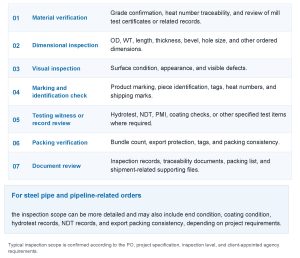
The inspection scope depends on the product type and project requirement, but in steel supply the mostcommon inspection items are clear. Octal Steel can support third-party inspection for the following areas:
Third Party Inspection for Steel Pipe and Pipeline Projects
For pipeline and line-pipe-related projects, third party inspection usually carries more weight because acceptance is not based on one item alone. The buyer may review the pipe body, pipe ends, welding status where applicable, coating or surface condition, traceability, and test records as part of one release process. In these projects, TPI helps ensure that the supplied materials are not only manufactured to the order, but also documented and prepared in a way that matches project approval procedures.
This is why pipe and pipeline inspection services are a meaningful part of Octal Steel’s support scope. Pipeline buyers are often managing multiple interfaces at the same time: specification review, testing, logistics, document release, and site schedule. A missing marking record or an incomplete packing check can delay the same project as much as a dimensional issue. Good TPI support is about controlling the whole acceptance chain, not just one inspection point.
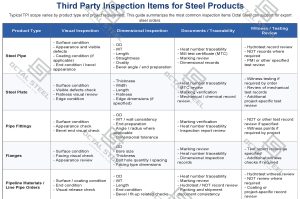
Agencies and Inspection Coordination
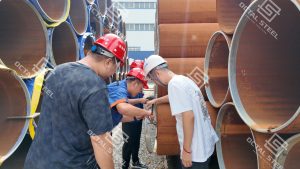
In export steel orders, the inspection body is usually nominated by the client, project owner, EPC contractor, or buyer. Octal Steel works with client-appointed third-party agencies such as BV, SGS, TUV, and other nominated inspectors. Our role is to help the buyer keep the inspection process visible, organized, and ready before the inspector arrives on site.
How Octal Steel Supports the Inspection Process
1. Align inspection scope in advance
We confirm the applicable standard, product specification, inspection points, and document requirements with the client before inspection. This helps reduce delays caused by unclear checkpoints, missing reports, or mismatch between the order and the inspection plan.
2. Share progress updates during production
We can keep the buyer informed with production status, workshop photos, finished product photos, marking details, and packing progress. This gives the client better visibility before the formal inspection date.
3. Prepare documents before the inspector arrives
Relevant records can be organized in advance according to the order requirement, such as MTC, dimension reports, NDT reports, hydrotest records where applicable, coating records, packing lists, and other release documents. Draft copies can also be shared with the client for early review.
4. Support smoother inspection and shipment release
By connecting the inspected goods with marking, lot traceability, and final documentation, we help make site inspection, document approval, and shipment release more efficient, especially for export orders with client-appointed inspection agencies.
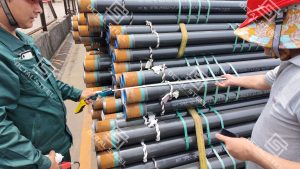
Documents and Inspection Records
In steel TPI, documents matter as much as the physical goods. The inspector may review certificates, dimensional records, marking lists, packing lists, and testing records together, because acceptance depends on consistency across these documents. A product can be dimensionally correct and still fail release if the traceability or document mapping is incomplete.
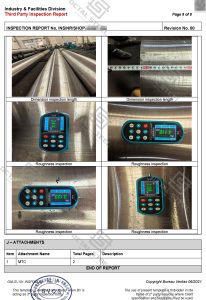
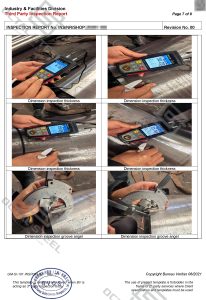
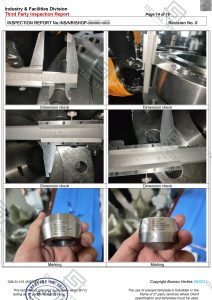
That is why Octal Steel pays attention to the documentation side of inspection support. Depending on the order, the release package may include mill certificates, dimensional inspection records, traceability information, packing details, and related supporting documents. When needed, sample report pages can also be prepared for reference, with sensitive information masked, to show customers the typical structure of inspection records used in export projects.
Why Buyers Use Octal Steel for TPI Support
For many buyers, the value of third party inspection is not just “someone checks the goods.” The real value is that the order moves forward with fewer surprises. In practice, buyers use Octal Steel for TPI support because we understand that inspection is connected to production, packing, documents, and release. If one part is not aligned, the whole shipment can slow down.
This is especially important when the order is time-sensitive, technically controlled, or linked to project approval. By supporting the inspection process as part of the supply workflow, we help buyers reduce mismatch risk and improve confidence before shipment. That is also why many customers see TPI support not as an extra service, but as part of a reliable export steel supply process.
Sample Inspection Files and Previous Support Experience
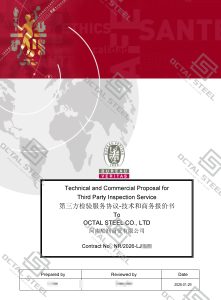
When appropriate, sample inspection pages or report formats can be shared for reference. In these cases, customer names, project numbers, pricing, and other sensitive details should be masked or watermarked. This helps show the structure of the inspection records without exposing confidential commercial information.
For customer follow-up, this kind of reference material is often useful. It allows the buyer to quickly understand what a steel third party inspection file may include and how the inspection process is typically documented. For Octal Steel, this also supports a clearer discussion with customers who are still deciding whether TPI is needed for their order.
What Third Party Inspection Means in Steel Supply
In steel export projects, third party inspection is commonly used to verify that the supplied goods match the agreed technical and commercial requirements before release. The inspection scope may cover material grade, heat number traceability, dimensional checks, marking, testing records, packing, and related documents. For project buyers, this process provides an independent checkpoint before shipment. For suppliers, it creates a clear release path that links production status with inspection evidence and document closure.
This is particularly important in orders involving steel pipe, plate, fittings, flanges, structural materials, and pipeline-related products. If the products are intended for pressure service, line pipe systems, EPC packages, or export projects with strict approval procedures, buyers often need more than a mill certificate alone. They need confirmation that the goods presented for shipment are the same goods supported by the inspection and document package.
for review, or poor coordination between the supplier, inspector, and buyer. Our job is to reduce these gaps so the order can move from “produced” to “approved for shipment” more smoothly.
Third Party Inspection as Part of Reliable Steel Delivery
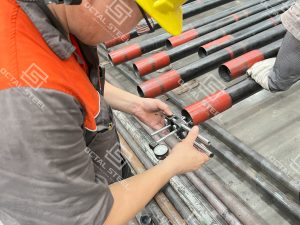
A good third party inspection process is not only about passing inspection. It is about aligning the products, records, and shipment release conditions before the goods leave the factory. For export steel projects, that alignment matters. It protects the buyer, supports the supplier, and reduces avoidable problems after shipment.
Octal Steel provides third party inspection service support for steel products as part of this delivery logic. Whether the order involves steel pipe, plate, fittings, flanges, or pipeline materials, the objective is the same: make sure the goods are ready for inspection, ready for documentation review, and ready for shipment with fewer approval risks.
FAQ
Q1. What does third-party inspection cover for steel products?
A1. It usually covers material verification, dimensions, visual condition, marking, selected test records, and document review before shipment release.
Q2. When should third-party inspection be arranged for a steel order?
A2. It is best arranged before shipment, when the goods are ready for inspection and the key records can be checked against the order requirements.
Q3. Can MTC and heat number traceability be checked before shipment?
A3. Yes. The buyer can review MTCs, heat numbers, marking, and related records to confirm the goods remain traceable to the ordered material.
Q4. Can BV, SGS, or other nominated inspectors witness the inspection process?
A4. Yes. Client-appointed inspectors can be coordinated for witness points, record review, and release checks when required by the project or order procedure.


Tags:API 5CT Casing and TubingSteel pipesteel plate manufacturer
Related Resources
Recent Faqs
Rencent Articles
Hot Topic

Custom Posts

Octal is located in China recognized as a leading supplier, distributor, and manufacturer union in providing piping solutions for oil and gas company. Product ranges in Steel Pipe, Casing and Tubing, Steel Plate, Sucker Rod, Steel Pipe Fittings, Valves, and Equipment for pipelines.
Contact Info
Unit 2544, 25/F, Tower A, Wanda Plaza, Wenfeng District, Anyang, Henan, China & Building A, No.18 Dirun Road, Zhengdong New District, Zhengzhou, Henan, China
+86 372 2157660 / +86 186 3727 1277
[email protected]